
 Reviewed by
Most WooCommerce store owners know AI is supposed to help them sell more. But when you look at the actual tools available, it’s hard to know where to start or whether the results justify the setup time. The hype makes it worse. Every plugin page promises to “transform your store,” but few explain what that actually looks like in practice.
The stores getting the most value from WooCommerce AI in 2026 aren’t using it for everything. They’re using it for specific, high-impact tasks where AI delivers measurable results. According to EComposer, 77% of ecommerce professionals now use AI daily, up from 69% in 2024. The adoption is happening because the ROI is real, not because the technology is trendy.
Here are five use cases where WooCommerce stores are seeing the biggest returns from AI.
1. AI Chatbot Handling 70% Of Customer Support
A well-configured AI chatbot connected to your WooCommerce product catalog and order system can handle the majority of incoming support queries without human intervention. Order tracking, return policy questions, product availability, shipping estimates, and basic troubleshooting all fall within what today’s chatbots resolve on their own.
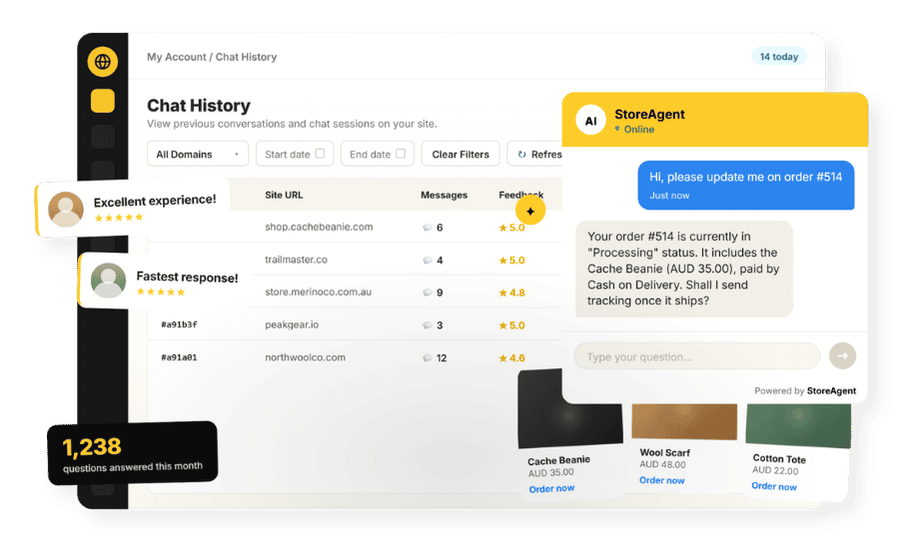
The 70% figure comes from a consistent pattern we’ve observed: stores that connect their chatbot to their full product data (not just a FAQ page) see deflection rates between 60-70%. The difference between a 30% deflection rate and a 70% one almost always comes down to data integration. A chatbot that knows your products gives specific, helpful answers. One that doesn’t frustrates customers with generic responses.
Here’s what a typical interaction looks like on a WooCommerce store with a connected WooCommerce AI chatbot:
- Customer: “Does the wool blend cardigan come in size XL?”
- AI: “Yes, the Merino Wool Blend Cardigan is available in XL in three colors: Charcoal, Navy, and Oatmeal. The XL fits chest sizes 44-46 inches. Would you like me to add one to your cart?”
That answer pulled from real product data: attributes, size charts, and current inventory. No script, no human agent needed.
According to Klarna’s press release, their AI assistant handled 2.3 million conversations in its first month, covering two-thirds of all customer service chats and cutting average resolution time from 11 minutes to under 2 minutes.
What We’ve Seen: WooCommerce stores that connect their AI chatbot to their full product catalog, including attributes, categories, and stock status, consistently hit 60-70% support deflection rates. Stores that use a generic, unconnected chatbot rarely exceed 30%.
Want to see how an AI chatbot handles your product questions? Try StoreAgent Chat on your store, free plan available.
2. Bulk Product Descriptions Saving 40+ Hours
Stores with large catalogs (100+ products) face a painful math problem when it comes to product descriptions. Writing 500 descriptions manually at 15 minutes each equals 125 hours of work. That’s more than three weeks of full-time writing for one person.
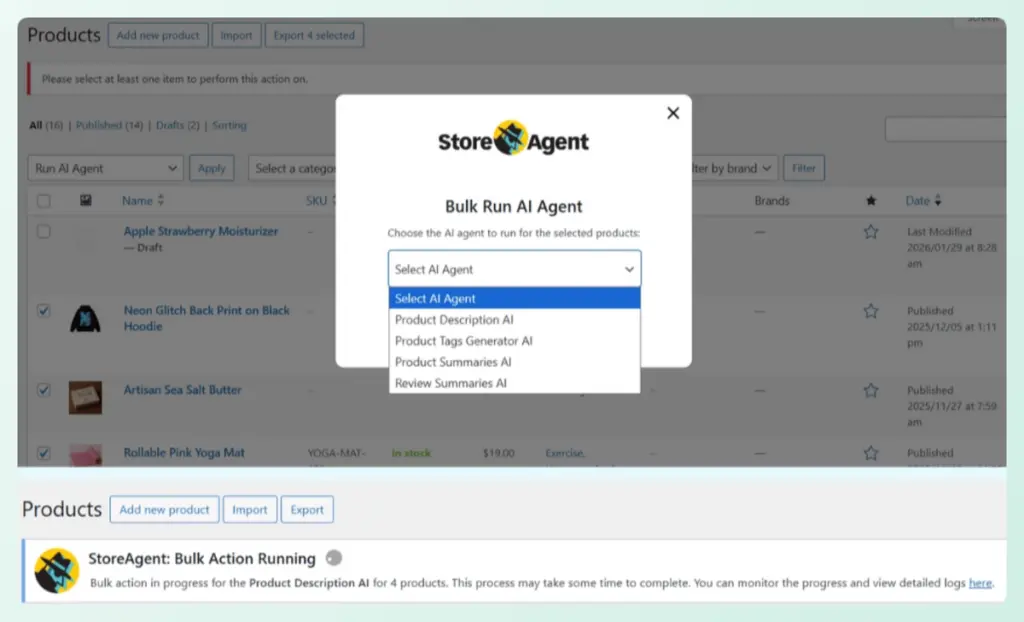
AI changes this equation dramatically. AI content generation for WooCommerce pulls from your existing product data (title, attributes, categories, tags) to generate unique, benefit-focused descriptions. The AI does the heavy lifting; you review and polish.
Here’s the revised math:
- Manual: 500 descriptions x 15 minutes = 125 hours
- AI-assisted: 500 AI-generated drafts + review at 3 minutes each = roughly 25 hours
- Time saved: 100+ hours
The quality question is fair. From our testing, AI-generated descriptions that pull from rich product data (attributes, categories, use cases) produce drafts that need light editing, not rewrites. Descriptions for products with sparse data (just a title and price) need more work. The takeaway is that the better your product data, the better the AI output.
According to Precedence Research, the global AI in ecommerce market is valued at $9.01 billion in 2025, projected to reach $74.93 billion by 2035. Content generation is one of the most practical applications driving that growth.
Need to write descriptions for hundreds of products? StoreAgent generates them from your existing product data.
3. AI Alt Text Improving Image Search Visibility
Most WooCommerce stores have hundreds of product images with missing or generic alt text. File names like “IMG_4523.jpg” or “product-image-1.jpg” tell Google nothing about the image content. That’s missed organic traffic from Google Image search, which drives a meaningful percentage of ecommerce visits.
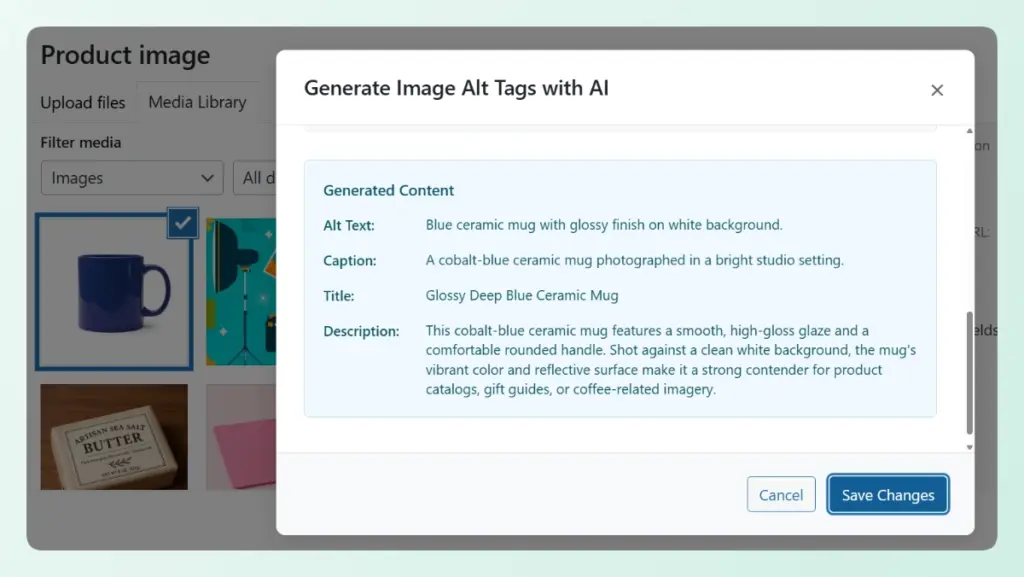
AI generates descriptive, keyword-rich alt text by analyzing the product data and image context. Instead of manually writing alt text for every image (which almost nobody does), AI handles the entire catalog in minutes.
Here’s a before-and-after example:
- Before:
alt="product-image-front" - After:
alt="Merino wool blend cardigan in charcoal gray, button front closure, relaxed fit"
The SEO impact compounds over time. Each properly described image becomes an entry point through Google Image search. For stores with 500+ product images, the cumulative traffic gain from proper alt text is significant.
From our hands-on testing, AI alt text generation works best when the product already has good titles and attributes in WooCommerce. The AI uses that data to describe the image accurately. Products with minimal data get generic alt text, so investing in your product catalog pays dividends across multiple AI features.
Explore how StoreAgent’s features handle alt text generation alongside content and chat.
4. Review Summaries Boosting Conversion Rates
Shoppers scan reviews for key themes: quality, sizing accuracy, shipping speed, durability. When a product has dozens or hundreds of reviews, that scanning takes effort. AI review summaries distill all reviews into digestible highlights that surface the information shoppers care about most.
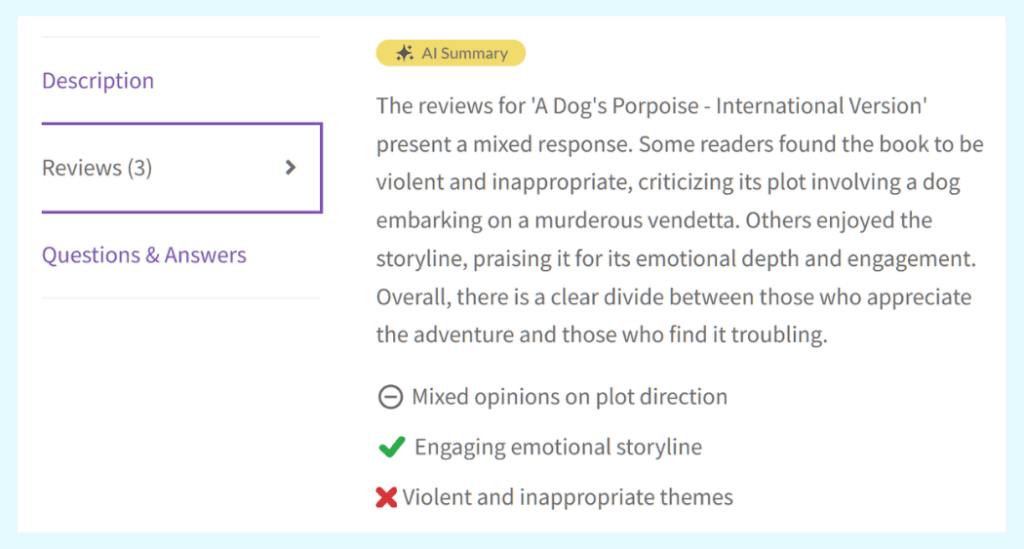
The psychology is straightforward. Shoppers don’t read every review. They look for patterns. “Is this jacket warm enough?” “Does this tool actually last?” AI pulls those patterns out and presents them clearly, so customers get to confidence faster.
According to Envive, products with 11-30 reviews convert approximately 68% higher than those with zero reviews. Review summaries make that social proof even more accessible by highlighting the themes that matter to buyers.
Here’s what an AI review summary might look like for a WooCommerce product:
- Quality: 92% positive. Customers frequently mention durable construction and premium feel.
- Sizing: Runs slightly small. Multiple reviewers recommend ordering one size up.
- Shipping: Consistently arrives within the estimated delivery window.
That summary saves the shopper five minutes of scrolling and addresses their top concerns in seconds. The faster a customer reaches confidence, the more likely they are to add to cart.
Learn more about how review optimization can increase your ecommerce conversion rate.
5. AI Insights Identifying Underperforming Products
AI analytics tools analyze your WooCommerce store data to flag products that should be selling better. High traffic but low conversion, high return rates, poor or missing descriptions, thin image galleries, and pricing anomalies all surface automatically.
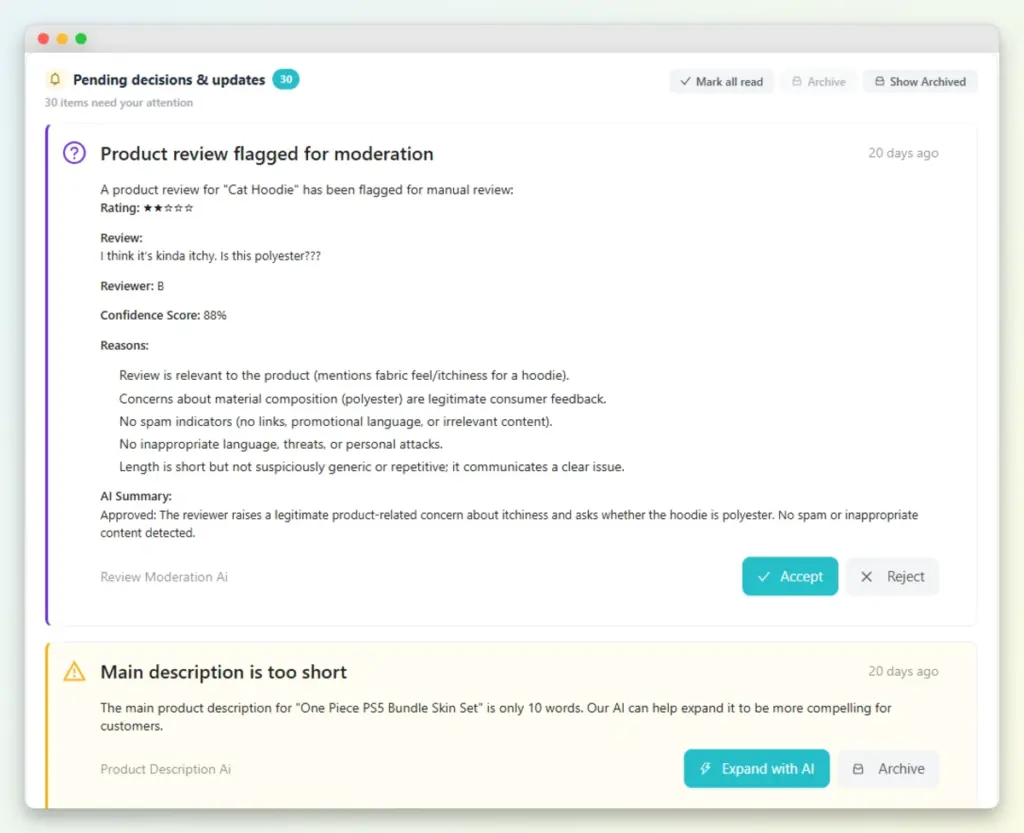
This turns passive data into action. Instead of reviewing spreadsheets and trying to spot patterns across hundreds of products, AI tells you which products need attention and why. The actionable specificity is what makes this valuable.
For example, AI insights might flag:
- Product A: 800 monthly page views, 0.5% conversion rate. Likely cause: product description is 12 words long with no benefits or use cases.
- Product B: 15% return rate (store average is 6%). Likely cause: customers consistently mention sizing confusion in reviews.
- Product C: Similar products in the same category sell at 3x the rate. Likely cause: main product image is low quality compared to competitors.
Each flag comes with enough context to take immediate action. Fix the description, add a sizing guide, reshoot the product photo. The AI does the detective work; you make the decisions.
Explore how StoreAgent’s features surface these insights from your WooCommerce data.
Getting Started: One Plugin Vs. Five
You could install five separate tools for these five use cases: a chatbot plugin, a content generation tool, an image SEO plugin, a review management tool, and an analytics dashboard. That means five subscriptions, five learning curves, five potential conflicts, and five separate data silos.
Consolidation only pays off when the integration underneath it is deep enough to matter. Judging woocommerce AI features on how directly they read live product and order data is what separates a tool that answers a specific customer question from one that returns a polite guess.
The alternative is a single plugin that covers chatbot, content generation, and store insights in one package. StoreAgent is the only WooCommerce plugin that combines all three, giving you a shared data layer where your chatbot, content tools, and analytics all draw from the same product catalog.
The practical advantages of consolidation:
- Shared context: Your chatbot knows the same product data as your content generator
- Single subscription: One cost to track, one plugin to update, one support team to contact
- No API key: StoreAgent handles all AI infrastructure, so you never need to create an OpenAI account or manage token costs
- Free tier available: Start with 25 content generations per month and basic chatbot functionality
Check out the best AI plugins for WordPress for a broader look at the landscape, or explore free AI tools to see what’s available at no cost.
Get chatbot, content generation, and insights in one WooCommerce plugin. Start free with StoreAgent, no API key needed.
FAQ
Do I need technical skills to use AI on my WooCommerce store?
No. Modern AI plugins for WooCommerce install like any other WordPress plugin. Tools like StoreAgent work out of the box without API keys or coding. You activate the plugin, and it connects to your product catalog automatically.
How much does AI for WooCommerce cost?
Costs range from free to $50-250/month depending on the tool and your store size. StoreAgent offers a free tier with 25 content generations per month and basic chatbot functionality. Most stores see positive ROI within the first month from support time savings alone.
Will AI-generated product descriptions hurt my SEO?
Not if they’re unique, relevant, and product-specific. Google evaluates content quality regardless of how it was created. The risk comes from using the same generic template across all products, which is the same risk with manual writing.
Can AI chatbots handle WooCommerce order-specific questions?
Yes, when the chatbot integrates with WooCommerce’s order system. StoreAgent Chat can pull real-time order status, shipping tracking, and return eligibility for specific orders, not just generic FAQ answers.
How long does it take to see results from AI tools on WooCommerce?
Support chatbots show immediate impact (same-day reduction in support tickets). Content generation ROI depends on volume: stores generating 100+ descriptions see time savings within the first week. SEO improvements from better alt text and descriptions typically take 4-8 weeks to show in search rankings.