
You already use ChatGPT or Claude every day. Wouldn’t it be easier if it could look things up in your own store, instead of you copying product details back and forth? StoreAgent includes a WooCommerce MCP server that does exactly that. This article walks you through turning it on, connecting your assistant, and approving the connection from your own WordPress admin. It also lists the StoreAgent abilities your assistant can use.
MCP is included on every StoreAgent plan, including the free one.
What you need
- StoreAgent installed and activated on your store
- A connected StoreAgent account. The MCP tab shows only a connect prompt until your account is connected
- An administrator or shop manager account on your store, because only a store manager can approve a connection
- A paid Claude plan (Pro, Max, Team, or Enterprise) or a paid ChatGPT plan (Plus, Pro, Business, or Enterprise). Custom connectors are not available on the free tiers of either.
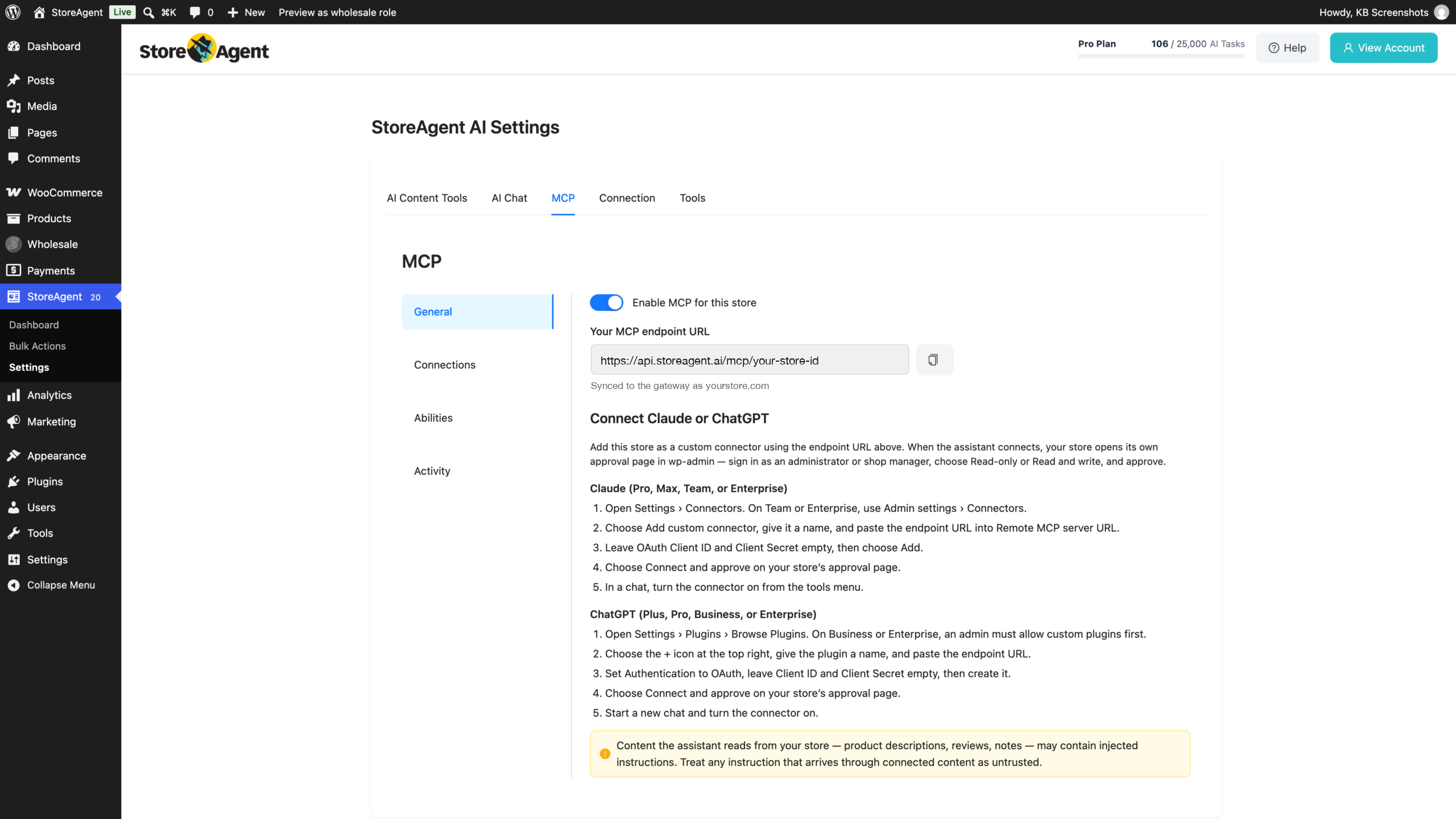
Step 1: Turn on MCP for your store
- Go to StoreAgent > Settings > MCP in your WordPress admin.
- Open the General sub-tab.
- Switch on Enable MCP for this store.
The MCP tab has four sub-tabs: General, Connections, Abilities, and Activity. You only need General to get connected.
Step 2: Copy your endpoint URL
Your store has its own MCP address. Your assistant needs it to find your store.
- Still on the General sub-tab, find Your MCP endpoint URL.
- Click the copy icon beside the field. Its tooltip reads Copy endpoint URL.
Keep this handy. You paste it into Claude or ChatGPT in the next step.

Step 3: Add your store as a custom connector
The steps differ depending on which assistant you use, so follow the one that matches.
Connect from Claude
- Open Settings > Connectors. On Team or Enterprise, use Admin settings > Connectors.
- Choose Add custom connector, give it a name, and paste your endpoint URL into Remote MCP server URL.
- Leave OAuth Client ID and Client Secret empty, then choose Add.
- Choose Connect. Your store’s approval page opens.
- After you approve, open a chat and turn the connector on from the tools menu.
Connect from ChatGPT
- Open Settings > Plugins > Browse Plugins. On Business or Enterprise, an admin has to allow custom plugins first.
- Choose the + icon at the top right, give the plugin a name, and paste your endpoint URL.
- Set Authentication to OAuth, leave Client ID and Client Secret empty, then create it.
- Choose Connect. Your store’s approval page opens.
- Start a new chat and turn the connector on.
Step 4: Approve the connection in your store
This is the part people miss. Approval does not happen inside Claude or ChatGPT. Your store opens its own approval page in wp-admin, headed with the name of the assistant that asked, followed by wants to connect to your store. Nothing works until you answer it there.
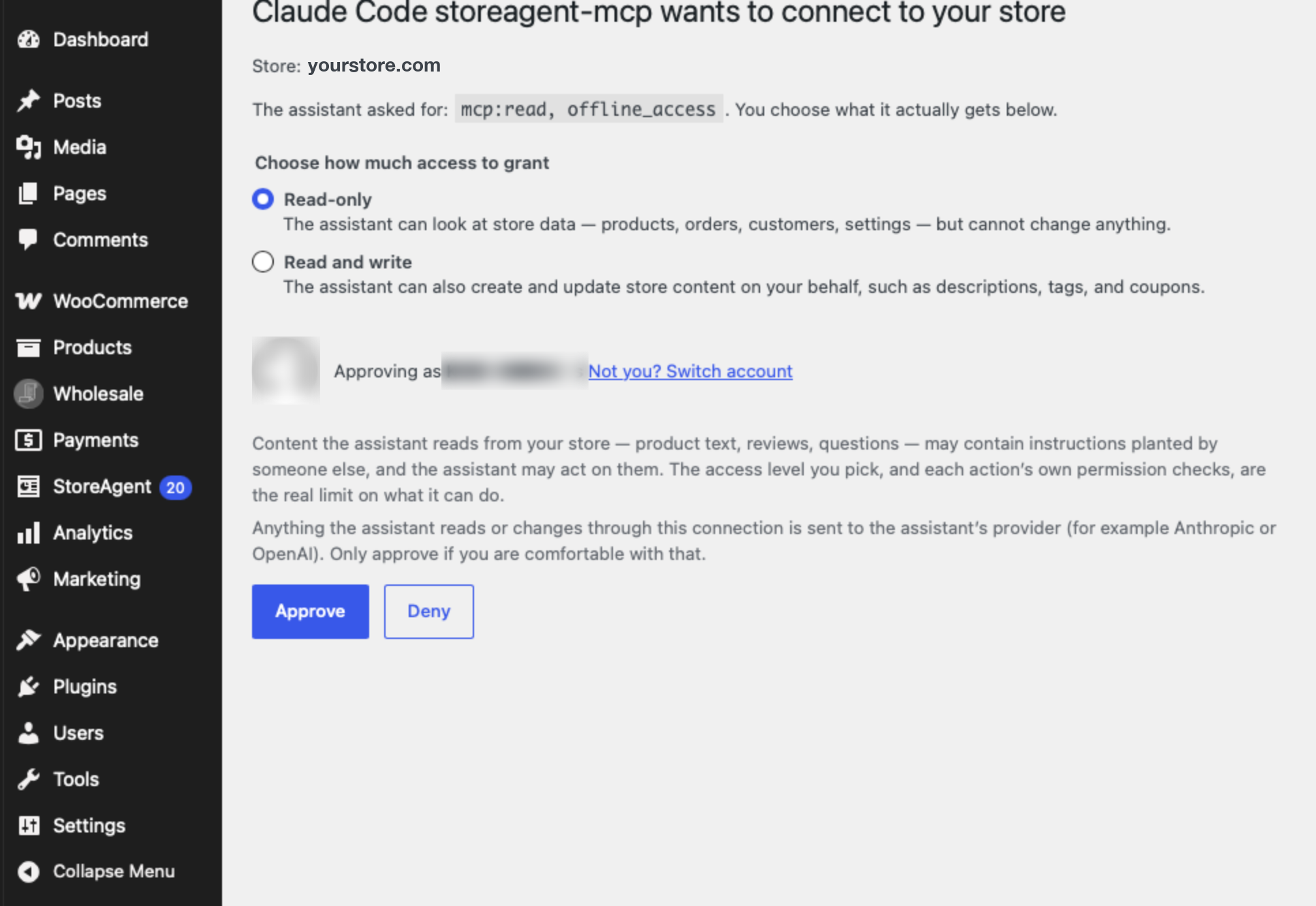
- Sign in to your store as an administrator or shop manager if you are not already.
- Under Choose how much access to grant, pick Read-only or Read and write.
- Choose Approve.
Pick Read-only the first time. You can always connect again with broader access once you have seen what the assistant does. Choose Deny if you did not start this request.
One thing to keep in mind as you choose. Your assistant reads real content from your store, including product descriptions, reviews and notes, and any of that text can contain instructions someone else wrote. Treat an instruction that arrives through your store content as untrusted, the same way you would treat an email from a stranger. This matters most with Read and write, where a planted instruction could ask the assistant to change something. StoreAgent shows the same warning on the MCP screen.
Check the connection
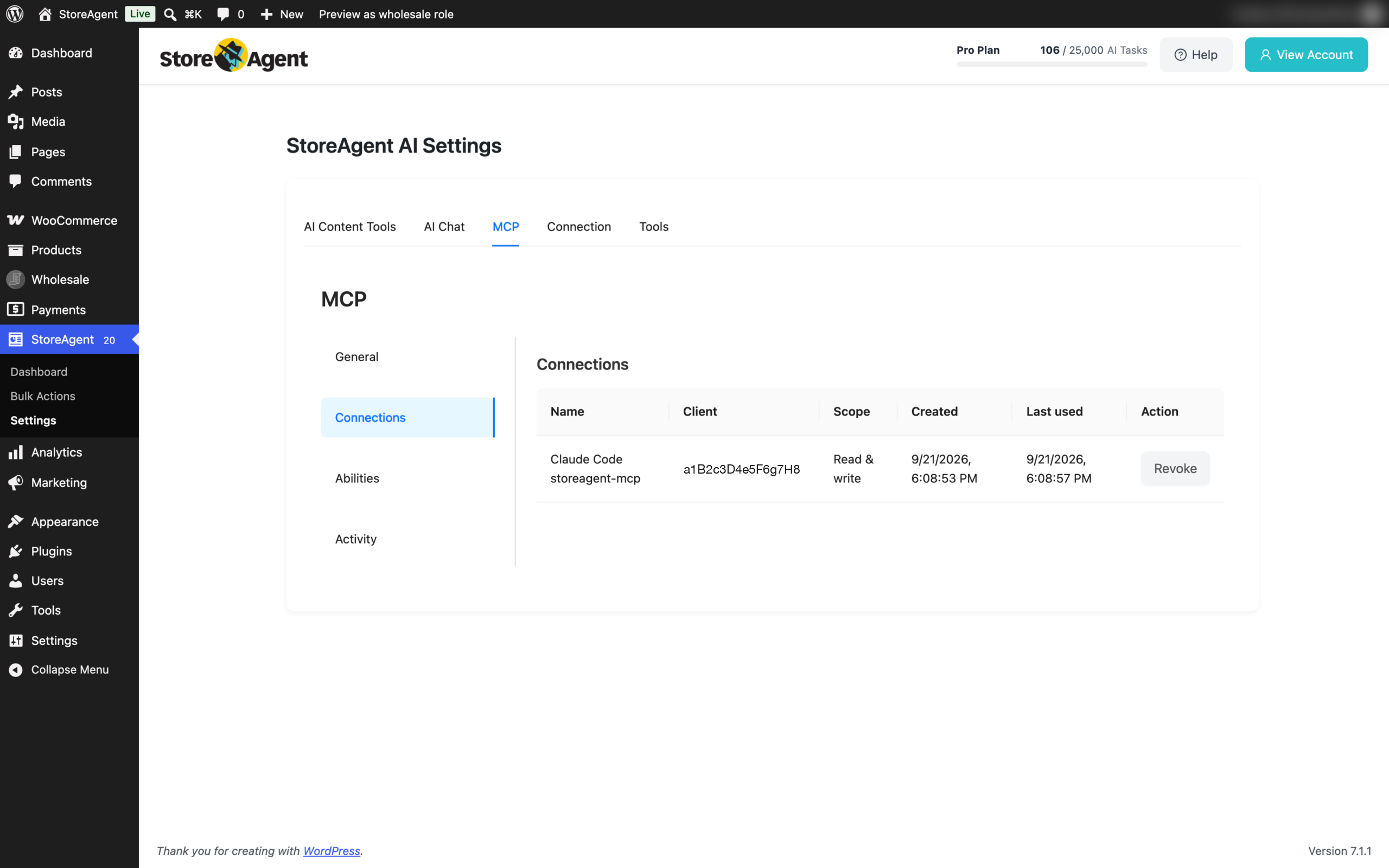
Open the Connections sub-tab to see what is connected. Each row shows Name, Client, Scope, Created, Last used, and Action. Scope reads Read only or Read & write, matching what you approved.
To cut off an assistant’s access, choose Revoke on its row. If nothing is listed yet, you see No connections yet, which means the approval has not gone through.
Connected? Give it a real job next. The MCP Recipes directory has copy-paste prompts for common store tasks, and each one shows whether it only reads or also makes changes.
What your assistant is allowed to do
Two controls decide this, and the one you already used matters most.
The access level you picked on the approval page is the main gate. A connection approved as Read-only can look at store data and nothing more. A connection approved as Read and write can also let StoreAgent create and update content, such as product descriptions, tags and coupons. The Scope column on the Connections sub-tab shows which one is in force, and the way to change it is to revoke the connection and approve it again.
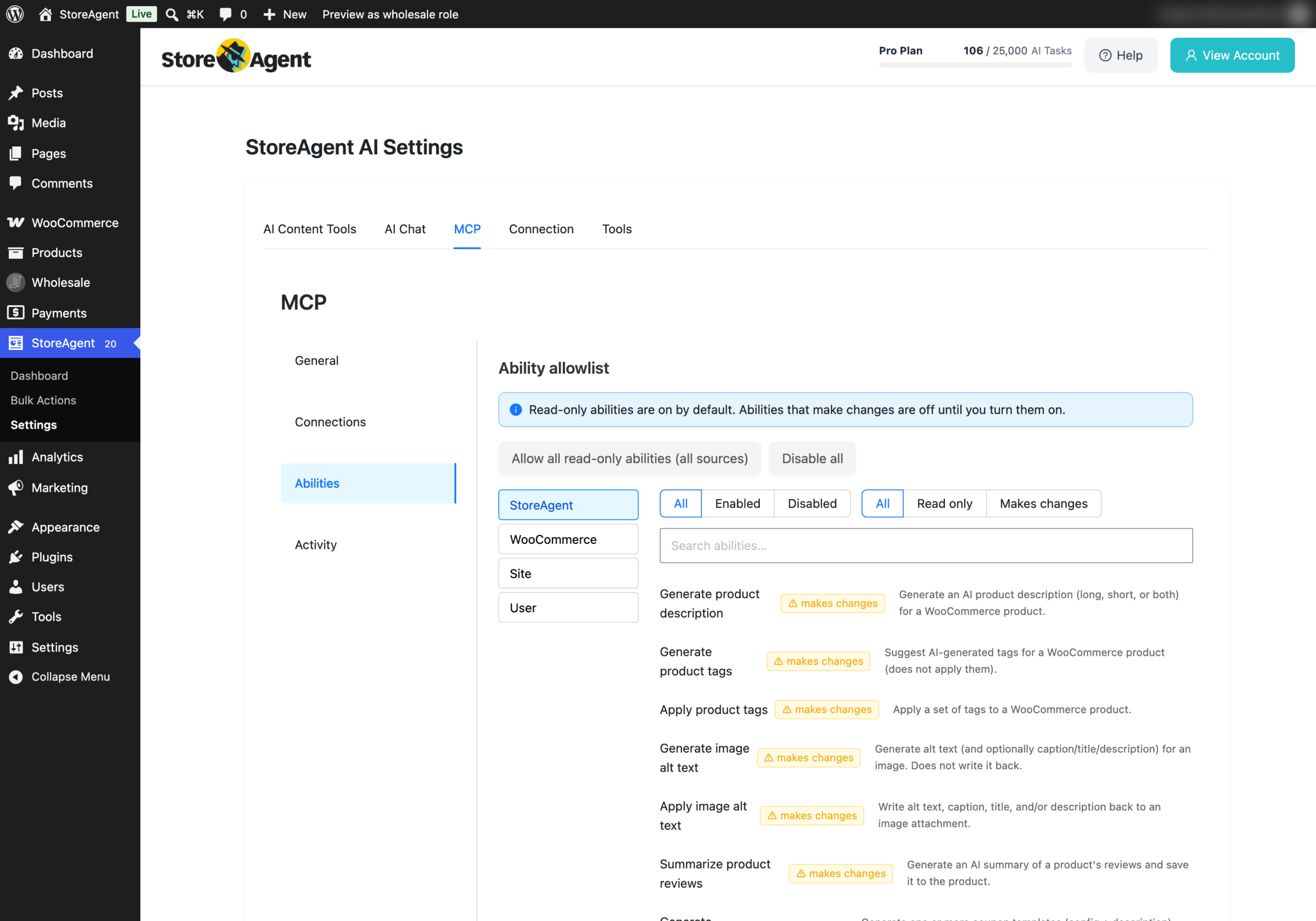
The Abilities sub-tab is the second control, and it covers abilities that come from somewhere other than StoreAgent. The panel is called Ability allowlist and it groups abilities by source: StoreAgent, WooCommerce, Site and User. Each group filters by Enabled or Disabled, and by Read only or Makes changes. Read-only abilities from these sources are switched on by default, so an assistant can look things up straight away. An ability that makes changes stays off until you switch it on here.
The notice at the top of that panel describes those sources. StoreAgent’s own abilities work differently: they have no switches, because the access level you approved governs them. If you want to stop StoreAgent making changes, revoke the connection and approve it again as Read-only.
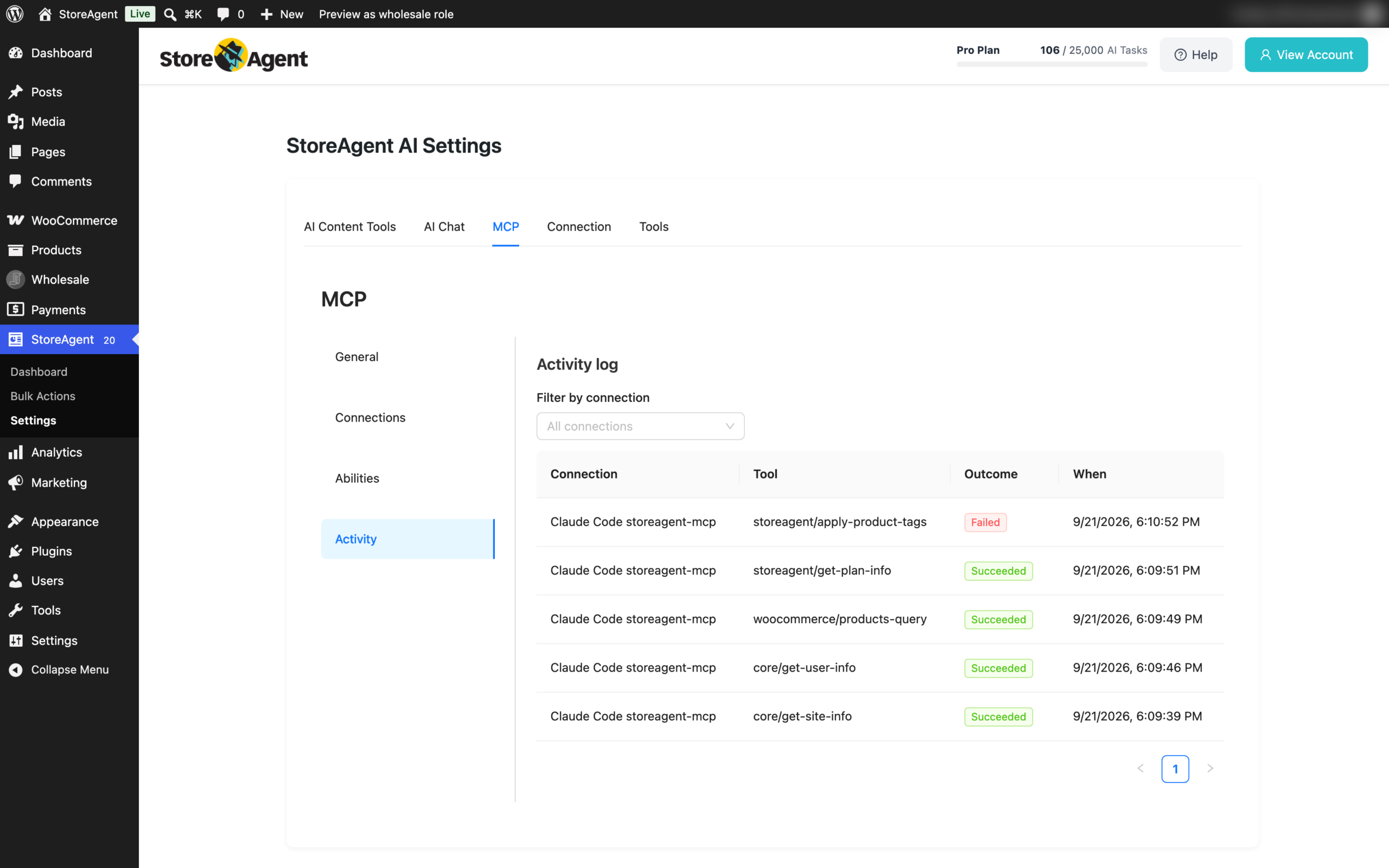
The Activity sub-tab records what a connected assistant actually did, and keeps 30 days of history. Each row shows the connection, the tool it called, whether the call succeeded, and when. It is worth a look after the first few days.
What StoreAgent’s abilities can do
Abilities are the actions StoreAgent lets a connected assistant take in your store. StoreAgent adds 24 of them, in four areas. The Read only abilities show up for every connection. The ones marked Makes changes only show up when you approved the connection as Read and write.
| Area | Ability | Type |
|---|---|---|
| Product content | Generate product description | Makes changes |
| Product content | Generate product tags | Makes changes |
| Product content | Apply product tags | Makes changes |
| Product content | Generate image alt text | Makes changes |
| Product content | Apply image alt text | Makes changes |
| Product content | Summarize product reviews | Makes changes |
| Product content | Generate coupon | Makes changes |
| Product content | Generate coupon description | Makes changes |
| Product content | Suggest upsells and cross-sells | Makes changes |
| AI Memory | Get AI memory sync status | Read only |
| AI Memory | List AI memory content | Read only |
| AI Memory | Get AI memory content status | Read only |
| AI Memory | Toggle AI memory for content | Makes changes |
| AI Memory | Set AI memory post types | Makes changes |
| AI Memory | Trigger AI memory sync | Makes changes |
| AI Memory | Get AI memory failed items | Read only |
| AI Chat | Get chat widget config | Read only |
| AI Chat | Update chat widget config | Makes changes |
| AI Chat | Toggle chat widget | Makes changes |
| AI Chat | Set chat escalation settings | Makes changes |
| AI Chat | List chat conversations | Read only |
| AI Chat | Get chat conversation | Read only |
| Account | Get usage summary | Read only |
| Account | Get plan info | Read only |
Generate product tags, Generate image alt text and Suggest upsells and cross-sells only return suggestions. They do not change your products until you apply them. Summarize product reviews is different: it saves the summary to the product. All of the Generate, Summarize and Suggest abilities are marked Makes changes, and each run uses AI Tasks from your plan. See how StoreAgent calculates your usage.
Your assistant may show these abilities by their technical names, such as storeagent_generate_product_description.
Who can run them
Every StoreAgent ability needs an administrator or shop manager account, including the Read only ones. Those read abilities still show private store data, such as chat transcripts, AI Memory content, and your plan and usage details.
Troubleshooting
The MCP tab only shows a connect prompt
Connect your StoreAgent account first. MCP is gated on it, and the tab calls no MCP endpoint until the account is connected.
The approval page says only a store manager can approve
Sign in as an administrator or shop manager, then open the approval link again. A customer or subscriber account cannot approve a connection.
The approval page says this request is for a different store
The endpoint URL you pasted belongs to another site. Go back to StoreAgent > Settings > MCP > General, copy the endpoint URL again, and recreate the connector with the correct address.
The assistant connected but cannot see anything in my store
Check that the connector is switched on for the chat you are in. In Claude, turn it on from the tools menu. In ChatGPT, start a new chat and turn the connector on. A connector that is approved but not enabled in the conversation does nothing.
The connection fails with a store unreachable error
Check that your store is online and reachable from the public internet. This error means StoreAgent could not reach your store, or your store answered with a server error. An IP allowlist or a firewall that blocks outside visitors is the usual cause. If your store is publicly reachable and it still fails, the problem is between StoreAgent and your store rather than in your settings, so open a support ticket.
The connection fails with “The store’s approval surface is not available”
Before the approval page opens, StoreAgent checks your store at /wp-json/storeagent/v1/mcp/approve. You see this error, with the code approval_surface_unavailable, when that check gets a “not found” reply, a login or security page, or a redirect instead of StoreAgent’s answer. Work through these, then try to connect again:
- Go to Settings > Permalinks, choose any option except Plain, and click Save Changes.
- Make sure StoreAgent is active on the store.
- Check that no security plugin or hosting rule blocks the WordPress REST API (addresses that start with
/wp-json/). - If you use Cloudflare, another firewall with bot protection, or a coming soon or maintenance plugin, let requests to
/wp-json/storeagent/v1/mcp/approvethrough. - Remove password protection from the site. A staging site behind a password always fails this check.
- Make sure your store’s address does not redirect to a different domain.
If your store passes all of these and it still fails, open a support ticket.
The assistant reports stale or missing abilities
Reconnect your StoreAgent account, or re-save your MCP settings to resync. This usually means the gateway last synced under a different host than your endpoint URL uses.
The assistant cannot generate descriptions, tags or coupons
Choose Revoke on the assistant’s row on the Connections sub-tab, then approve the connection again as Read and write. A connection approved as Read-only only sees the Read only abilities, so the Generate abilities never appear in your assistant’s list.
Frequently asked questions
Does MCP cost extra?
No. It is included on every StoreAgent plan, including the free one.
Can I connect both Claude and ChatGPT?
Yes. Each one is its own connector and its own row on the Connections sub-tab, so you can approve them separately and revoke either on its own.
Can the assistant change my store without asking?
Only if you let it. A Read-only connection cannot change anything. With Read and write, StoreAgent’s own abilities that make changes are available straight away. Abilities from WooCommerce and other sources that make changes stay off until you switch them on in the Ability allowlist.
How do I stop an assistant from having access?
Choose Revoke on its row on the Connections sub-tab. That ends its access immediately.
Why do I need a paid Claude or ChatGPT plan?
Custom connectors are a paid feature in both products. That is their restriction, not StoreAgent’s.
Can I turn off StoreAgent’s abilities?
Yes, but it takes a small code change, so ask your developer. Setting the SAAI_DISABLE_ABILITIES constant to true, or returning true from the saai_disable_abilities filter, stops StoreAgent from registering any of its abilities. A connected assistant then has none of StoreAgent’s abilities to use.
Need help?
If you have a question or run into any issues, we’re here to help.
- Premium users: Open a support ticket
- Free users: Visit our community forum