
 Reviewed by
If you’re weighing StoreAgent vs Storebird, you’re looking at two AI chatbots built specifically for WooCommerce, not generic bots bolted onto a store. StoreAgent and Storebird are both AI chatbots built for WooCommerce that read your live product catalog directly. The difference is scope: StoreAgent is a WordPress plugin that bundles an AI chatbot, AI content generation (product descriptions, tags, review summaries), and store insights under one flat-priced plan, while Storebird focuses on the chat surface as a SaaS product.
If you want one tool that does chat plus content plus analytics inside WordPress, StoreAgent is the better fit; if you only need a standalone chat widget, either works.
That matters more than it used to. WooCommerce powers more than 7 million active stores, and shoppers leave when they can’t get a fast answer. Baymard Institute puts the average cart abandonment rate at 70.22%, averaged across 50 studies. A chatbot that actually knows your catalog is one of the simpler ways to catch those would-be-lost sales.
So which one fits your store? In this guide, we’ll compare StoreAgent vs Storebird on pricing, features, WooCommerce integration, setup, and support, with the honest trade-offs for each. Let’s break it down.
The short answer: StoreAgent is a full WooCommerce AI suite, an AI chatbot plus content generation, review summaries, and a content insights dashboard, with a free Lite plan and paid plans from $19/mo. Storebird is a focused AI sales and support chatbot with two-way WhatsApp, a free-to-install WordPress.org plugin (a paid plan is required to go live), and paid plans from €39/mo (Essential) to €199/mo (Scale). Pick StoreAgent if you want one tool that does several AI jobs at a low flat price. Pick Storebird if you want a dedicated chatbot, especially one with WhatsApp at the center.
Table Of Contents
StoreAgent Vs Storebird: Quick Overview
Both tools cover the WooCommerce basics well: live catalog sync, order tracking, multilingual replies, and human handoff. The split comes down to breadth versus focus. StoreAgent spreads across chat, content, and insights, while Storebird concentrates on the chat experience and adds WhatsApp.
Here’s the side by side.
| Dimension | StoreAgent | Storebird |
|---|---|---|
| Core purpose | Full WooCommerce AI suite (chat + content + insights) | Dedicated AI sales and support chatbot |
| Live catalog sync | ✅ Real-time | ✅ Real-time |
| Live order tracking | ✅ Yes | ✅ Yes (1,500+ carriers) |
| AI content generation | ✅ Yes | ❌ Chat only |
| Review summaries | ✅ Yes | ❌ No |
| WhatsApp two-way chat | ❌ On-site widget | ✅ Yes |
| Multilingual replies | ✅ Yes | ✅ Yes (WPML) |
| Free plan | ✅ Lite (free) | ❌ 14-day Pro trial only |
| Pricing | $0–$249/mo, unlimited sites | €39–€199/mo, by conversation volume |
| Best for | SMB stores wanting a full AI stack at a flat price | Stores wanting focused chat, especially on WhatsApp |
How Do StoreAgent And Storebird Pricing Compare?
StoreAgent starts at $0 and scales on flat tiers. Storebird has no free plan (the plugin is free to install, but a paid plan is required to go live), and its paid tiers are priced by how many conversations your store handles each month. The clearest gap is at the paid entry point: StoreAgent’s first paid plan is $19/mo, while Storebird’s is €39/mo.
StoreAgent pricing (2026)
- Lite (free): 200 AI content tasks and 50 AI chat replies (one-time), plus 1,000 memory items. No credit card required, though you do need a free StoreAgent.ai account to activate the AI features.
- Growth ($19/mo): higher chat and content limits for growing stores.
- Pro ($49/mo): the most popular tier, with full chat history logs and larger limits.
- Business ($249/mo): for large catalogs and teams.
Every StoreAgent plan runs on unlimited websites and comes with a 14-day money-back guarantee. There are no API keys to buy and no per-message overage charges, so the price on the plan is the price you pay.
Storebird pricing (2026)
- Free trial: the plugin is free to install from WordPress.org, but a paid plan is required to go live. The Pro plan includes a 14-day free trial.
- Essential (€39/mo): 750 conversations per month, 100 knowledge pages.
- Pro (€89/mo): 5,000 conversations, unlimited knowledge pages, advanced tracking, lead capture and handoff. Includes a 14-day free trial.
- Scale (€199/mo): 15,000 conversations, 3 stores included, API access and a dedicated support manager.
One point worth clearing up in any StoreAgent vs Storebird pricing comparison: €199/mo is Storebird’s top plan, not its entry price. A small store would sit on Essential at €39/mo, not Scale, and the 14-day Pro trial lets you test the chatbot first. Storebird’s pricing is flat within each tier with no overage charges, which makes costs easy to forecast.
What Features Does Each Chatbot Offer For WooCommerce?
Both chatbots handle product questions, order lookups, and handoff to a human. The difference is what surrounds the chat. StoreAgent adds a content engine and an insights dashboard, while Storebird adds WhatsApp and carrier-level shipment tracking.
StoreAgent features
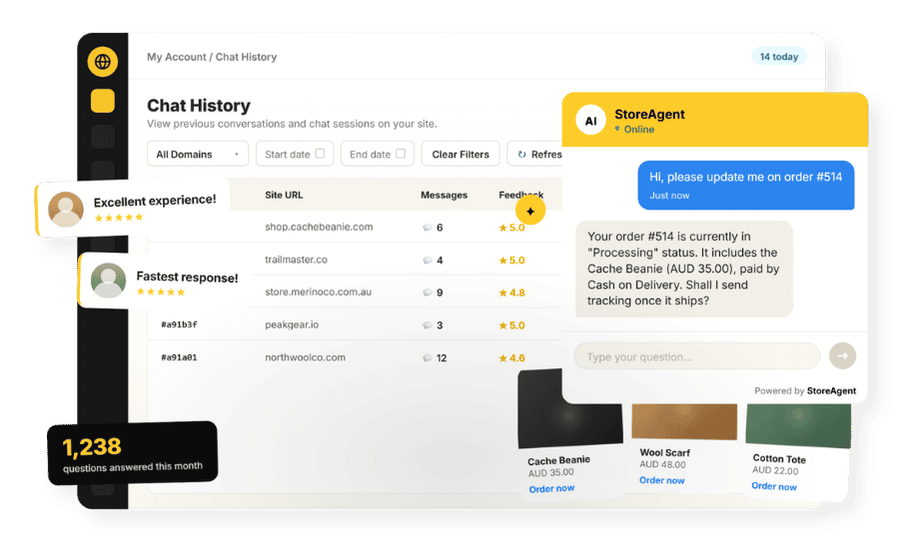
StoreAgent’s WooCommerce AI chatbot reads your product titles, specifications, attributes, and reviews, so it answers from real data rather than a script. It tracks orders, surfaces product details in the conversation, and hands off to your team when a shopper needs a person.
Beyond chat, StoreAgent includes a Content module that generates product descriptions, short descriptions, category descriptions, product tags, image alt tags, and review summaries.
An Insights dashboard then flags content improvement opportunities and tracks chat-to-cart activity. The AI memory trains on your products, pages, posts, and custom post types, and refreshes automatically as you add, edit, or remove products.
Also Read: What Is A Chatbot Analytics Dashboard? Key Features To Look For In 2026
Storebird features
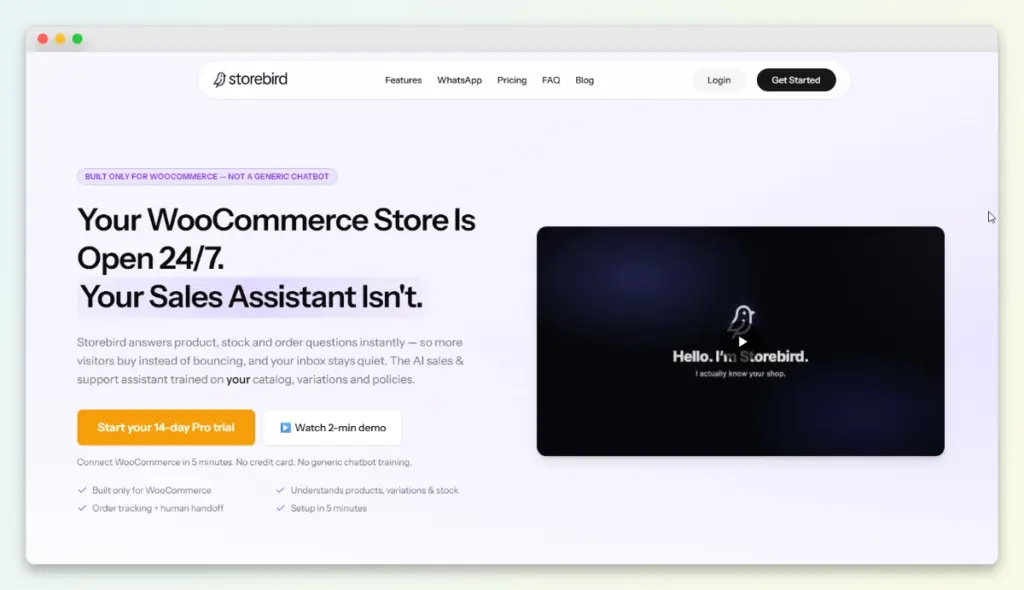
Storebird syncs your catalog, including variations, prices, images, and stock, and answers product and order questions from that live data. Its standout feature is two-way WhatsApp: agents can take over a conversation and reply directly from WhatsApp, and the bot can send order notifications there too.
It also offers real-time order tracking across 1,500+ carriers, lead capture forms, custom branding, and replies in 50+ languages with WPML compatibility. What it does not include is content generation or review summaries. Storebird is built to do chat well, not to write your product copy or analyze your catalog.
StoreAgent vs Storebird: feature comparison
| Feature | StoreAgent | Storebird |
|---|---|---|
| Real-time catalog sync | ✅ | ✅ |
| Live order tracking | ✅ | ✅ (1,500+ carriers) |
| Product details in chat | ✅ | ✅ |
| AI content generation | ✅ (StoreAgent Content) | ❌ |
| Review summaries | ✅ | ❌ |
| Content insights dashboard | ✅ (StoreAgent Insights) | ⚠ Analytics and revenue attribution only |
| Multilingual replies | ✅ | ✅ (50+ languages, WPML) |
| Human handoff | ✅ | ✅ |
| WhatsApp two-way chat | ❌ (on-site widget focus) | ✅ |
| Free plan | ✅ | ❌ (14-day Pro trial) |
| Runs on unlimited websites | ✅ | ❌ (Scale includes 3 stores) |
| No API keys required | ✅ | ✅ |
How Each Chatbot Works With Your WooCommerce Data
Both chatbots connect to your store and answer from live product data, so for basic product and order questions, they’re closely matched. The difference is what each one does with that data once it has it.
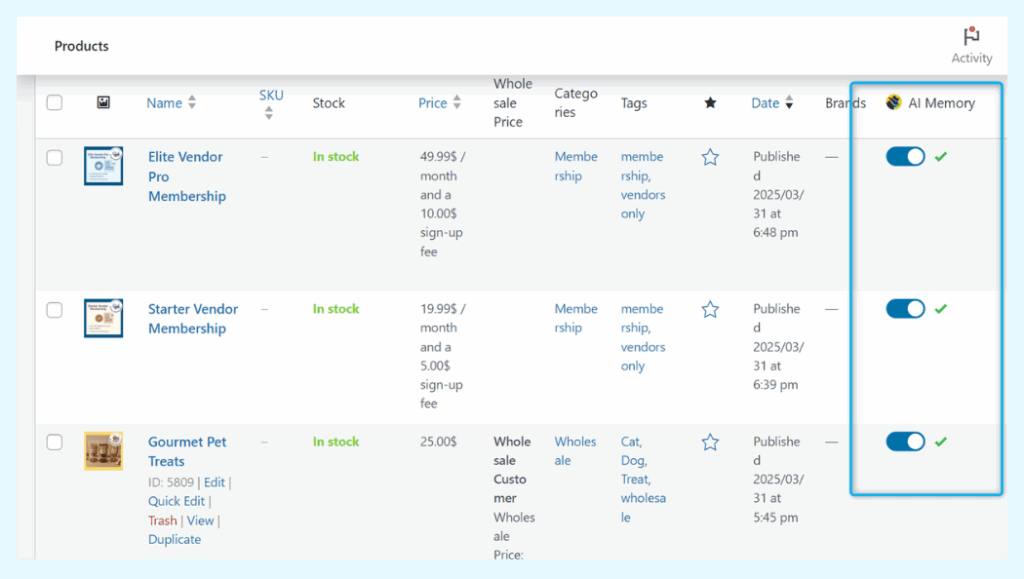
StoreAgent builds an AI memory from your products, pages, posts, and custom post types, the same product data you manage in the WooCommerce product editor. That memory then feeds two directions: the chatbot uses it to answer shoppers, and the Content and Insights modules use it to generate copy and flag improvements. It’s one data layer doing several jobs.
Storebird uses its catalog sync to power chat, WhatsApp, and order tracking, and it adds a knowledge base layer (100 knowledge pages on Essential, unlimited on Pro) for content you want the bot to reference. If your priority is reaching shoppers on WhatsApp and tracking shipments across many carriers, that’s where Storebird puts its data to work.
How Easy Is Each One To Set Up?
Both products install as WordPress plugins and connect to their own account, and both advertise a roughly five-minute setup. Neither asks you to touch API keys or code.
With StoreAgent, you install the plugin, connect your StoreAgent.ai account, and run the onboarding wizard. The wizard pre-selects recommended data sources and content tools, syncs your products to AI memory, and the chatbot goes live from your WordPress dashboard. You stay inside WordPress the whole time, and the memory keeps itself updated as your catalog changes.
Storebird follows a similar path: install the plugin, click Connect to Storebird to link your store, and products sync automatically before the widget goes live. It requires WordPress 5.8 or higher and PHP 7.4 or higher. The flow is straightforward, though as a newer plugin it has a smaller install base to lean on so far.
How Do Support And Reliability Compare?
StoreAgent is backed by email support and a maturing plugin. Because the AI memory refreshes automatically and runs weekly product syncs, the data behind your chatbot stays current without manual upkeep. Pro and Business plans add full chat history logs, so you can review conversations and spot recurring questions.
Storebird offers support through the WordPress.org support forum, plus a dedicated support manager on its Scale plan. It’s a genuinely new product, with a small number of active installs on the plugin directory at the time of writing, so it has a shorter track record than longer-established tools. Its WhatsApp handoff with push notifications is a real strength for stores that run support through messaging apps.
For reliability, the honest read is that StoreAgent has the longer history and the self-maintaining data layer, while Storebird is newer but purpose-built around messaging. Neither choice is risky, but the maturity gap is worth knowing.
StoreAgent Vs Storebird: Which Should You Choose?
There’s no single winner in the StoreAgent vs Storebird matchup, because they’re built for slightly different jobs. Here’s how to decide based on what your store actually needs.
Choose StoreAgent if you:
- Run a small to mid-sized WooCommerce store and want a full AI stack in one plugin: chat, content generation, review summaries, and insights
- Want to start free and test the full product before paying, with the Lite plan’s 50 chat replies and 200 AI tasks (one-time)
- Prefer a low, predictable entry price ($19/mo Growth) with no per-message overages
- Manage more than one store and want to run the same plan on unlimited websites
- Want AI help writing product copy, not just answering chats
Choose Storebird if you:
- Want a dedicated chatbot and don’t need content generation or content insights
- Run customer support through WhatsApp and want two-way chat and handoff built in
- Ship with many carriers and want detailed, carrier-level order tracking in chat
- Handle high conversation volumes and prefer flat tiers priced around that volume
For most growing WooCommerce stores, StoreAgent covers more ground for less money, and the free Lite plan removes the risk of trying it. Storebird earns its place when messaging-first support, especially on WhatsApp, is the heart of how you serve customers.
Conclusion
StoreAgent and Storebird are both strong WooCommerce-native AI chatbots, and both will answer your shoppers accurately from live store data. They part ways on scope and price.
Here’s a quick recap of what we covered:
- Pricing: StoreAgent starts free and runs $19–$249/mo on unlimited sites; Storebird has no free plan; paid plans run €39–€199/mo with a 14-day Pro trial
- Features: StoreAgent adds content generation, review summaries, and insights; Storebird adds WhatsApp and carrier-level tracking
- WooCommerce data: both sync live; StoreAgent reuses that data for content and insights, Storebird for chat and messaging
- Setup: both install as WordPress plugins with a guided, no-code connect step
- Support: StoreAgent has the longer track record and a self-updating data layer; Storebird is newer and messaging-first
If you’re ready to put an AI chatbot to work without paying for tools you won’t use, the StoreAgent vs Storebird decision is an easy one for most growing stores. Start free on the Lite plan, then explore our plans and pricing today when you need higher limits. Still comparing options? Read our StoreAgent vs Tidio breakdown next.
Frequently Asked Questions
Do StoreAgent and Storebird read the WooCommerce catalog the same way?
Both connect to WooCommerce and answer from your store’s live product data rather than a generic script. StoreAgent reads product titles, specifications, attributes, and reviews directly and builds an AI memory from them. Storebird syncs your catalog (variations, prices, images, stock) and adds a knowledge base layer. The bigger difference is what sits alongside the chat: StoreAgent adds content generation and insights, while Storebird adds WhatsApp and carrier tracking.
Does Storebird offer a free plan?
No. The Storebird plugin is free to install from WordPress.org, but a paid plan is required to go live. Paid plans run from €39/mo (Essential) to €199/mo (Scale), with a 14-day free trial on Pro. StoreAgent also offers a free Lite plan with 200 AI content tasks and 50 AI chat replies (one-time) plus 1,000 memory items, though it does require a free StoreAgent.ai account to activate the AI features.
Can Storebird generate product descriptions like StoreAgent Content?
No. Storebird focuses on the chatbot surface, including WhatsApp. StoreAgent includes a Content module (product descriptions, short descriptions, tags, alt text, and category descriptions) and an Insights module alongside the Chat module, all under one plugin.
Does Storebird have anything StoreAgent doesn’t?
Yes. Storebird offers two-way WhatsApp chat, where agents can take over and reply directly from WhatsApp, and order tracking across 1,500+ carriers. If messaging-app support is central to your store, that’s a real point in Storebird’s favor. StoreAgent focuses on the on-site chat widget and pairs it with content and insights tools.
Is StoreAgent or Storebird cheaper for a small store?
StoreAgent is cheaper to start. StoreAgent’s free Lite plan includes 200 AI content tasks and 50 AI chat replies plus 1,000 memory items, and its first paid tier, Growth, is $19/mo on unlimited websites. Storebird has no free plan; its first paid plan, Essential, is €39/mo for a single store, with a 14-day trial on Pro. At very high conversation volumes the gap narrows, since Storebird’s tiers are built around large conversation counts.