

If you’re weighing StoreAgent vs Alhena AI for a WooCommerce store, you have probably landed on Alhena’s WooCommerce page, seen “AI shopping assistant” next to a Woo logo, and assumed the two products are doing the same job at different prices. Alhena lists WooCommerce alongside Shopify, Magento and Salesforce Commerce Cloud, and connecting a store takes one OAuth approval.
Here’s what that page doesn’t say. Alhena’s own data-source documentation states that it fetches your products and “updates this data daily”. Its entry paid plan is $199 a month, and that figure only holds if you commit to a year up front. Month to month it is $239. And the human handoff everyone assumes is included needs a separate helpdesk you already pay for.
So StoreAgent vs Alhena AI isn’t really a contest between two WooCommerce chatbots. It’s a choice between a plugin that reads your store as it is right now and a hosted assistant that works from a copy of it, priced per conversation. This comparison covers what each one connects to, what each can actually read, and what you’d really pay.
StoreAgent Vs Alhena AI: The Short Answer
StoreAgent is the better fit for a WooCommerce store because it runs inside WordPress and reads live product and order data at the moment it answers. Alhena is a hosted platform that holds a daily copy of your catalogue, meters every conversation, and starts at $199 a month on annual billing.
Alhena is a broad product, and it does several things StoreAgent has no answer to. It just isn’t priced or built for a small-to-mid WooCommerce store, and those are different purchases.
| Comparison Factor | StoreAgent | Alhena AI |
|---|---|---|
| Where the AI runs | WordPress plugin on your store | Hosted SaaS, connected over OAuth |
| Product data freshness | Live reads at answer time | Documented: product data updated daily |
| Order lookups | Live, signed-in customers only | Live API call on order questions |
| Order actions | Read-only, no cancel or refund | Returns agent needs a returns app such as Loop |
| Pricing model | Flat monthly, unlimited websites | Metered conversation credits |
| Entry paid price | $19/mo | $199/mo on annual billing, $239 month to month |
| Free plan | Yes, StoreAgent Lite | Yes, 25 conversations a month |
| Content generation for your catalogue | Descriptions, tags, alt text, summaries | None, AEO content credits only |
| Human agent inbox | No | No, transfers into a helpdesk you already own |
| Voice and social channels | No | Yes, voice plus Instagram and WhatsApp |
Does Alhena AI Read Your WooCommerce Store Live?
Partly. Orders yes, products no, and the split matters more than it sounds.
Alhena’s WooCommerce API documentation is two paragraphs long and both of them count. It says Alhena “fetches all products visible to the end user and updates this data daily”, then adds that for specific user queries it “directly calls the Woocommerce API to fetch order and customer-related information”. Read those together and the shape is clear: order and customer questions hit your store in real time, product questions are answered from yesterday’s snapshot.
For a stable catalogue that is fine. For a store that runs flash sales, changes variation prices, or sells stock that runs out, a day-old copy is the difference between a correct answer and a refund request. A shopper asks whether the blue jacket is still $89 after you dropped it to $69 this morning, and the assistant quotes the old figure with total confidence.
One thing I noticed while reading around this: Alhena’s own WooCommerce roundup article describes its Woo sync as “Plugin + API, real-time”, which is not what the documentation says. Where a marketing page and a setup document disagree, the setup document is the one you’ll live with. No Alhena plugin exists on WordPress.org either. I searched the plugin directory for both “alhena” and “gleen”, the name the company traded under before the rebrand, and got zero results. The documented connection is an OAuth approval plus a JavaScript snippet.
What Each AI Can Actually See In Your Store
Take one shopper message and route it through both tools: “Do you have this jacket in blue, and where’s my order from last week?”
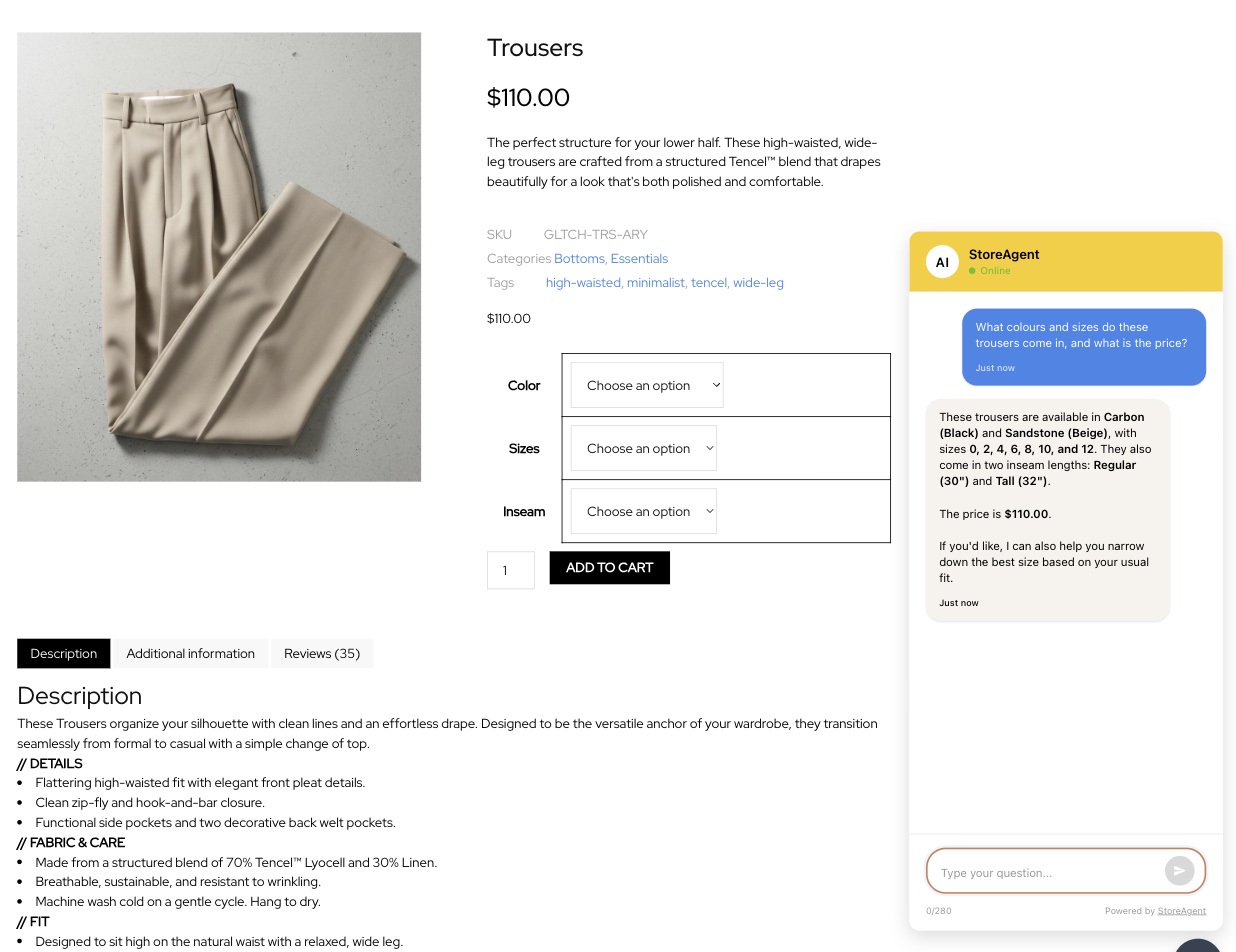
StoreAgent’s WooCommerce AI chatbot answers both halves from the live database. It reads the current variation price and stock at the moment it replies rather than from an indexed copy, and it looks the order up directly, but only for a signed-in customer whose WooCommerce account owns it. A guest asking after someone else’s parcel gets pointed to the login screen instead. That constraint is the point: order data is only as safe as the check in front of it.
Alhena answers the second half live and the first half from its daily product pull. Its Order Management Agent is documented as a lookup tool: order status by number or email, tracking, delivery estimates, and answers about shipping and returns policy. It does not cancel, edit or refund. Alhena has a separate Return Management Agent that can actually start a return, but its documentation lists a prerequisite most Woo stores won’t have: a returns platform such as Loop wired in first.
This is where accuracy stops being a checkbox and starts being money. Baymard Institute puts the average documented cart abandonment rate at 70.22% across 50 studies, and among shoppers who were not just browsing, 40% blamed extra costs like shipping, tax and fees. Those are exactly the questions an assistant gets asked at the moment of doubt, and exactly the answers that have to be current.
What We’ve Seen: Store owners evaluate an AI assistant on the quality of its writing, because that is what a demo shows you. Six weeks later the complaints are rarely about tone. They are about a price that was right last Tuesday, a stock level that lagged a sellout, and a shopper who was told an item shipped when it hadn’t. The question to ask before you buy isn’t “how good are the answers?” It’s “how old is the data behind them?”
One StoreAgent quirk is worth flagging so it doesn’t catch you out. The chat widget deliberately stays off your storefront until the first product index finishes, so a fresh install looks broken for a few minutes. It is doing that on purpose, so shoppers never reach an assistant that knows nothing about your catalogue.
How StoreAgent And Alhena AI Pricing Compare
This is the widest gap between the two, and it is arithmetic rather than opinion. Here are StoreAgent’s plans, all billed monthly:
| Plan | Price | AI chat replies | Memory items | AI tasks |
|---|---|---|---|---|
| Lite | Free | 50 one-time | 1,000 | 25 one-time |
| Growth | $19/mo | 500 | 5,000 | 500 |
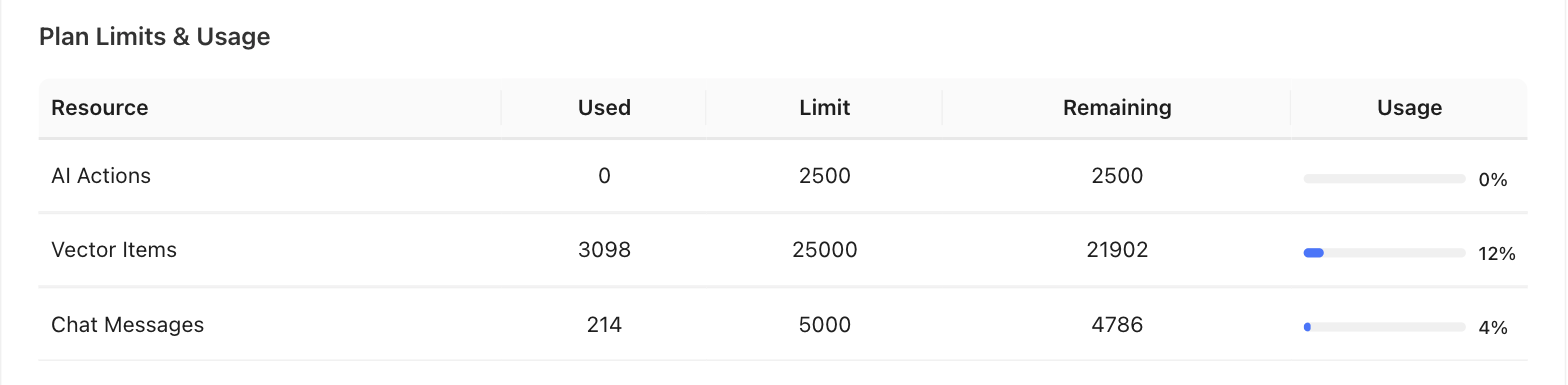
| Pro | $49/mo | 5,000 | 25,000 | 2,500 |
| Business | $249/mo | 50,000 | 100,000 | 10,000 |
Lite credits are one-time and don’t renew, so it’s a way to test the tool rather than run a busy store on it. Support Escalation starts on Growth, and full chat history is listed on Pro and Business. Only the AI’s replies count against the quota; customer messages don’t. Every paid plan runs on unlimited websites and carries a 14-day money-back guarantee.
Alhena bills by conversation credit, and its published prices assume you pay for a year in advance:
| Plan | Billed annually | Month to month | Conversations/mo | Overage |
|---|---|---|---|---|
| Free | $0 | $0 | 25 | None |
| Essentials | $199/mo | $239/mo | 200 | $1.20 per credit |
| Growth | $499/mo | $599/mo | 550 | $1.20 per credit |
| Scale | $999/mo | $1,199/mo | 1,200 | $1.20 per credit |
| Enterprise | Custom | Custom | Unlimited | Custom rate |
Their pricing page loads with the annual toggle already selected, so $199 is the number you see first. I switched it to monthly and the same plan reads $239. That is a fair discount for a year’s commitment, but it is a year’s commitment, and it is the figure most comparison posts quote without saying so.
Read the credit definitions on the same page and the meter gets wider than it looks. One credit is spent on a customer conversation, and also on an FAQ served, and also on a nudge interaction. Nudges are the proactive prompts Alhena fires at browsing visitors, which means the feature designed to start more conversations is also the feature that spends your allowance faster. Spam and irrelevant queries are free, which is decent of them.
Here’s what the difference looks like in practice (example data, not a real store): a WooCommerce shop handling 600 shopper conversations a month. On Alhena Growth that is 550 included plus 50 overage credits at $1.20, so $559 a month on annual billing or $659 month to month, before a single nudge is counted. The same volume sits inside StoreAgent Pro at $49 a month, which includes 5,000 AI replies. Over a year that is roughly $6,700 against $588. If you want the general version of this maths, we’ve written up what an AI chatbot actually costs.
Two things you’d only find after signing up. Data export is Enterprise-only, so below that tier your conversation history stays inside Alhena’s dashboard. And the documentation for API Tools and MCP Servers marks both as plan “Pro”, a tier name that appears nowhere on the pricing page.
Beyond Support: What Else Each Tool Does
Both products argue they are more than a chat widget, and both are right, in opposite directions.
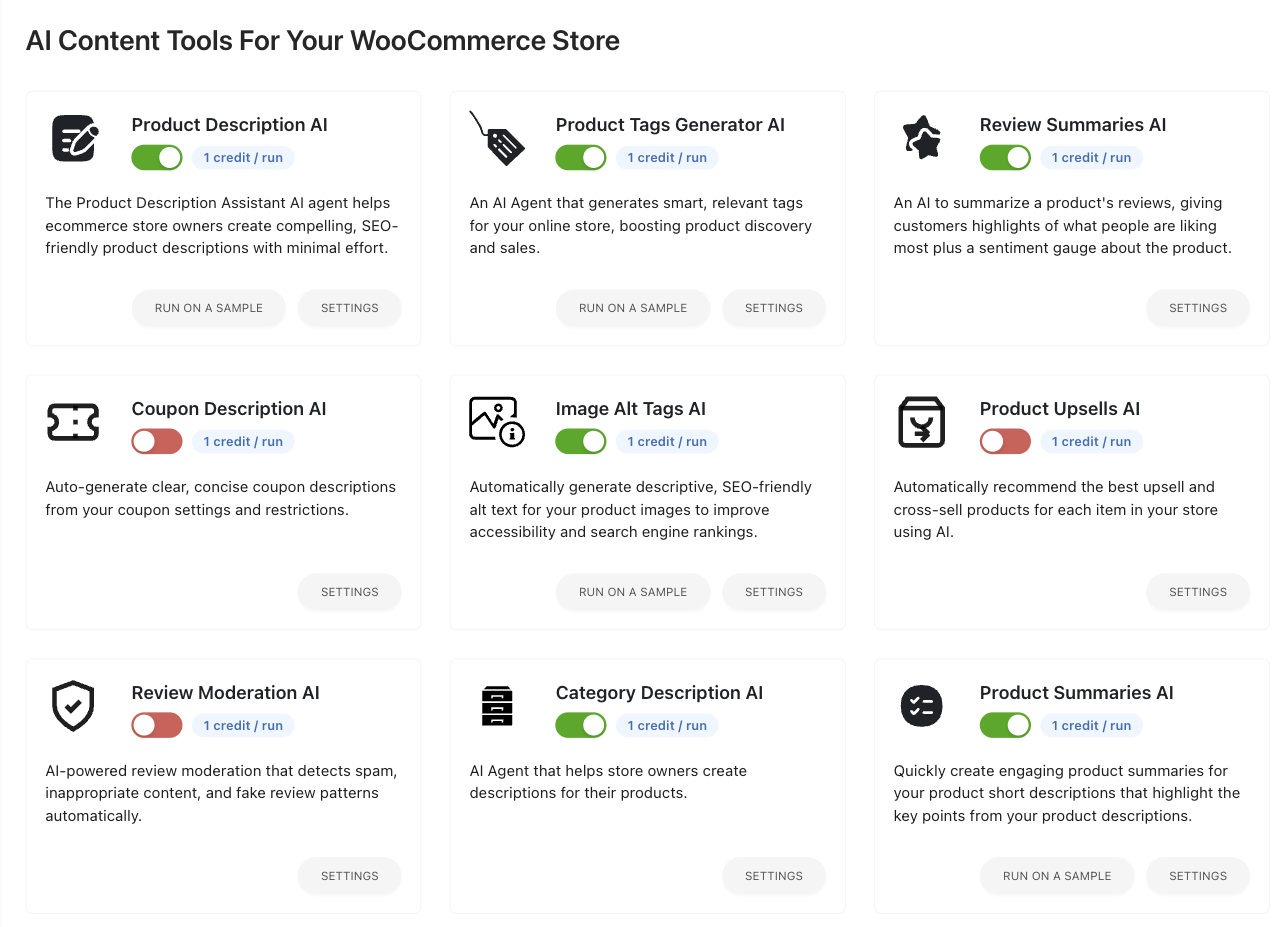
StoreAgent’s second job is writing. The same plan that runs the chatbot ships content agents that work on your catalogue: product and short descriptions, category descriptions, product tags, image alt text, product summaries, review summaries, upsell copy and coupon descriptions. They run per product, in bulk from the product list, or on a sample product first so you can see the output before committing. Its third job is measurement: AI-powered store insights track widget impressions, chat-to-cart events and chat-attributed purchases, and flag listings with content gaps.
Alhena’s second job is visibility. A large slice of what you pay for is AEO and GEO monitoring: tracking how often your brand shows up in AI answers, benchmarking competitors, and spending optimization credits on product-page rewrites, FAQ generation and blog briefs. There is nothing like it in StoreAgent, and if that is a problem you have, StoreAgent does not solve it.
On the automation side, StoreAgent registers 24 WooCommerce AI abilities through the WordPress Abilities API, so an assistant can write content, tune the AI memory and check your plan usage, with every write action stopping for confirmation first. The managed WooCommerce MCP connection that exposes those abilities to Claude and ChatGPT is live on every plan, including free. Alhena also has an MCP endpoint, but it points the other way: it lets your assistant query Alhena’s conversations and analytics, not your store.
Where Alhena AI Is Genuinely Strong
Alhena is a serious product and it would be silly to pretend otherwise. Its multi-agent routing is more developed than anything StoreAgent ships: a planner hands each message to a Product Expert, Order Management, Sizing Assistant, Return Management, Lead Generation or Outfit Builder agent, and you can add custom agents on top. It reaches channels StoreAgent does not have, including voice, Instagram and WhatsApp. It manages Trustpilot and Yotpo reviews, plugs into eleven helpdesks, and runs on Shopify, Magento, BigCommerce and Salesforce Commerce Cloud, so a multi-platform merchant can standardise on one assistant. The AI-visibility work is a real, current problem most WooCommerce tooling ignores.
Now the honest counterweight, because you should hear it from us rather than find out later. StoreAgent is not a multichannel helpdesk. There is no human-agent inbox, no SMS, no voice, no Instagram or WhatsApp, and no review-platform management. When a conversation needs a person, StoreAgent emails your admin an AI summary of the chat with the customer set as the reply-to address, so hitting reply in your inbox goes straight back to the shopper. That’s a faster human, which is worth something, but it is not a ticketing system.
Alhena’s handoff is worth putting next to that, though, because it is not the upgrade it looks like. Its human-transfer documentation opens with a prerequisite: at least one helpdesk integration must be active before transfers work at all. Alhena has no inbox of its own either. So the comparison is StoreAgent’s email-to-admin against Alhena plus a Zendesk or Gorgias subscription, on top of $199 a month. If you already run one of those, that is a genuine advantage. If you don’t, it is a second bill.
For the wider field, our StoreAgent comparisons cover the other tools a Woo store usually shortlists alongside these two.
Frequently Asked Questions
Does Alhena AI work with WooCommerce?
Yes. Alhena lists WooCommerce as a supported e-commerce platform, and connecting a store is an OAuth approval rather than a plugin install. Doing so enables its Product Expert and Order Management agents. There is no Alhena plugin in the WordPress.org directory, so the widget itself arrives as a JavaScript snippet you add to your site.
Does Alhena AI read live WooCommerce prices?
No. Alhena’s WooCommerce API documentation states that it fetches your products and updates that data daily. Order and customer information is fetched live when a shopper asks about it, but product answers come from the most recent daily pull, so a price or stock change made today may not be reflected until tomorrow.
Is StoreAgent a full helpdesk?
No, and that’s deliberate. There is no agent inbox, no SMS and no voice. StoreAgent handles the conversation and, when it can’t, emails your admin a summary of the chat with the shopper set as the reply-to address. If you need queues, macros and SLAs across several channels, buy a helpdesk and keep StoreAgent for the store-aware answering.
How much does StoreAgent cost compared to Alhena AI?
StoreAgent runs $19, $49 or $249 a month, billed monthly, with a free Lite tier. Alhena’s paid plans are $199, $499 and $999 a month on annual billing, or $239, $599 and $1,199 month to month, with conversations metered and overage at $1.20 per credit. StoreAgent’s entry paid plan is roughly a tenth of Alhena’s.
Can I try StoreAgent before paying?
Yes. StoreAgent Lite is free and needs no credit card, giving you 50 AI chat replies, 200 AI tasks and 1,000 memory items. Those credits are one-time rather than monthly, so treat Lite as a proper trial on your own catalogue. Paid plans add a 14-day money-back guarantee if you upgrade and change your mind.
Which AI Is Right For Your WooCommerce Store?
StoreAgent, for most WooCommerce stores, and on price alone StoreAgent vs Alhena AI isn’t a close call. Alhena earns its number if you are multi-platform, already running a helpdesk, and buying the AI-visibility programme as much as the chatbot. A single Woo store is paying enterprise rates for a daily copy of its own catalogue.
Here’s what to do with all this:
- Check how fresh each tool’s product data is before you compare anything else
- Ask what the AI can do beyond looking things up, because neither one cancels or refunds an order
- Price your real conversation volume, not the headline tier, and check whether the headline needs annual billing
- Count the helpdesk you’d need underneath if human handoff matters to you
- Decide which second job you’re buying, catalogue content or AI visibility
If you run a WooCommerce store and want AI that reads your real catalogue and your real orders, StoreAgent is built for exactly that. Our customer service AI agent handles the questions your inbox is full of, and you can start free on StoreAgent Lite and see what it answers before you spend anything.
Sources
- Baymard Institute, Cart Abandonment Rate Statistics — Supports: “average documented cart abandonment rate at 70.22% across 50 studies”
- Baymard Institute, Cart Abandonment Rate Statistics — Supports: “40% blamed extra costs like shipping, tax and fees”
Note: Alhena AI platform support, WooCommerce data-refresh behaviour, agent capabilities, human-transfer prerequisites and plan pricing were verified directly against Alhena’s own live documentation and pricing page on 2026-09-01, and the absence of an Alhena plugin was checked against the WordPress.org plugin directory the same day. StoreAgent plan pricing, quotas and feature claims were verified against the live StoreAgent site and plugin source the same day. Per the competitor linking policy, Alhena AI pages are named in prose but deliberately not linked.