
 Reviewed by
StoreAgent vs AI Product Tools? This is a real decision to make when WooCommerce store owners want AI chat and content tools in one place. Both plugins bundle a chatbot and content generation into a single package. Both promise to save you hours of manual work. But the way they deliver is very different.
According to Salesforce, 76% of ecommerce teams using AI credit it with revenue growth. So the question is not whether to adopt AI. It is which tool fits your workflow.
The core split is simple: managed SaaS vs. bring-your-own-key (BYOK). StoreAgent handles everything for you. No API keys, flat pricing, zero setup. AI Product Tools hands you the keys to 300+ AI models, bulk runs for thousands of products, and full control over every setting.
In this guide, we’ll cover the StoreAgent vs AI Product Tools split across features, pricing, content tools, chatbots, bulk runs, and setup. So, let’s get started!
Table Of Contents
- How Do StoreAgent and AI Product Tools Compare at a Glance?
- What Is the Difference Between SaaS and BYOK?
- What Does Each Tool Actually Cost Per Month?
- Which Tool Generates Better Product Content?
- How Do the AI Chatbots Differ?
- Does AI Product Tools Handle Bulk Operations Better?
- How Easy Is Each Tool to Set Up?
- Final Verdict
- Frequently Asked Questions
How Do StoreAgent And AI Product Tools Compare At A Glance?
The StoreAgent vs AI Product Tools split is clear at this level. StoreAgent wins on simplicity and deeper WooCommerce integration. That includes order data in the chatbot, image alt text, review summaries, and an insights dashboard. AI Product Tools wins on flexibility and model choice.
That covers 300+ models, advanced filtering for bulk runs across 2,000+ products, and SEO meta for 6 plugins. Both tools support bulk generation and scheduled automations. The difference is in scope. Here is the full breakdown.
| Feature | StoreAgent | AI Product Tools |
|---|---|---|
| Operating Model | SaaS (managed, no API key) | BYOK (bring your own API key) |
| Plugin Price | Free – $249/mo | Free – $14.99/mo |
| Total Cost (incl. API) | Same as plugin price | Plugin price + API costs (variable) |
| AI Models | Managed (handled for you) | GPT-5.4, GPT-5.3, Gemini 3.1/2.5, Claude, 300+ via OpenRouter |
| Chatbot | Yes (order + product data) | Yes (product data only) |
| Content Generation | Descriptions, tags, alt text, review summaries | Descriptions, titles, tags, FAQs, SEO meta |
| Bulk Generation | Yes (product list bulk actions + WP-CLI) | Yes (2,000+ products, advanced filtering) |
| SEO Meta | No | Yes (6 SEO plugin integrations) |
| Image Alt Text | Yes | No |
| Review Summaries | Yes | No |
| Insights Dashboard | Yes | No |
| Automation Scheduling | Yes (scheduled content quality checks) | Yes (scheduled bulk regeneration) |
| Community Prompts | No | Yes (shared prompt library) |
| Brand Voice Training | Yes (tone and style settings) | Yes |
| Downloads | 9,335 | 18,585 |
| Rating | 5/5 (5 reviews) | 4.7/5 (15 reviews) |
Want the simpler option? Try StoreAgent free, with no API keys and no setup complexity.
What Is The Difference Between SaaS And BYOK?
The SaaS vs. BYOK split is the biggest call in the StoreAgent vs AI Product Tools decision. Every other difference flows from this one. Pricing, features, setup time. They all trace back to it.
How does StoreAgent’s managed SaaS work?
StoreAgent operates as a fully managed SaaS. You install the plugin, activate it, and start generating content immediately. There is no API key to configure, no model to select, and no third-party usage dashboard to monitor.
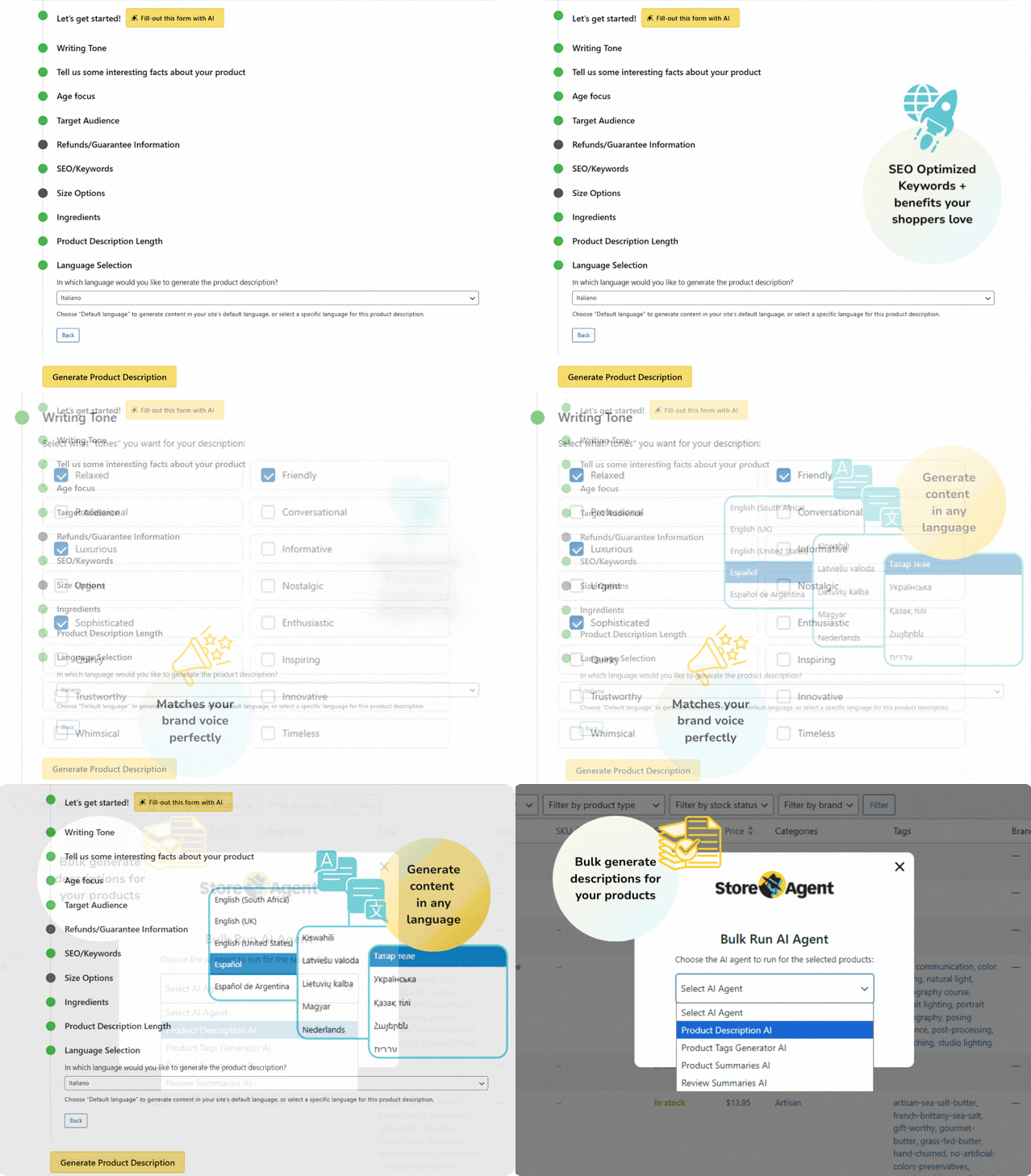
The benefits are straightforward:
- No API key needed, ever
- Flat monthly pricing, so you know exactly what you pay before you pay it
- Everything managed, including model selection, updates, and scaling, all behind the scenes
- Trade-off: you cannot choose your AI model or fine-tune generation parameters
How does AI Product Tools’ BYOK model work?
AI Product Tools takes the opposite approach. You bring your own API key from OpenAI, Google, Anthropic, or any of the 300+ models available through OpenRouter.
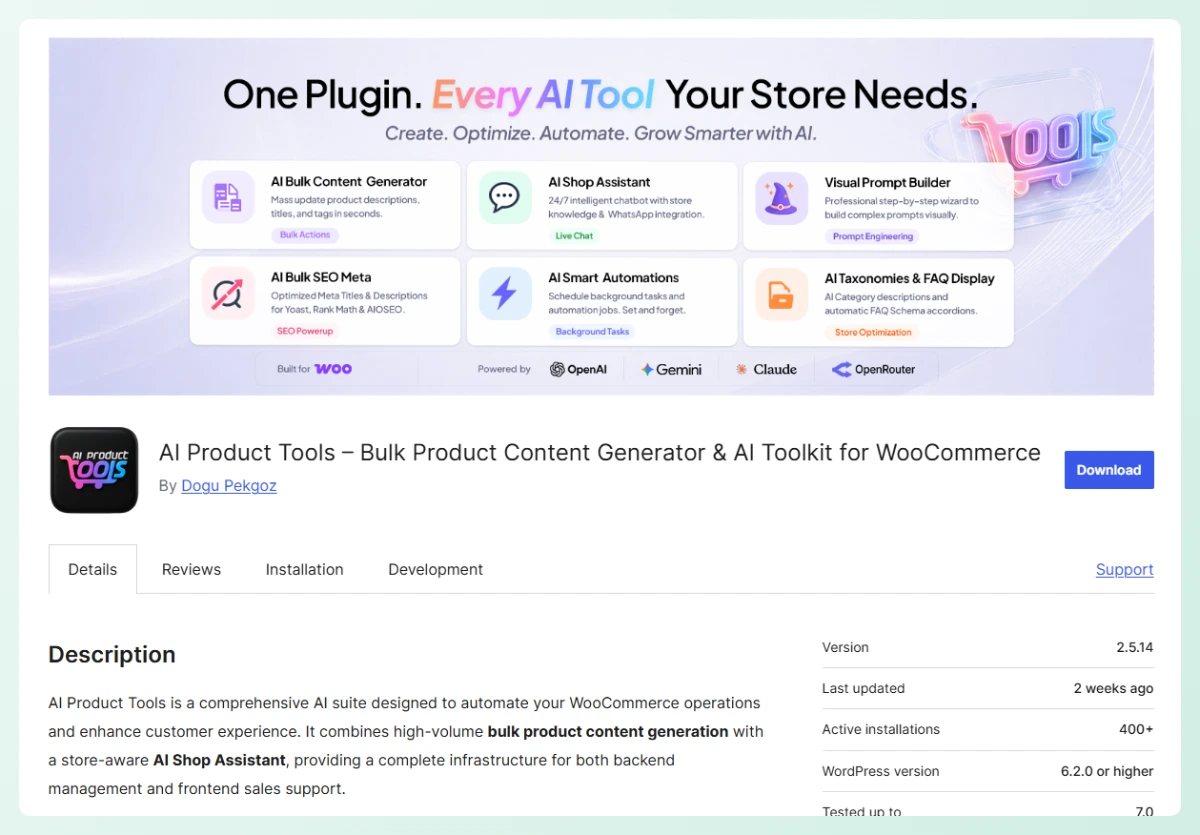
The benefits are also clear:
- Choose from 300+ models including GPT-5.4, GPT-5.3, Gemini 3.1/2.5, and Claude
- Potentially cheaper at high volume, since API costs can undercut SaaS pricing at scale
- Full control over model parameters, temperature, and output length
- Trade-off: unpredictable costs, API key management, and occasional rate limit issues
According to a 2025 Master of Code survey, 62% of consumers prefer interacting with an AI chatbot over waiting for a human agent. That makes the chatbot in either suite a real revenue driver.
Neither model is objectively better. If you have managed API keys before and enjoy control, BYOK is empowering. If you want AI that works without a second thought, SaaS is liberating. And if you would rather work in Claude or ChatGPT, StoreAgent’s WooCommerce MCP connects them to your store with no API key.
What We’ve Seen: Store owners who start with a BYOK tool often underestimate the upkeep. There’s API billing to monitor, rate limit errors to handle in busy periods, and model versions to keep track of. We commonly see merchants switch to a managed SaaS like StoreAgent after a few months. The time spent on API admin tends to outweigh the cost savings.
What Does Each Tool Actually Cost Per Month?
Pricing is where the StoreAgent vs AI Product Tools call gets concrete. StoreAgent’s subscription price is the total price. API costs are included. AI Product Tools’ plugin price is only part of the bill. You also pay your AI provider for every API call your store makes.
Here is what the total monthly cost looks like.
| Cost Component | StoreAgent | AI Product Tools |
|---|---|---|
| Plugin subscription | $19/mo (Growth) | $9.99/mo (Pro) |
| API costs | $0 (included) | ~$5–25/mo (varies by model) |
| Total estimated cost | $19/mo | ~$15–35/mo |
| Includes chatbot? | Yes (500 chats) | Yes (no order data) |
| Includes insights? | Yes | No |
| Cost predictability | 100% predictable | Variable |
AI Product Tools’ base plugin price is cheaper: $9.99/mo vs. $19/mo. That is real and worth saying out loud. But for a store generating around 500 descriptions per month, the total cost lands roughly the same once API fees are added.
The hidden costs with BYOK go beyond raw API fees. You can hit rate limits during bulk runs. That means waiting, or paying to upgrade your API tier. Chatbot traffic spikes can also push your API bill higher than expected in busy months.
For larger operations, the math shifts. StoreAgent Pro costs $49/mo flat. AI Product Tools Business costs $14.99/mo, plus API costs of around $30–80/mo. That puts you at $45–95/mo total. The cost gap narrows or even flips, depending on which model you pick and how long your content is.
See the full breakdown on the StoreAgent pricing page.
Which Tool Generates Better Product Content?
Content generation is where the StoreAgent vs AI Product Tools comparison gets specific. Both tools generate product descriptions. Past that, they diverge sharply. StoreAgent exclusively offers image alt text and review summaries.
AI Product Tools exclusively offers SEO meta integration, FAQ generation, and a community prompt library. Both support bulk generation and scheduled automations, though the way they work is different.
| Content Feature | StoreAgent | AI Product Tools |
|---|---|---|
| Product descriptions | Yes | Yes (bulk) |
| Product titles | No | Yes |
| Product tags | Yes | Yes |
| Image alt text | Yes | No |
| Review summaries | Yes | No |
| FAQs | No | Yes |
| SEO meta (titles + descriptions) | No | Yes (6 plugin integrations) |
| Category descriptions | Yes | No |
| Community prompt library | No | Yes |
| Automation scheduling | Yes (content quality checks) | Yes (bulk regeneration) |
StoreAgent’s review summaries are particularly useful for building social proof sections on product pages without manually reading dozens of customer reviews. The image alt text generation automates accessibility and image SEO in one step.
How I Tested: I generated descriptions for the same product in both tools. StoreAgent produced a description, tags, and alt text in a single step with no setup. AI Product Tools needed more steps. I had to select a model, adjust the prompt template, and confirm the API key was connected before generating. The trade-off: the output included an SEO meta title and description that StoreAgent does not produce. The quality of the descriptions themselves was comparable when given the same product data.
AI Product Tools’ SEO meta feature works with Yoast, Rank Math, AIOSEO, The SEO Framework, SEOPress, and Squirrly SEO. The community prompt library is a clever touch. You get to use prompts that other store owners have already tested.
If your content workflow involves building out category landing pages for SEO, StoreAgent generates category descriptions that AI Product Tools does not. If your priority is SEO meta fields and FAQ sections, AI Product Tools covers those gaps.
How Do The AI Chatbots Differ?
The chatbot is the clearest gap in the StoreAgent vs AI Product Tools comparison. StoreAgent’s WooCommerce chatbot handles both pre-sale product questions and post-purchase support. That covers order tracking, shipping status, and customer history. AI Product Tools’ Shop Assistant focuses only on product-related queries. This is one of the biggest splits between the two suites.
What can StoreAgent chat do?
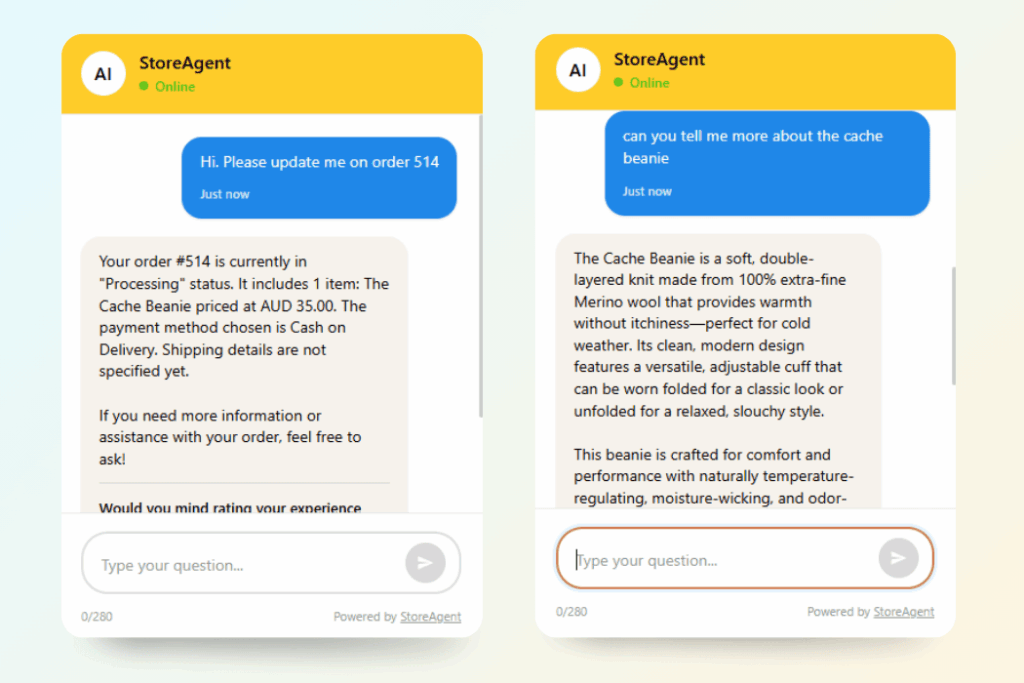
StoreAgent Chat ingests product data, order data, pricing, stock levels, and customer information. It functions as both a pre-sale product advisor and a post-purchase support assistant. Customers can ask “Where is my order?” and get live tracking data.
It is available on every plan including free.
What can AI Product Tools’ shop assistant do?
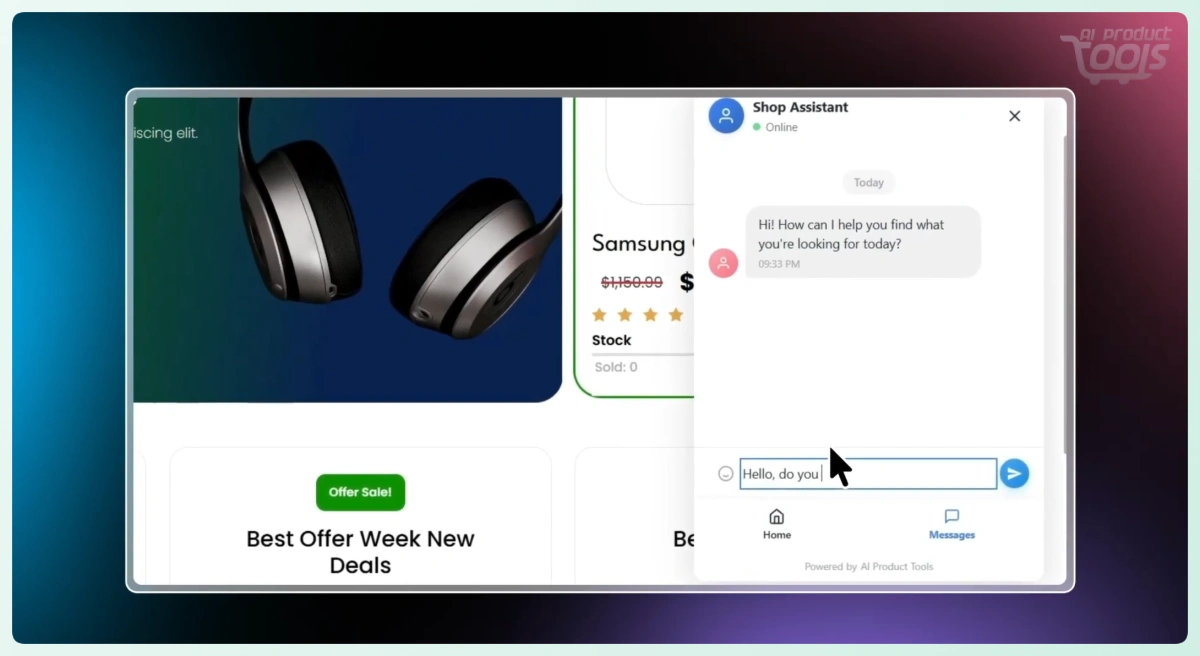
AI Product Tools’ Shop Assistant ingests product data for context-aware product recommendations and answers. It handles pre-sale queries well, including questions about product features, comparisons, and availability.
It does not access order data and it cannot answer order status questions, shipping inquiries, or refund-related requests.
How I Tested: I ran both chatbots side by side. I asked, “What’s the shipping status of order #1234?” StoreAgent pulled the live order data and returned a specific shipping status. AI Product Tools’ Shop Assistant came back with a generic message. It told the customer to check their order confirmation email, because it could not access that data. For product questions like “Is this jacket available in large?”, both chatbots answered correctly. StoreAgent did respond noticeably faster in this test.
If your customers use chat for both pre-sale and post-purchase questions, StoreAgent covers both. For stores where shipping questions, return requests, and order changes make up a large share of support tickets, the order data gap in AI Product Tools is a real problem.
For a deeper comparison of how StoreAgent stacks up against another competitor, see our StoreAgent vs. WriteText.ai comparison.
Does AI Product Tools Handle Bulk Operations Better?
For bulk runs, the StoreAgent vs AI Product Tools call tilts toward AI Product Tools on volume scale and filtering. Both tools handle bulk well, but they go about it differently.
How does AI Product Tools handle bulk runs?
AI Product Tools offers bulk content generation with advanced filtering for catalogs of 2,000+ products. You pick a filter, then regenerate descriptions for the whole filtered set in one run.
- Filter options: category, tag, stock status, custom attribute
- Automation scheduling: new products get descriptions generated automatically on a recurring schedule
- Best fit: very large catalogs where you regenerate by segment
How does StoreAgent handle bulk runs?
StoreAgent runs bulk through the standard WordPress product list bulk-action menu and via WP-CLI commands. Each run logs to WooCommerce > Status > Logs, so you can audit what changed.
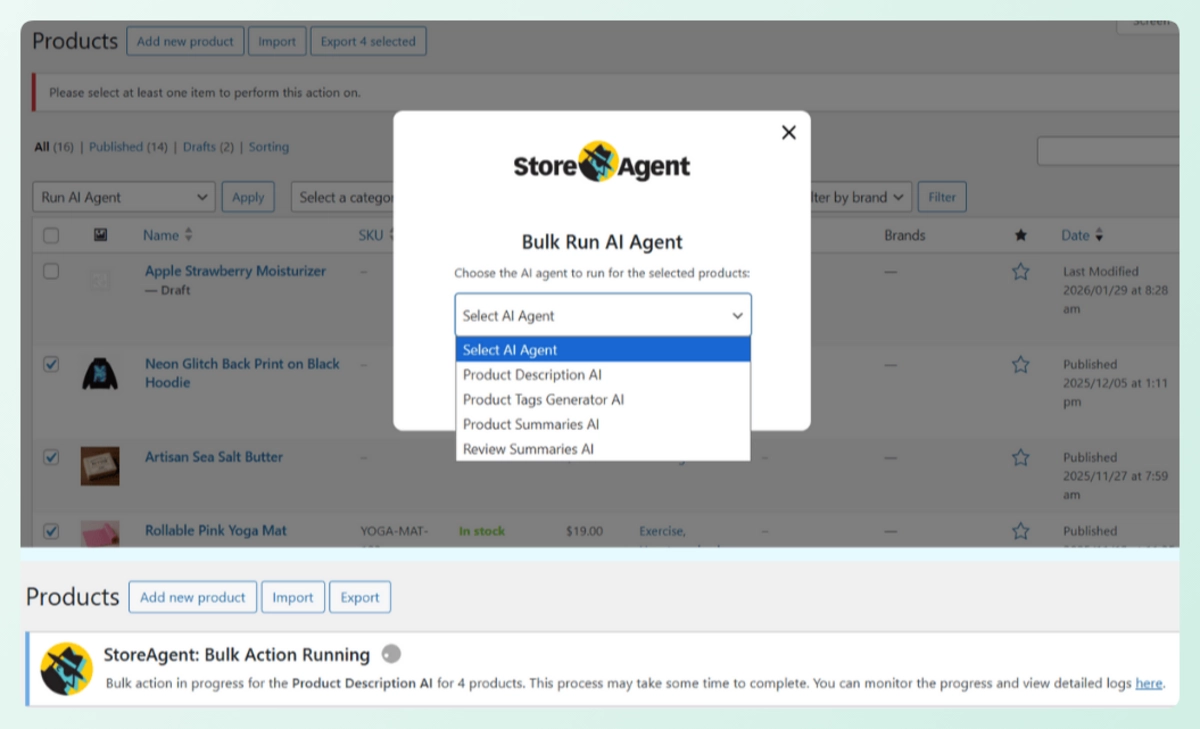
- Bulk agents: product descriptions, tags, summaries, review summaries, and upsells
- Scheduled automations: recurring jobs flag products with missing short descriptions or descriptions that are too short or too long
- Review summary refresh: daily or weekly cadence
- Best fit: ongoing maintenance off your product list selection
According to WordPress.org plugin data, AI Product Tools has 18,585 downloads and a 4.7/5 rating from 15 reviews, which signals solid adoption among store owners who need that scale. If your workflow needs filtered bulk runs across very large catalogs, AI Product Tools delivers there. For ongoing maintenance with audit trails, StoreAgent fits better.
How Easy Is Each Tool To Set Up?
Setup is the most lopsided part of the StoreAgent vs AI Product Tools call. StoreAgent gets you to your first generated description and chatbot reply within minutes of activation. Install, activate, done. AI Product Tools needs more from you up front. You configure at least one API key, select a model, set chatbot parameters, and run a test generation to verify the connection.
Both are reliable once running. AI Product Tools has a longer track record on WordPress.org, with many more downloads. StoreAgent is newer, but it’s backed by Rymera Web Co., a long-time WooCommerce plugin developer. In hands-on testing, neither plugin crashed, threw errors, or produced garbled output.
The difference is purely time-to-first-result. StoreAgent gets you there faster. AI Product Tools gives you more control over how you get there.
For another comparison focused on a different AI chat tool, check out our StoreAgent vs. Amio comparison.
Final Verdict: StoreAgent Is The Best Choice For Most WooCommerce Store Owners
The StoreAgent vs AI Product Tools verdict comes down to scope. StoreAgent delivers the most complete WooCommerce AI experience in a single plugin. That includes AI chat with real-time order data, content tools with image alt text and review summaries, and an insights dashboard. All with zero setup and 100% predictable pricing.
Here’s a quick recap of what we covered:
- The SaaS vs. BYOK split that drives every other StoreAgent vs AI Product Tools difference
- Total monthly cost (StoreAgent’s all-inclusive pricing vs. AI Product Tools’ plugin + API model)
- Where each tool wins on content generation (StoreAgent for alt text, review summaries, category descriptions; AI Product Tools for SEO meta and FAQs)
- The chatbot order-data gap that only StoreAgent closes
- How bulk operations compare for very large catalogs
- Time-to-first-result on setup, where StoreAgent wins
StoreAgent is the best fit for:
- Store owners who want one plugin that handles chat, content, and insights without managing external API accounts
- Merchants who need post-purchase support (order tracking, shipping status) alongside pre-sale product chat
- Anyone who values predictable monthly costs and a setup process that takes minutes, not hours
If you’re ready to skip the API key setup and run AI chat, content generation, and insights from a single WooCommerce plugin, explore our plans and pricing today.
Frequently Asked Questions
Do I need to manage API keys with StoreAgent?
No. In the StoreAgent vs AI Product Tools comparison, this is one of the biggest splits. StoreAgent is a fully managed SaaS, and all AI costs are included in your subscription. You do not need an OpenAI, Google, or Anthropic account. You do not need to set up billing with any AI provider. AI Product Tools requires you to bring your own API key from at least one provider and manage those costs separately.
Can AI Product Tools’ chatbot handle order status questions?
No. AI Product Tools’ Shop Assistant focuses on product-related queries using your product catalog data. It does not access WooCommerce order data for post-purchase support like shipping status, delivery tracking, or refund inquiries. StoreAgent’s chatbot handles both product and order queries from a single widget.
Which tool is better for large product catalogs?
Both tools support bulk content generation, but AI Product Tools has the clearer edge for very large catalogs. That comes from its advanced filtering (category, tag, stock status, custom attribute) and scheduled bulk regeneration. StoreAgent supports bulk generation through the WordPress product list bulk-action menu and WP-CLI. It also runs scheduled automations that flag content quality issues. That makes it well-suited to ongoing maintenance. It does not have the filtered bulk-run scale that AI Product Tools markets for 2,000+ product catalogs.
Can I switch between StoreAgent and AI Product Tools?
Yes. The StoreAgent vs AI Product Tools choice is not a lock-in. Both are standard WordPress plugins that install and uninstall independently. Your WooCommerce product data stays in WooCommerce regardless of which plugin you use. Any generated content (descriptions, titles, tags, meta data) that was already saved to your products remains intact after switching.
Does AI Product Tools include an insights dashboard?
No. AI Product Tools focuses on content generation and chatbot features. It does not include a store insights or optimization dashboard. StoreAgent’s insights dashboard gives data-driven recommendations based on your store’s performance. That helps you spot optimization wins without leaving your WordPress admin.