
You already use ChatGPT or Claude every day. Wouldn’t it be easier if it could look things up in your own store, instead of you copying product details back and forth? StoreAgent includes a WooCommerce MCP server that does exactly that. This article walks you through turning it on, connecting your assistant, and approving the connection from your own WordPress admin. It also lists the StoreAgent abilities your assistant can use.
MCP is included on every StoreAgent plan, including the free one.
What you need
- StoreAgent installed and activated on your store
- A connected StoreAgent account. The MCP tab shows only a connect prompt until your account is connected
- An administrator or shop manager account on your store, because only a store manager can approve a connection
- A Claude plan (Free, Pro, Max, Team, or Enterprise) or a paid ChatGPT plan (Plus, Pro, Business, Enterprise, or Edu). Claude Free allows only one custom connector.
Step 1: Turn on MCP for your store
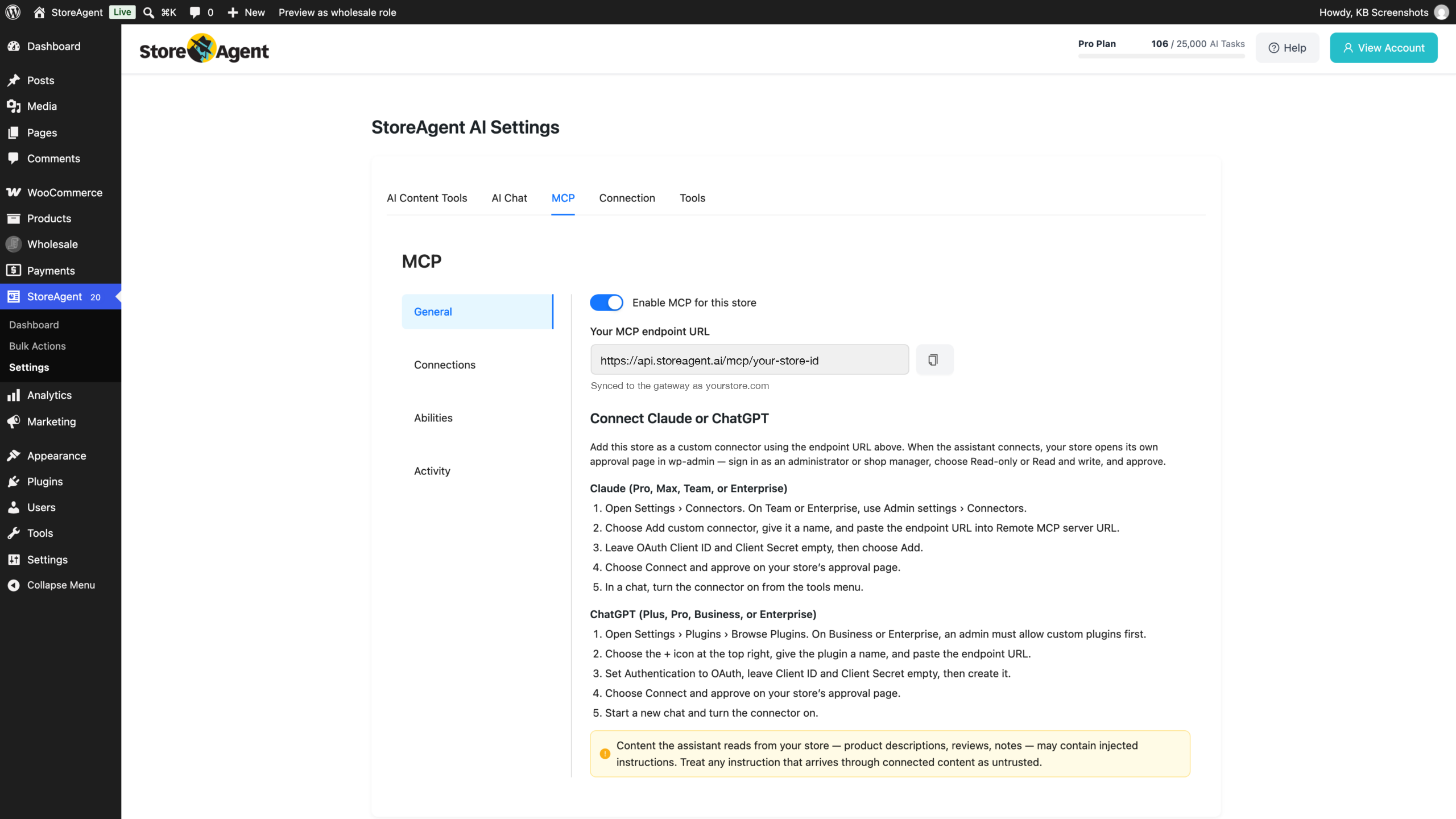
- Go to StoreAgent > Settings > MCP in your WordPress admin.
- Open the General sub-tab.
- Switch on Enable MCP for this store.
The MCP tab has four sub-tabs: General, Connections, Abilities, and Activity. You only need General to get connected.
Step 2: Add your store as a custom connector
Every store uses the same connector address. You paste it into Claude or ChatGPT below:
https://api.storeagent.ai/mcpWhen you connect, StoreAgent asks for your store domain, then sends you to your store to approve the connection.
Your MCP settings screen also shows a longer address under Your MCP endpoint URL. It ends with your store’s domain. That address works too, but you do not need it.
The steps differ depending on which assistant you use, so follow the one that matches.
Connect from Claude
- Go to Customize > Connectors.
- Click + Add, then Add custom connector.
- Enter a name, paste
https://api.storeagent.ai/mcpas the server URL, then click Continue. - Review the authentication settings Claude detects, then click Continue.
- Keep the recommended options. Under Authentication, do not choose No sign in. Under OAuth client, leave Use Claude’s published identity (Recommended) selected, then click Add.
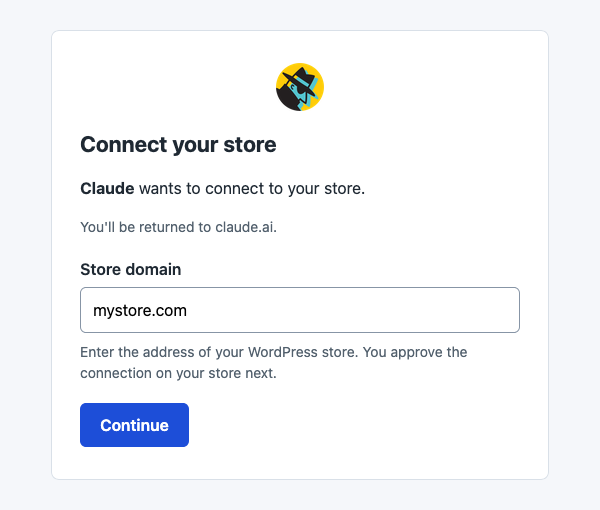
- Click Connect. StoreAgent asks for your store domain.
- Enter your store’s domain, such as
mystore.com, and click Continue. Your store’s approval page opens. - After you approve, open a new chat.
- Click the + button at the lower left, choose Connectors, and switch your store’s connector on.
On Team or Enterprise, an Owner or Primary Owner adds the connector for the organization. Go to Organization settings > Connectors, click Add, hover over Custom, and select Web. Enter the name and https://api.storeagent.ai/mcp, keep the recommended authentication options, and click Add. Each member then goes to Customize > Connectors, finds the connector labeled Custom, clicks Connect, and enters the store domain when StoreAgent asks.
Connect from ChatGPT
- Go to ChatGPT Plugins. Your workspace policies decide if you can add a custom MCP server. On Business or Enterprise, ask your admin if the option is missing.
- Select the + button, then Add custom MCP server.
- Enter a name and description. Under Connection, paste
https://api.storeagent.ai/mcp. - Configure authentication so ChatGPT signs in through your store, review the risk warning, and select I understand and want to continue.
- Select Create as a plugin.
- Install the plugin and sign in when ChatGPT asks. StoreAgent asks for your store domain.
- Enter your store’s domain, such as
mystore.com, and click Continue. Your store’s approval page opens. - Start a new chat, type @, and select the plugin.
Step 3: Approve the connection in your store
Before your store opens, StoreAgent shows a page titled Connect your store. Type your store’s address in Store domain and click Continue. Write it the way your store’s address is written, with www if your address has it. You can also paste a full address such as https://mystore.com/shop/. StoreAgent only reads the domain.
This is the part people miss. Approval does not happen inside Claude or ChatGPT. Your store opens its own approval page in wp-admin, headed with the name of the assistant that asked, followed by wants to connect to your store. Nothing works until you answer it there.
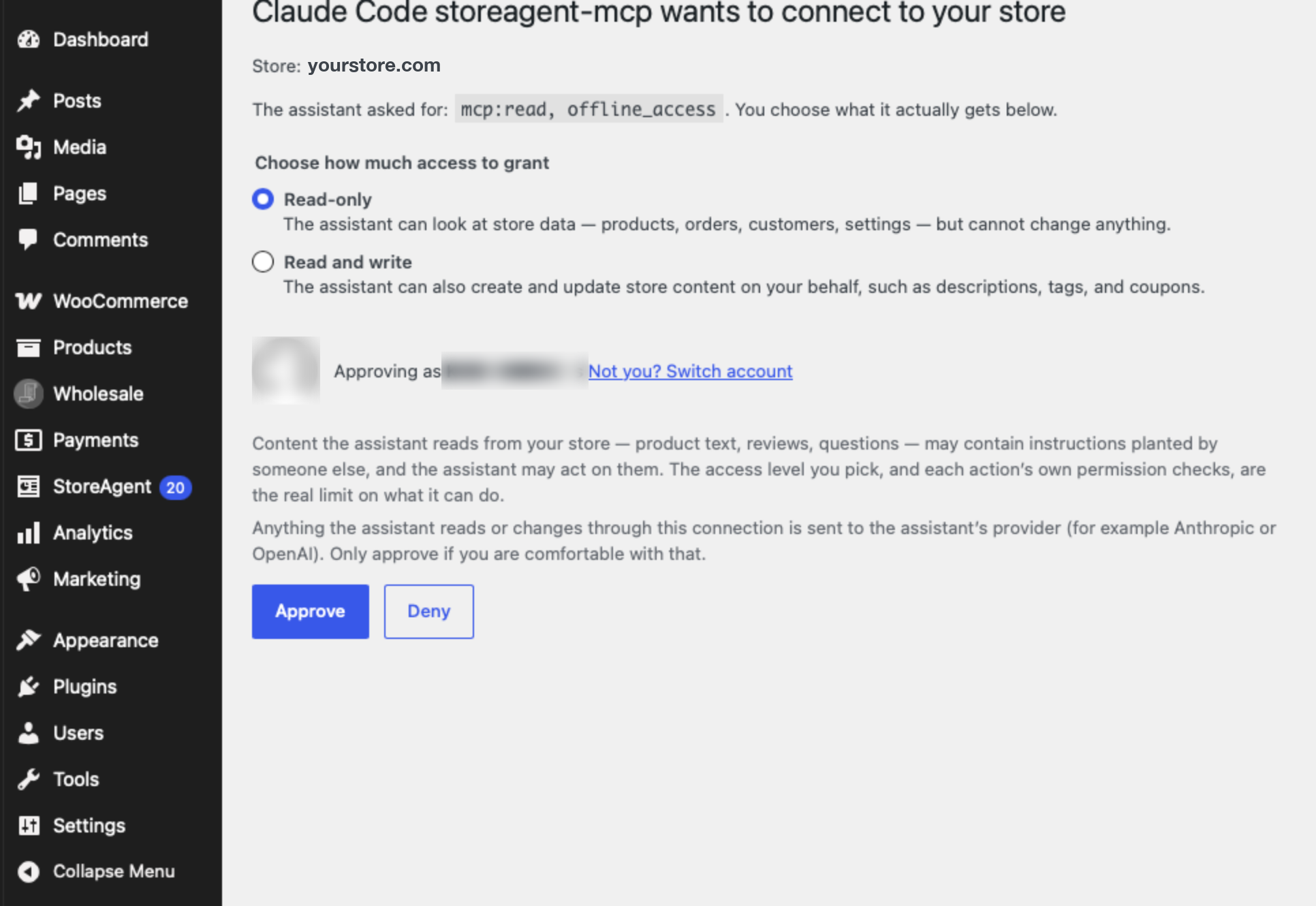
- Sign in to your store as an administrator or shop manager if you are not already.
- Under Choose how much access to grant, pick Read-only or Read and write.
- Choose Approve.
Pick Read-only the first time. You can always connect again with broader access once you have seen what the assistant does. Choose Deny if you did not start this request.
One thing to keep in mind as you choose. Your assistant reads real content from your store, including product descriptions, reviews and notes, and any of that text can contain instructions someone else wrote. Treat an instruction that arrives through your store content as untrusted, the same way you would treat an email from a stranger. This matters most with Read and write, where a planted instruction could ask the assistant to change something. StoreAgent shows the same warning on the MCP screen.
If the approval page says MCP is switched off
If MCP is switched off when your assistant starts the connection, the approval page shows the notice MCP is switched off for this store. and an Enable MCP and continue button. The access choices are not shown yet.
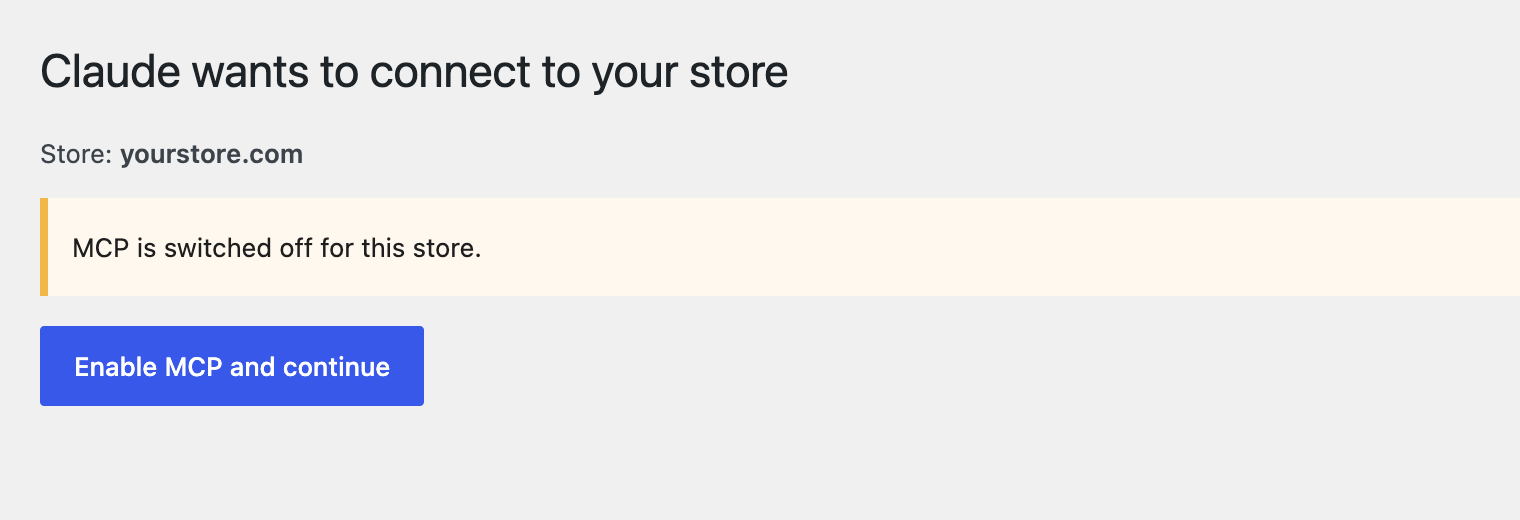
- Choose Enable MCP and continue.
- On the approval page that opens again, choose Read-only or Read and write, then choose Approve.
The button turns MCP on for your store, the same as switching on Enable MCP for this store on the General sub-tab. It does not approve anything. The page reloads with the usual approval choices, and nothing is approved until you choose Approve.
Only an administrator or shop manager can open this page and use the button. After you choose the button, if more than 5 minutes have passed since your assistant started the connection, the page shows MCP is on now. Go back to your assistant and start the connection again. MCP stays on, so start the connection again from Claude or ChatGPT. If your store is not connected to a StoreAgent account, the page asks you to connect your store first and does not show the button.
Check the connection
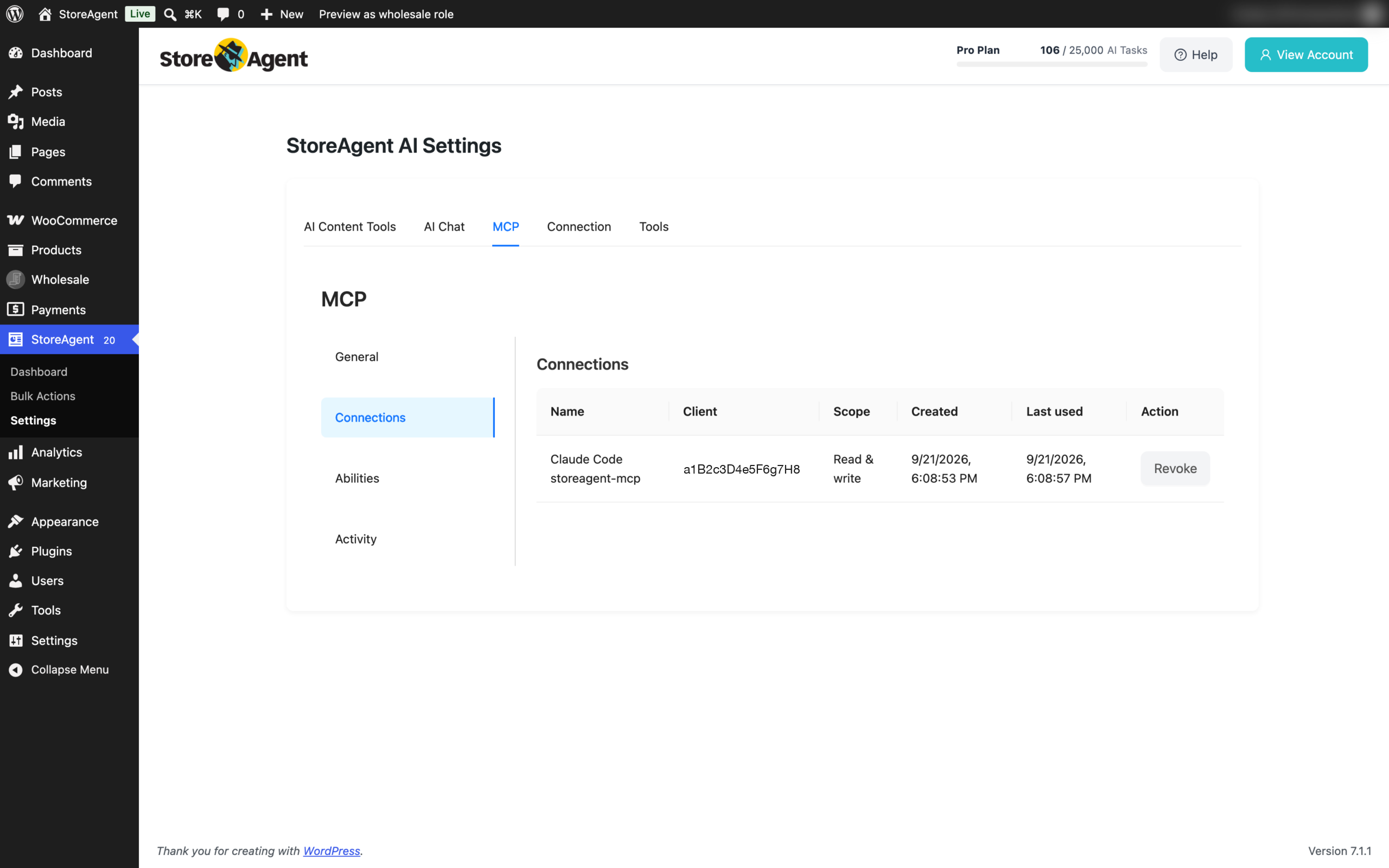
Open the Connections sub-tab to see what is connected. Each row shows Name, Client, Scope, Created, Last used, and Action. Scope reads Read only or Read & write, matching what you approved.
To cut off an assistant’s access, choose Revoke on its row. If nothing is listed yet, you see No connections yet, which means the approval has not gone through.
Connected? Give it a real job next. The MCP Recipes directory has copy-paste prompts for common store tasks, and each one shows whether it only reads or also makes changes.
What your assistant is allowed to do
Two controls decide this, and the one you already used matters most.
The access level you picked on the approval page is the main gate. A connection approved as Read-only can look at store data and nothing more. A connection approved as Read and write can also let StoreAgent create and update content, such as product descriptions, tags and coupons. The Scope column on the Connections sub-tab shows which one is in force, and the way to change it is to revoke the connection and approve it again.
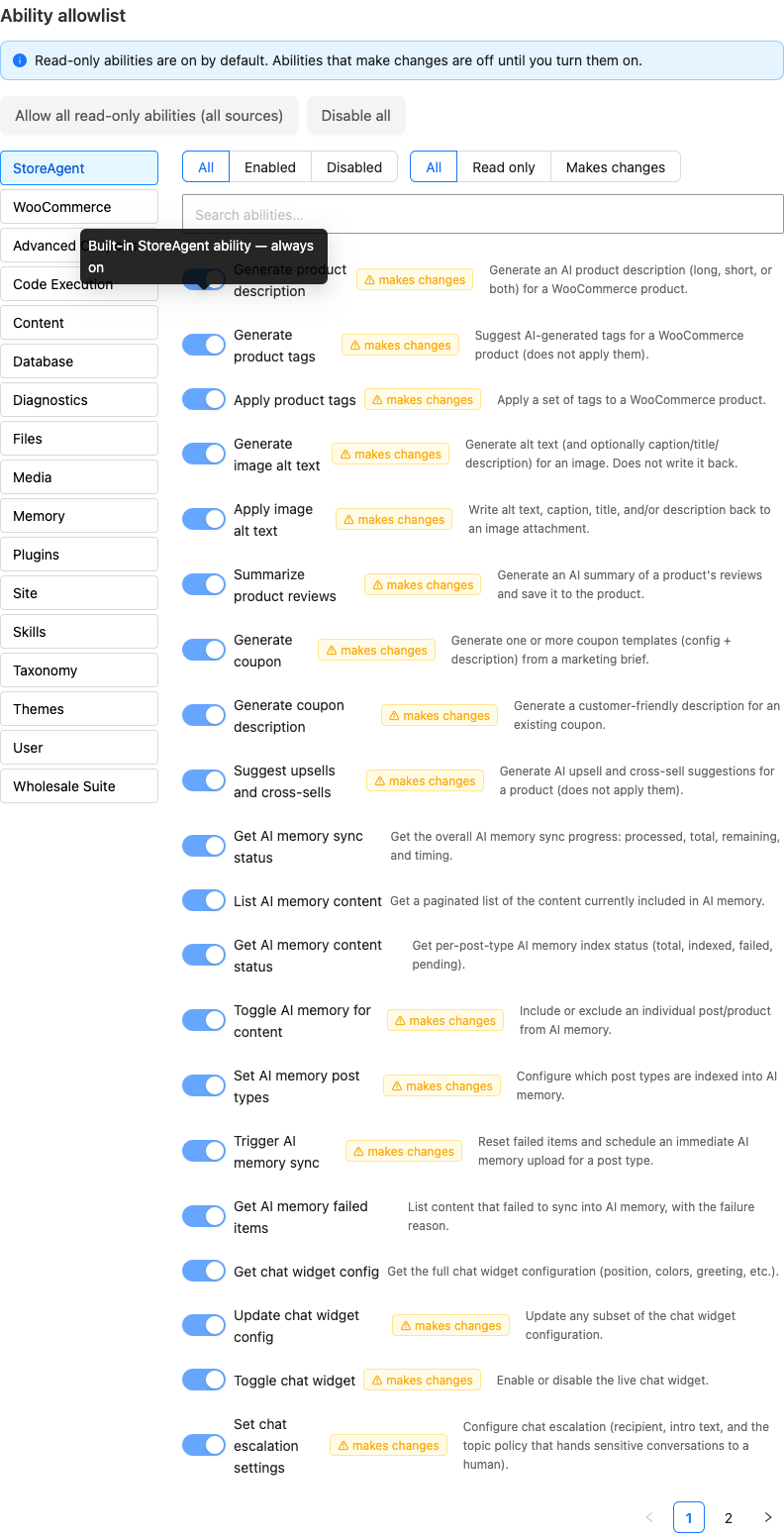
The Abilities sub-tab is the second control, and it covers abilities that come from somewhere other than StoreAgent. The panel is called Ability allowlist and it groups abilities by source, such as StoreAgent, WooCommerce, StoreAgent – WooCommerce data, Site and User. Each group filters by Enabled or Disabled, and by Read only or Makes changes. Read-only abilities from these sources are switched on by default, so an assistant can look things up straight away. An ability that makes changes stays off until you switch it on here.
When you open the tab, it starts on the first source with switches you can change. It starts on StoreAgent only when StoreAgent is the only source. A source with more than 20 abilities splits them into pages, with page controls below the list.
The notice at the top of that panel describes those sources. StoreAgent’s own abilities work differently. Each one shows a switch that is always on and that you cannot change. Hover over the switch, or move to it with your keyboard, to see a tooltip that says it is a built-in StoreAgent ability and is always on. The access level you approved governs these abilities. If you want to stop StoreAgent making changes, revoke the connection and approve it again as Read-only.
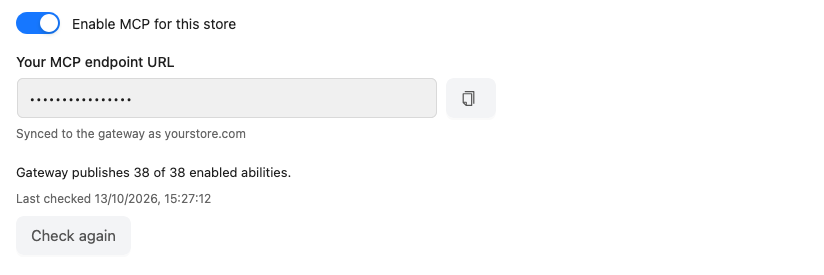
Each time you save a change on the MCP screen, such as switching an ability on or off, StoreAgent checks what the gateway offers your assistant. The gateway is the StoreAgent service that connects your assistant to your store. To see the result, open the General sub-tab and look below Your MCP endpoint URL. A line such as Gateway publishes 5 of 5 enabled abilities shows the count, with a Last checked time below it. Choose Check again to run the check again.
The count covers abilities from other sources only, because StoreAgent’s own abilities are always on. If your store has no abilities from other sources switched on, the count line does not show. Read-only abilities from other sources are on by default, so most stores see it. If the numbers do not match, a warning lists the abilities involved. See the troubleshooting entry about stale or missing abilities below.
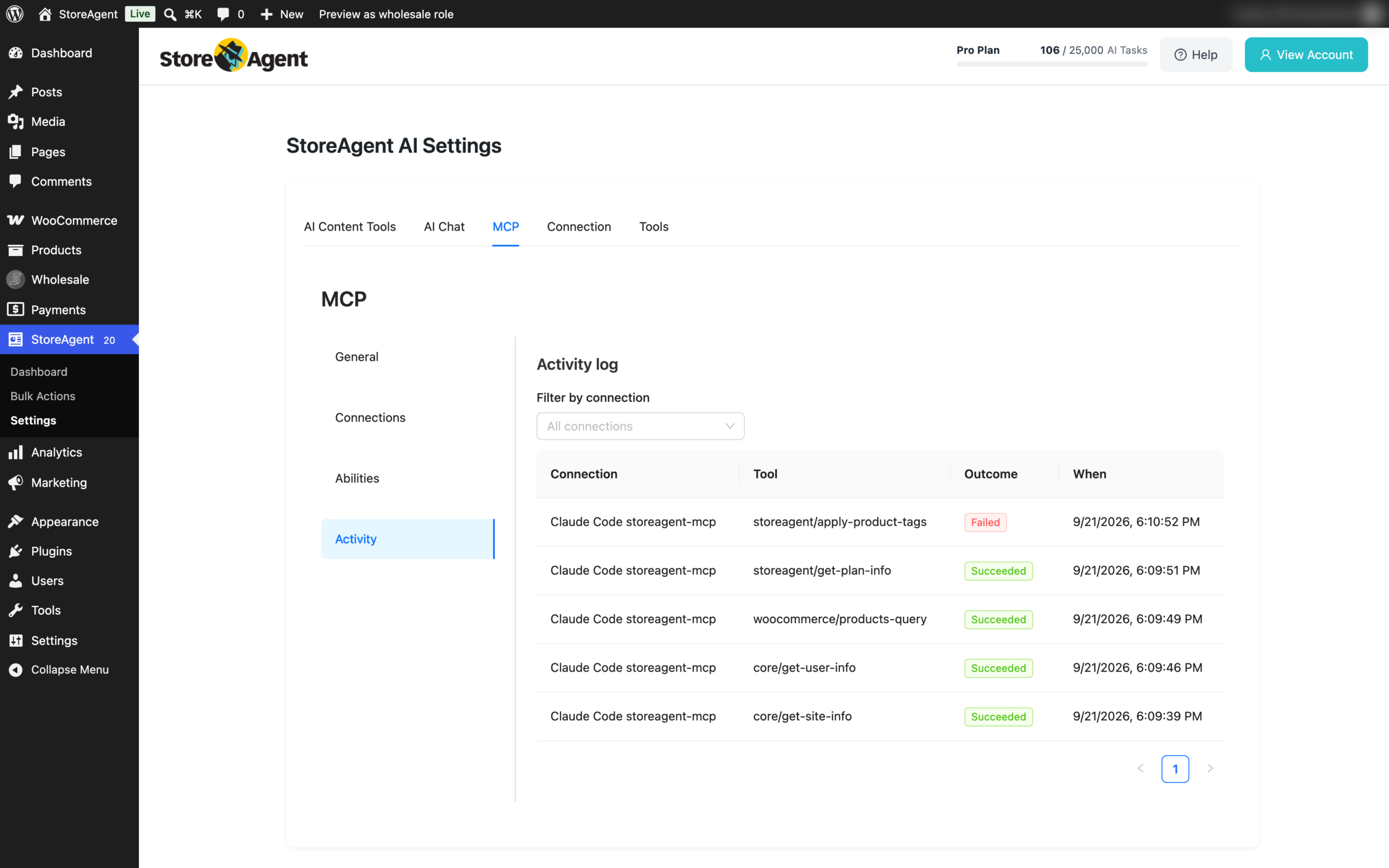
The Activity sub-tab records what a connected assistant actually did, and keeps 30 days of history. Each row shows the connection, the tool it called, whether the call succeeded, and when. It is worth a look after the first few days.
What StoreAgent’s abilities can do
Abilities are the actions StoreAgent lets a connected assistant take in your store. StoreAgent adds 30 of its own, in five areas. It adds 57 more for your WooCommerce data, covered in the next section. The Read only abilities show up for every connection. The ones marked Makes changes only show up when you approved the connection as Read and write.
| Area | Ability | Type |
|---|---|---|
| Product content | Generate product description | Makes changes |
| Product content | Generate product tags | Makes changes |
| Product content | Apply product tags | Makes changes |
| Product content | Generate image alt text | Makes changes |
| Product content | Apply image alt text | Makes changes |
| Product content | Summarize product reviews | Makes changes |
| Product content | Generate coupon | Makes changes |
| Product content | Generate coupon description | Makes changes |
| Product content | Suggest upsells and cross-sells | Makes changes |
| AI Memory | Get AI memory sync status | Read only |
| AI Memory | List AI memory content | Read only |
| AI Memory | Get AI memory content status | Read only |
| AI Memory | Toggle AI memory for content | Makes changes |
| AI Memory | Set AI memory post types | Makes changes |
| AI Memory | Trigger AI memory sync | Makes changes |
| AI Memory | Get AI memory failed items | Read only |
| AI Chat | Get chat widget config | Read only |
| AI Chat | Update chat widget config | Makes changes |
| AI Chat | Toggle chat widget | Makes changes |
| AI Chat | Set chat escalation settings | Makes changes |
| AI Chat | List chat conversations | Read only |
| AI Chat | Get chat conversation | Read only |
| AI Chat | Get chat feedback summary | Read only |
| AI Chat | Export chat conversations | Makes changes |
| Notifications | Get notifications | Read only |
| Notifications | Get notification detail | Read only |
| Notifications | Dismiss notification | Makes changes |
| Notifications | Act on notification | Makes changes |
| Account | Get usage summary | Read only |
| Account | Get plan info | Read only |
Generate product tags, Generate image alt text and Suggest upsells and cross-sells only return suggestions. They do not change your products until you apply them. Summarize product reviews is different: it saves the summary to the product.
Each ability your assistant runs uses 1 AI Task from your plan, including abilities from WooCommerce and other sources. The Generate, Summarize and Suggest abilities use the AI Task of their generation instead. Get usage summary and Get plan info use no AI Tasks. When your plan runs out of AI Tasks or AI chat replies, your assistant gets a usage limit error until you upgrade or your monthly plan renews. AI Tasks and AI chat replies on the free plan do not renew. See how StoreAgent calculates your usage.
Export chat conversations is marked Makes changes, but it does not change anything in your store. It is marked that way because it sends chat transcripts out of your store, so it only shows up on a Read and write connection.
Get chat feedback summary counts the thumbs up and thumbs down ratings on your chat conversations. It only covers conversations still in your chat history, which is about the last 30 days.
The Notifications abilities work with the notifications on your StoreAgent dashboard. Dismiss notification archives one. Act on notification accepts or rejects a pending decision. If accepting a decision would run an AI generation, such as writing a short description, your assistant can only reject it. Accept it from the StoreAgent dashboard instead.
Your assistant may show these abilities by their technical names, such as storeagent_generate_product_description.
Who can run them
Every StoreAgent ability needs an administrator or shop manager account, including the Read only ones. Those read abilities still show private store data, such as chat transcripts, AI Memory content, and your plan and usage details.
What the WooCommerce data abilities can do
StoreAgent also gives your assistant 57 abilities for reading and managing your WooCommerce data. They cover customers, coupons, refunds, product variations, categories, tags, attributes, reviews, store settings, reports, webhooks and system tools.
On the Abilities sub-tab they sit under their own source, StoreAgent – WooCommerce data. Unlike the built-in StoreAgent abilities, each one has a switch you can change:
- 28 Read only abilities are on by default.
- 29 abilities that make changes are off until you switch them on.
- Some rows carry tags: ⚠ makes changes, Destructive, Moves money and Personal data. Every ability that deletes something is tagged Destructive.
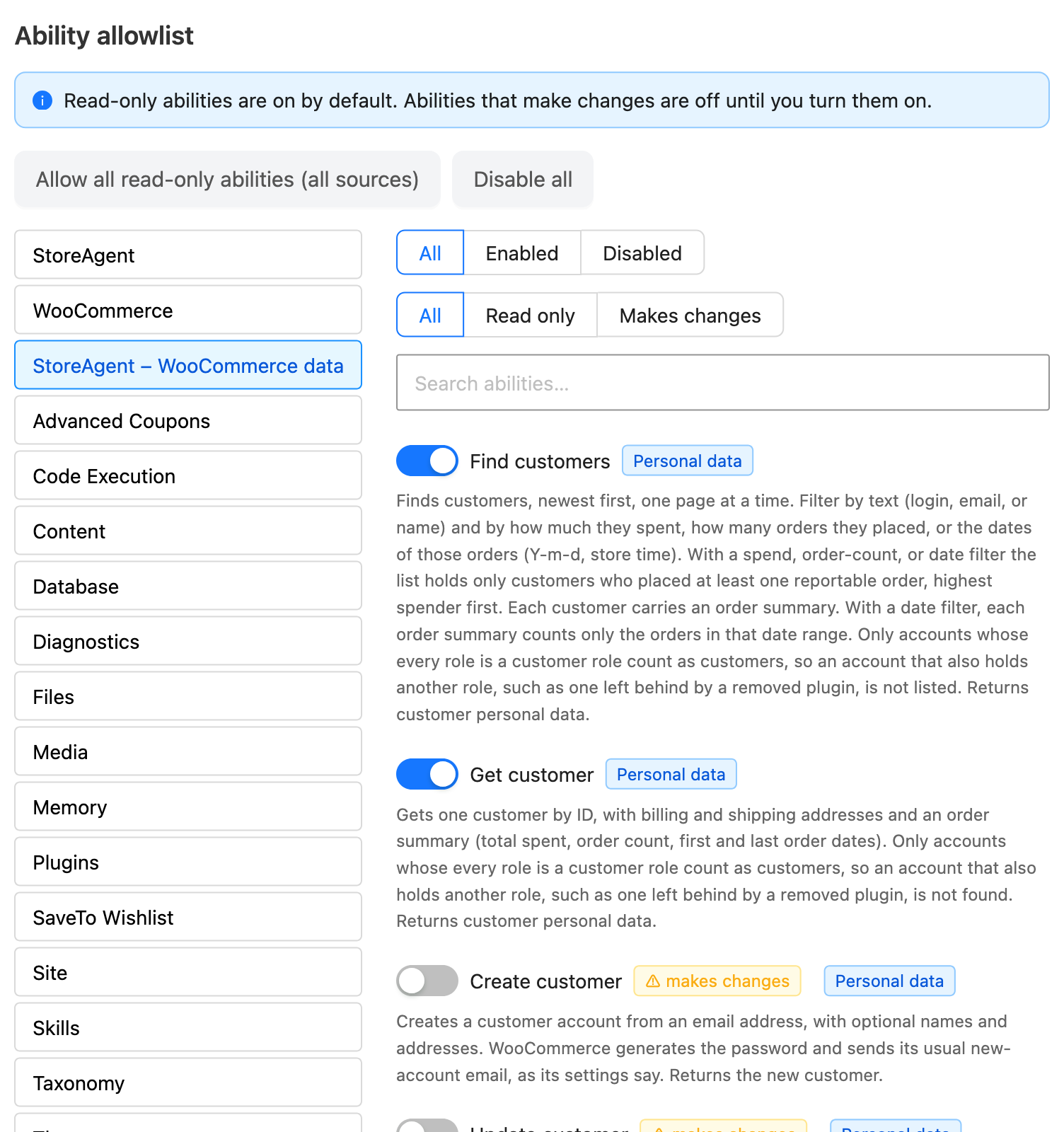
Because read-only abilities are on by default, an assistant with a Read-only connection can already read customers, order history, reviews and store settings. Switch off any ability you do not want your assistant to use. Abilities tagged Personal data can return details such as customer names, addresses and email addresses.
To let your assistant make changes with these abilities, two things must be true. The connection must be approved as Read and write, and you must switch the ability on. A Read-only connection never gets the abilities that make changes, even when their switch is on.
| Area | Read only | Makes changes |
|---|---|---|
| Customers | Find customers, Get customer | Create customer, Update customer, Delete customer |
| Coupons | Find coupons, Get coupon | Create coupon, Update coupon, Delete coupon |
| Orders | List order refunds, Get order history | Issue a refund |
| Product variations | List product variations, Get product variation | Create product variation, Update product variation, Delete product variation |
| Categories and tags | List product categories, List product tags | Save product category, Save product tag, Delete product category, Delete product tag |
| Product attributes | List product attributes | Save product attribute, Delete product attribute, Save attribute term, Delete attribute term |
| Product reviews | Find product reviews, Get product review | Moderate product review, Reply to product review |
| Store settings | Get shipping setup, List tax rates, List payment gateways, Get payment gateway, Get store settings | Update shipping zone, Save shipping class, Save tax rate, Save tax class, Turn payment gateway on or off, Update store settings |
| Reports | Sales report, Top sellers report, Order totals report, Customer totals report, Stock report, Coupon usage report | None |
| Webhooks | List webhooks, Get webhook | Save webhook, Delete webhook |
| System tools | Get system status, List maintenance tools | Run maintenance tool |
Every one of these abilities needs an administrator or shop manager account. Each call uses 1 AI Task from your plan.
Choose how refunds are paid
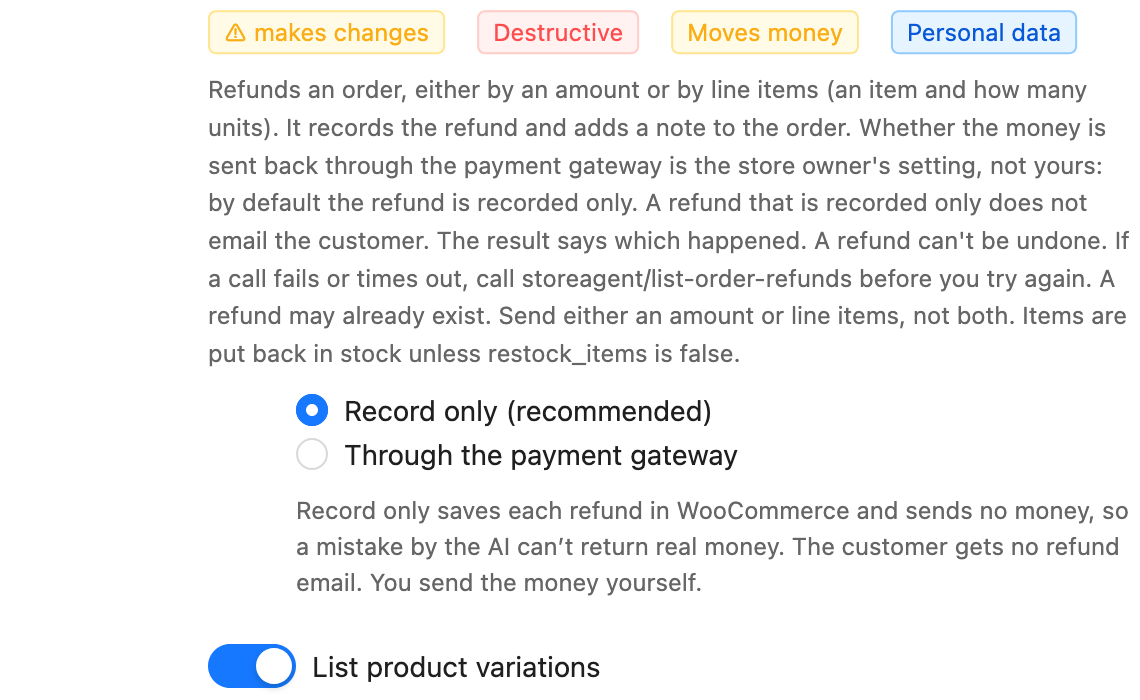
Issue a refund is tagged ⚠ makes changes, Destructive, Moves money and Personal data. Under it you choose how a refund is paid:
- Record only (recommended) is the default. StoreAgent saves the refund in WooCommerce, sends no money and sends no refund email. You send the money yourself.
- Through the payment gateway sends the money back to the customer at once, and it cannot be undone. This applies only to orders paid with a gateway you choose below the option, and only while that gateway is turned on in WooCommerce. Every other refund is recorded only.
If no enabled payment gateway supports refunds, the page says No enabled payment gateway supports refunds, so refunds stay record only.
Choose which version of an ability your assistant sees
WooCommerce adds abilities of its own over time. When a WooCommerce ability does the same job as a StoreAgent ability, an assistant that sees both has two tools for one task. StoreAgent calls this a same-job pair, and lets you pick which side your assistant sees. StoreAgent knows three pairs, all for coupons: Find coupons, Create coupon and Update coupon. A pair only appears when your store has both abilities, so you see none until your WooCommerce version adds its own coupon abilities.
Choose the WooCommerce or StoreAgent version of an ability
- Go to StoreAgent > Settings > MCP > Abilities.
- Choose the StoreAgent – WooCommerce data source. A button that shows a count such as 3 overlaps tells you the source holds a pair.
- On the StoreAgent row, for example Find coupons, find Expose to AI assistants:.
- Choose StoreAgent, WooCommerce or Both. The choice saves right away.
Each pair shows both ability names under the row, for example StoreAgent storeagent/find-coupons and WooCommerce woocommerce/coupons-query, so you can see which two the choice covers. The rows carry the tags Same job as WooCommerce and Same job as StoreAgent.
- StoreAgent is the default. Your assistant sees the StoreAgent ability and the WooCommerce one is hidden.
- WooCommerce shows the WooCommerce ability and hides the StoreAgent one.
- Both shows both. A warning reads Both abilities are exposed. AI assistants may pick either one for the same job.
A hidden ability is not listed for your assistant and cannot be called. Its row stays on the list with a note. On the WooCommerce row, the note reads Hidden from AI assistants. You chose the StoreAgent version. followed by the name of the StoreAgent row that holds the choice. On the StoreAgent row, it reads Hidden from AI assistants. You chose the WooCommerce version. The WooCommerce row has no choice of its own, so change the choice on the StoreAgent row.
The choice only decides which side is visible. It does not turn abilities on. A WooCommerce ability that makes changes, such as creating a coupon, stays off until you switch it on, even after you choose WooCommerce. If neither side is switched on, the row shows AI assistants see neither version right now. Turn on the version you chose, or choose the other one.
If you already switched on the WooCommerce side of a pair, the pair starts on Both instead of StoreAgent, so StoreAgent does not turn off something you turned on.
The notice about matching WooCommerce abilities
When your store gets a pair you have not seen before, a notice appears in your WordPress admin. It reads A WooCommerce update added abilities that do the same job as these StoreAgent abilities, then lists the StoreAgent abilities by name. It adds that AI assistants see only the StoreAgent version by default, unless you already turned on the WooCommerce one. Then they see both.
- Choose Review abilities to open StoreAgent > Settings > MCP > Abilities on the source that holds the first pair.
- Close the notice with its dismiss button once you have decided. It stays away for the pairs it named, and returns only when a new pair appears.
Only administrators see the notice, and only while your store is connected to a StoreAgent account and MCP is switched on.
Troubleshooting
The MCP tab only shows a connect prompt
Connect your StoreAgent account first. MCP is gated on it, and the tab calls no MCP endpoint until the account is connected.
The approval page says only a store manager can approve
Sign in as an administrator or shop manager, then open the approval link again. A customer or subscriber account cannot approve a connection.
The approval page says this request is for a different store
Start the connection again and enter your own store’s domain. This message means the domain you entered, or an older store-specific address saved in your connector, belongs to another site. If your connector still uses an address that ends with a domain, remove it in Claude or ChatGPT and add it again with https://api.storeagent.ai/mcp.
StoreAgent says your store is not connected
After you enter your domain, StoreAgent shows Set up StoreAgent on followed by your domain when it cannot find a StoreAgent account connected to that store.
- Check the domain in the page title. It must match your store’s address exactly, including
wwwif your address has it. To enter a different domain, click Use a different store. - If StoreAgent is not installed on the store, click Install on followed by your domain. If it is installed, click Open the StoreAgent dashboard to connect and connect your StoreAgent account.
- Keep the StoreAgent page open, then click Check again.
If Check again does not continue, start the connection again from Claude or ChatGPT.
StoreAgent says your store needs an update
StoreAgent shows Your store needs an update when your store is connected but StoreAgent cannot open its approval page. An old plugin version or a firewall is the usual cause.
- Update StoreAgent on your store to version 1.1.9 or later. The Open Plugins on button opens your store’s Plugins page.
- If you use a firewall or Cloudflare, add the allow rule from “A firewall or security plugin blocks the connection” below.
- Click Check again on the StoreAgent page.
If the page still shows, work through the checks in the approval surface entry below.
The Connect your store page shows an error
Check the address in Store domain, then click Continue again. Enter your store’s domain, such as mystore.com. A full address such as https://mystore.com/shop/ also works. If the error says there are too many requests, wait a few minutes and try again.
The approval page says MCP is switched off for this store
Choose Enable MCP and continue on the approval page, then approve the connection as usual. You can also switch on Enable MCP for this store under StoreAgent > Settings > MCP > General and start the connection again from your assistant.
The assistant connected but cannot see anything in my store
Check that the connector is switched on for the chat you are in. In Claude, click the + button at the lower left of the chat, choose Connectors, and switch it on. In ChatGPT, start a new chat, type @, and select the plugin. A connector that is approved but not enabled in the conversation does nothing.
The connection fails with a store unreachable error
Check that your store is online and reachable from the public internet. This error means StoreAgent could not reach your store, or your store answered with a server error. An IP allowlist or a firewall that blocks outside visitors is the usual cause. If your store is publicly reachable and it still fails, the problem is between StoreAgent and your store rather than in your settings, so open a support ticket.
If your firewall or security plugin drops connections from bots it does not recognize, it can block StoreAgent too. See “A firewall or security plugin blocks the connection” below.
The connection fails with “The store’s approval surface is not available”
Work through these checks, then try to connect again:
- Go to Settings > Permalinks, choose any option except Plain, and click Save Changes.
- Make sure StoreAgent is active on the store.
- Check that no security plugin or hosting rule blocks the WordPress REST API (addresses that start with
/wp-json/). - If you use Cloudflare, another firewall with bot protection, or a coming soon or maintenance plugin, let requests to
/wp-json/storeagent/v1/mcp/approvethrough. See “A firewall or security plugin blocks the connection” below for the User-Agent to allow. - Remove password protection from the site. A staging site behind a password always fails this check.
- Make sure your store’s address does not redirect to a different domain.
Before the approval page opens, StoreAgent checks your store at /wp-json/storeagent/v1/mcp/approve. You see this error, with the code approval_surface_unavailable, when that check gets a “not found” reply, a login or security page, or a redirect instead of StoreAgent’s answer.
If your store passes all of these and it still fails, open a support ticket.
A firewall or security plugin blocks the connection
Some host firewalls, Cloudflare rules and security plugins block requests from bots they don’t recognize. If yours does, add an allow rule for StoreAgent.
Every request StoreAgent sends to your store carries a User-Agent (the name a visitor sends to say who it is) that starts with StoreAgent-Gateway/. The full value looks like this:
StoreAgent-Gateway/1.2.1 (+https://storeagent.ai/kb/how-to-connect-chatgpt-or-claude-to-your-store-with-mcp/)The number after the slash is the version of the StoreAgent gateway, not your plugin version. It changes when the gateway updates. Match on values that start with StoreAgent-Gateway/, not on the full value, so the rule keeps working after an update.
Keep the rule narrow:
- Allow it only for requests to addresses that start with
/wp-json/storeagent/v1/mcp/. - Skip only the rule that blocked StoreAgent, usually a rule against missing or unknown User-Agents.
- Don’t allow this User-Agent across your whole site.
If you use Cloudflare’s free Bot Fight Mode, an allow rule does not help, because Cloudflare does not let custom rules skip it. Turn Bot Fight Mode off, or use Super Bot Fight Mode on a paid plan and add a skip rule for these addresses.
A User-Agent only says who a request claims to be, and anyone can copy it. That’s why the rule should stay on the MCP addresses. Those addresses stay protected without your firewall. Your store only runs a request to /mcp/list or /mcp/call when it carries a valid signature made with your store’s own secret. The /mcp/approve address only sends visitors on to the approval page, and only a logged-in store manager can approve a connection there.
The assistant reports stale or missing abilities
Open the General sub-tab and read the messages below Your MCP endpoint URL. Changes can take up to a minute to reach the gateway, so wait a minute, then choose Check again.
- If a warning still lists abilities the gateway is not publishing, or abilities you turned off, switch one ability off and on again on the Abilities sub-tab. This sends your settings to the gateway again.
- If a warning says the gateway last synced under a different host than the address under Your MCP endpoint URL uses, reconnect your StoreAgent account.
- If MCP is off but a warning says assistants may still reach your store, turn MCP on and off again to send your settings.
The Check again button only checks abilities from other sources. StoreAgent’s own abilities are always on.
The Abilities tab warns that too many read-only abilities are registered
Switch off the read-only abilities you do not need. Use Disable all, or switch abilities off one at a time, on the Abilities sub-tab. The warning goes away once the number of enabled abilities fits.
The warning reads More read-only abilities are registered than can be advertised to the assistant at once. All of them still work when called directly, but some may not appear in its tool list. Your store can advertise at most 200 enabled abilities to the gateway at once. When more are on, the extra ones may be missing from your assistant’s tool list, even though they still work when the assistant calls them by name.
The warning shows at the top of the Abilities sub-tab. It also shows on the General sub-tab, below Your MCP endpoint URL, while MCP is on.
The assistant cannot generate descriptions, tags or coupons
Choose Revoke on the assistant’s row on the Connections sub-tab, then approve the connection again as Read and write. A connection approved as Read-only only sees the Read only abilities, so the Generate abilities never appear in your assistant’s list.
The assistant says the plan’s usage limit has been reached
Check your AI Tasks and AI chat replies usage under My Account > Plan Details in your StoreAgent account. This error means your plan has used all of its AI Tasks or all of its AI chat replies, so StoreAgent refuses each ability that uses AI Tasks. Upgrade your plan to continue right away, or wait for your monthly plan to renew. AI Tasks and AI chat replies on the free plan do not renew, so upgrade to keep using these abilities. Get usage summary and Get plan info still work, so your assistant can show your usage. See how StoreAgent calculates your usage.
Frequently asked questions
Does MCP cost extra?
No. MCP is included on every StoreAgent plan, including the free one. Each ability your assistant runs uses AI Tasks from your plan.
Do I need a different address for each store?
No. Every store uses https://api.storeagent.ai/mcp. StoreAgent asks for your store domain when you connect.
Can I connect both Claude and ChatGPT?
Yes. Each one is its own connector and its own row on the Connections sub-tab, so you can approve them separately and revoke either on its own.
Can the assistant change my store without asking?
Only if you let it. A Read-only connection cannot change anything. With Read and write, StoreAgent’s own abilities that make changes are available straight away. Abilities from WooCommerce, StoreAgent – WooCommerce data and other sources that make changes stay off until you switch them on in the Ability allowlist.
How do I stop an assistant from having access?
Choose Revoke on its row on the Connections sub-tab. That ends its access immediately.
Can I use a free Claude or ChatGPT plan?
Claude Free works, but it allows only one custom connector. For ChatGPT, you need one of the paid plans listed under What you need. Anthropic and OpenAI decide which plans can add custom connectors, not StoreAgent.
Can I turn off StoreAgent’s abilities?
Yes, but it takes a small code change, so ask your developer. Setting the SAAI_DISABLE_ABILITIES constant to true, or returning true from the saai_disable_abilities filter, stops StoreAgent from registering any of its abilities. A connected assistant then has none of StoreAgent’s abilities to use.
What if WooCommerce and StoreAgent both have an ability for the same job?
Your assistant sees only the StoreAgent version by default. Change this with Expose to AI assistants: on the Abilities sub-tab.
Need help?
If you have a question or run into any issues, we’re here to help.
- Premium users: Open a support ticket
- Free users: Visit our community forum

