

 Reviewed by
If you’re weighing StoreAgent vs Clerk.io for your WooCommerce store, the two look almost interchangeable on a feature list. Both bring AI to WooCommerce. Both promise smarter customer interactions. But once you actually install them, the difference is obvious: they’re built for two completely different kinds of store owner.
StoreAgent is a WooCommerce-native plugin. It pairs an AI chatbot with content generation and store insights, all inside WordPress. Clerk.io is a full commerce platform that spans search, product recommendations, email automation, audience segmentation, and a chatbot across several ecommerce platforms. The overlap is real. The approach, the pricing, and the depth of WooCommerce integration are not.
In this article, we’ll cover how the two compare on features, pricing, and setup, so you can match the right tool to your store instead of paying for capabilities you’ll never switch on. Let’s break it down.
Table Of Contents
Quick Overview: What Each Tool Does
StoreAgent and Clerk.io both add AI to WooCommerce, but they start from opposite ends. StoreAgent is a focused WordPress plugin for chat, content, and insights. Clerk.io is a broad, multi-platform commerce suite. Here’s what each one actually brings to your store.
StoreAgent: WooCommerce-native AI
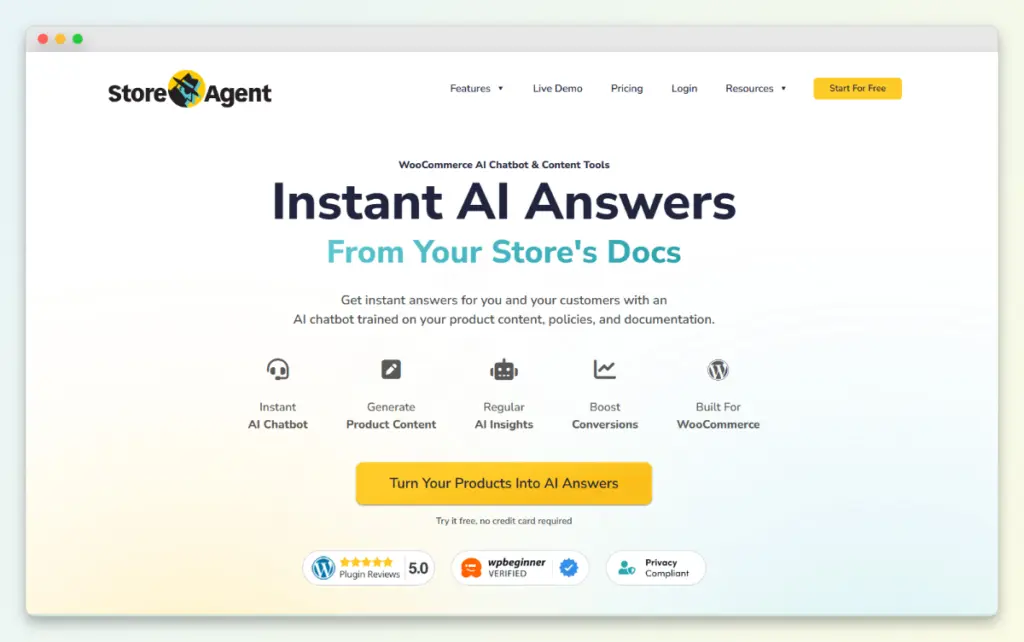
StoreAgent is a WooCommerce AI plugin built only for WooCommerce stores, and it sticks to three jobs:
- AI chatbot trained on your product catalog, answering customer questions with real product data
- Content generation for product descriptions, category descriptions, product tags, and review summaries, straight from WordPress
- Store insights that flag content gaps and product listing fixes in your dashboard
There’s no API key to paste in. You connect a free StoreAgent.ai account when you activate the plugin, and the chatbot starts indexing your catalog within minutes. The free Lite plan gets you started, with paid plans at $19/month (Growth) and $49/month (Pro).
You can see the full feature list here.
Clerk.io: full-platform commerce suite
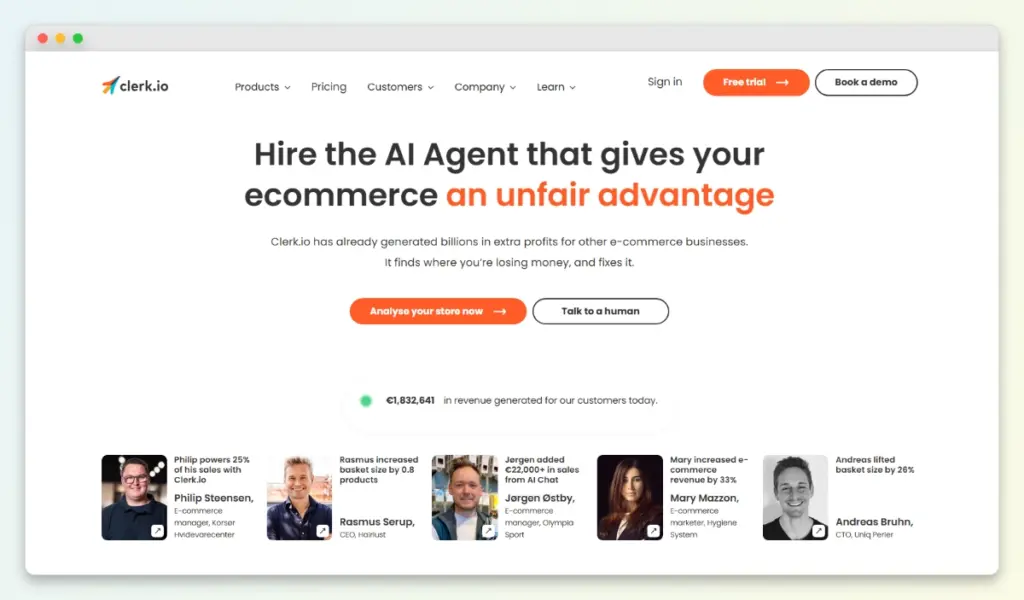
Clerk.io works across WooCommerce, Shopify, Magento, BigCommerce, and custom stores. It covers a much wider spread of commerce features:
- Personalized search with visual results and typo tolerance
- Product recommendations with multiple algorithm types and A/B testing
- Email automation with triggered, personalized product emails
- Audience segmentation for targeted campaigns
- Chatbot, a newer addition to the platform
Setup is heavier. Clerk.io needs API keys and a JavaScript snippet to connect to WooCommerce. Pricing is custom and usage-based, and no per-module price is published.
Feature-by-Feature Comparison
The two tools were built for different jobs, so they win in different places. StoreAgent goes deep on WooCommerce chat and content. Clerk.io goes wide across search, recommendations, and marketing. Here’s how that plays out feature by feature.
AI chatbot
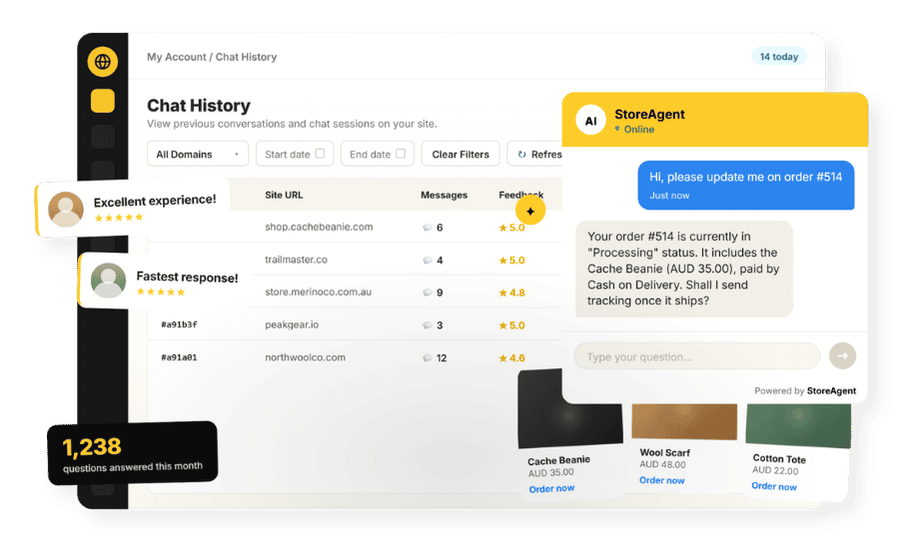
StoreAgent’s WooCommerce chatbot is the heart of the product. It indexes your WooCommerce catalog and uses that data to answer questions, suggest products, and handle support conversations. It reads natural language instead of following pre-built scripts, so it copes with the odd, off-script questions that trip up flow-based bots.
Clerk.io’s chatbot is newer and sits inside its wider suite rather than being the main event. In testing, it felt less tied to WooCommerce product data than StoreAgent’s, which tracks with where Clerk.io puts its focus: search and recommendations.
Product search and recommendations
This is where the two tools take genuinely different routes. Clerk.io leans into discovery with a dedicated search engine: visual results, typo tolerance, synonym handling, and behavioral ranking. Its recommendations cover similar products, trending items, and frequently bought together, with A/B testing built in.
StoreAgent doesn’t ship standalone search or recommendation widgets. Instead, recommendations happen inside the chatbot conversation. A shopper asks, and the AI suggests the right product in reply. It’s conversational discovery rather than browsable blocks. Which model fits depends on whether you want customers searching a results page or asking a question and getting an answer.
Content generation
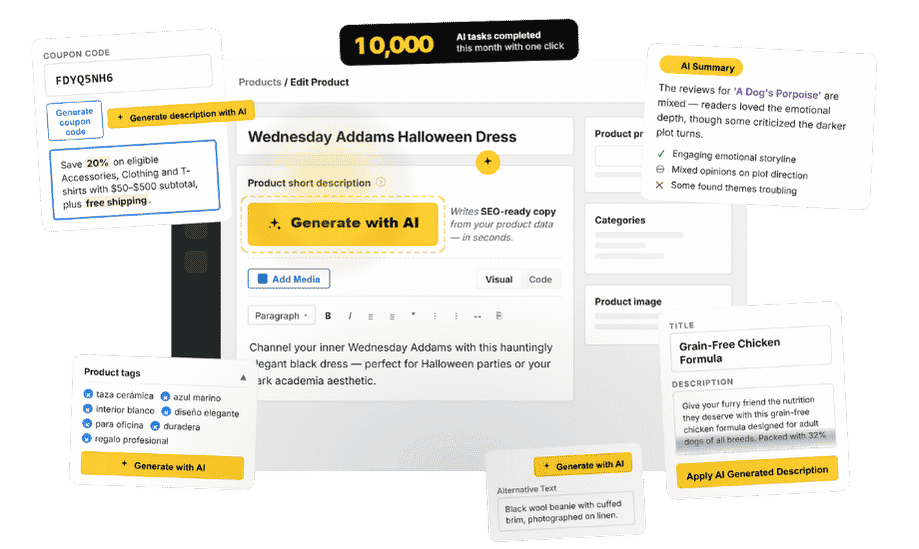
StoreAgent generates product descriptions, category descriptions, product tags, and review summaries with AI, and Clerk.io doesn’t offer content tools at all. This means if you’re sitting on a catalog full of thin or missing copy, StoreAgent handles it right from the WordPress dashboard, no second tool required.
When I ran the content tools on the test store, the descriptions pulled from real product attributes like dimensions, materials, and pricing. I still tidied the tone before publishing, but the facts came straight from live WooCommerce data, not guesswork.
Analytics and insights
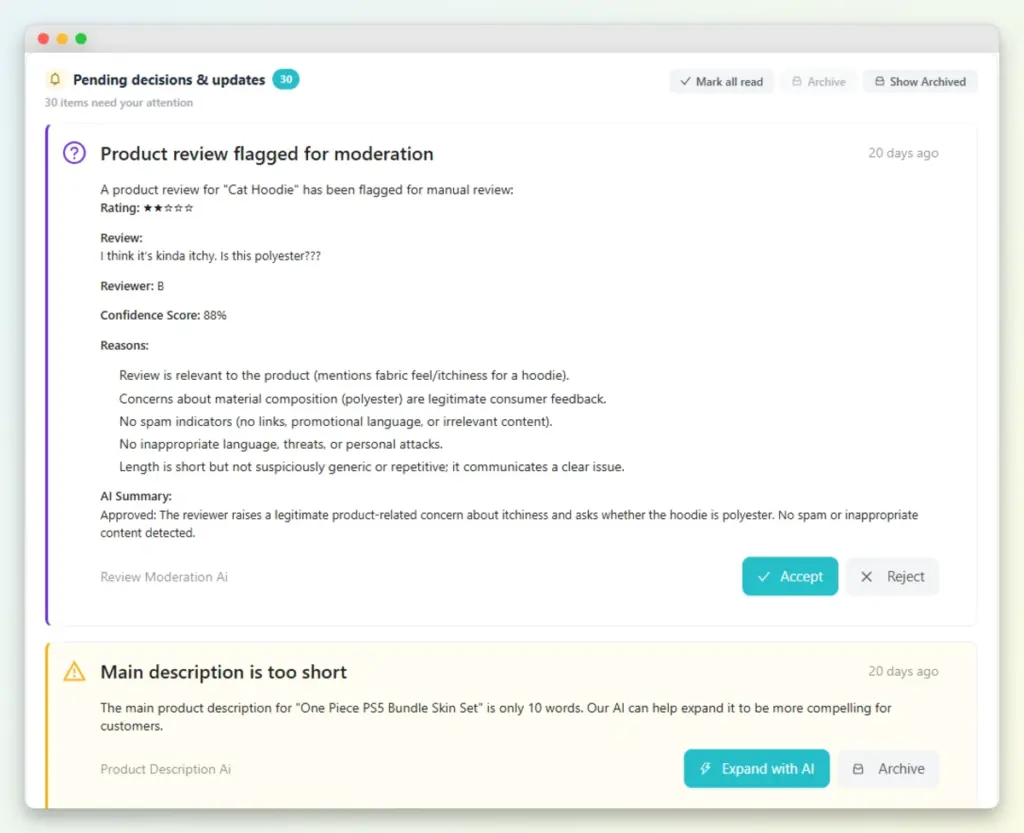
Both tools report, but on different things. StoreAgent’s AI Insights Dashboard surfaces content quality gaps and product listing improvements you can apply in a click, all inside WordPress. Clerk.io’s analytics track its own features: search performance, recommendation click-through, and revenue attribution.
So the question isn’t which one reports more. It’s what you want to act on. Clerk.io tells you how your search and recommendations are performing. StoreAgent tells you which product pages need better copy.
Email and marketing automation
Clerk.io includes email automation with triggered sends, product personalization, and audience segmentation, which is a full marketing layer most chat tools skip. StoreAgent doesn’t do email at all. If campaigns are part of your workflow, you’d run a separate email tool alongside it.
Here’s how the two stack up side by side:
| Feature | StoreAgent | Clerk.io |
|---|---|---|
| AI Chatbot | Core feature, catalog-trained | Available, newer product line |
| Product Search | Not a standalone feature | Core, personalized visual search |
| Product Recommendations | Via chatbot conversations | Core, multiple types + A/B testing |
| Content Generation | Yes (descriptions, categories, tags, reviews) | No |
| Store Insights/Analytics | Yes, content quality focused | Yes, revenue attribution |
| Email Automation | No | Yes, triggered + personalized |
| WooCommerce Integration | Native plugin, reads catalog | Plugin + API keys + JS snippet |
| Free Tier | Yes (Lite plan) | No |
| API Key Required | No | Yes |
| Platforms Supported | WooCommerce only | WooCommerce, Shopify, Magento, BigCommerce, custom |
Pricing Comparison
Pricing is the sharpest split between these two. StoreAgent posts flat monthly tiers right on its site. Clerk.io quotes custom, usage-based pricing you have to ask for. That difference alone tells you a lot about who each tool is built for.
StoreAgent publishes its plans openly:
- Lite (Free): 200 AI tasks and 50 AI chat replies as one-time starter credits, plus 1,000 memory items
- Growth ($19/month): 500 AI tasks, 500 AI chat replies, 5,000 memory items
- Pro ($49/month): 2,500 AI tasks, 5,000 AI chat replies, 25,000 memory items
- Business ($249/month): 10,000 AI tasks, 50,000 AI chat replies, 100,000 memory items
You can see the complete StoreAgent pricing breakdown here.
Clerk.io uses custom, usage-based pricing. Each module (Search, Recommendations, Email, Audience, Chat) is priced separately, and the final number scales with API calls, catalog size, customer count, and email volume. The pricing page offers a usage calculator rather than published prices, so you won’t get a firm figure without talking to sales.
That gap adds up fast. StoreAgent’s Pro plan is $49/month flat with chat, content, and insights included. A comparable Clerk.io setup with search, recommendations, and chatbot could easily pass $350/month before you even add email or audience features.
| Pricing Aspect | StoreAgent | Clerk.io |
|---|---|---|
| Starting Price | Free (Lite) | Custom quote per module |
| Pricing Model | Flat monthly tiers | Usage-based, custom quotes |
| Free Trial | Free tier (ongoing) | Free trial and demo available |
| Pricing Transparency | Published on website | Requires sales contact |
What We’ve Seen: Stores with under 1,000 products rarely need Clerk.io’s full platform. We’ve watched store owners sign up for the multi-module pricing, then realize a few months in that they mostly use search and recommendations, while their chat and content needs could’ve been covered by a simpler, cheaper tool. For a focused WooCommerce store, that’s a lot of budget sitting idle.
Setup and WooCommerce Integration
Setup is where the two tools feel most different. StoreAgent is a few clicks inside WordPress. Clerk.io is a multi-step configuration across keys, snippets, and dashboards. Here’s what each one took on the test store.
StoreAgent: I installed the plugin from the WooCommerce-friendly WordPress plugin directory, activated it, and connected a free StoreAgent.ai account when it prompted me. Within minutes the chatbot was indexing the catalog and answering product questions with real data. No API keys, no JavaScript snippet to drop in. The AI tools all live in the WordPress dashboard.
Clerk.io: This took longer. I installed the Clerk.io plugin, copied API keys over from the Clerk.io dashboard, then added the JavaScript tracking snippet to the storefront. After that, I set up each module (search, recommendations) one at a time, mapping data fields and building design templates. The initial setup ran well past what StoreAgent needed.
Neither approach is wrong. Clerk.io’s extra steps buy you granular control over every feature, which suits a store that wants to fine-tune each piece. StoreAgent trades that control for speed, so if you’d rather have AI working today without touching code, it’s the simpler path. Both sync your catalog automatically once setup is done.
When to Choose StoreAgent vs Clerk.io
The StoreAgent vs Clerk.io decision comes down to scope. If you want depth on WooCommerce chat and content, that points one way. If you want breadth across search, recommendations, and marketing on multiple platforms, that points the other. Here’s the quick read.
Choose StoreAgent if:
- Your store runs on WooCommerce
- An AI chatbot that knows your product catalog is a top priority
- You want AI content generation for product descriptions, category pages, tags, or review summaries
- You’d rather pay a flat monthly rate than stack module costs
- You want tools that live inside WordPress, with no external dashboard to learn
Choose Clerk.io if:
- You run stores on more than one platform, not just WooCommerce
- Advanced personalized product search is a priority
- You need recommendation widgets with A/B testing across your store pages
- Email automation with product personalization is part of your marketing
- You have the budget for a multi-module commerce platform
For more WooCommerce AI comparisons, take a look at our StoreAgent vs Tidio comparison and our roundup of free AI tools for WooCommerce.
Which WooCommerce AI Tool Should You Choose?
StoreAgent and Clerk.io solve different problems, so the right pick depends on what you need most. Clerk.io is a broad commerce platform spanning search, recommendations, email, and segmentation across several ecommerce platforms. StoreAgent is a focused WooCommerce tool that does AI chat, content generation, and product insights deeply inside WordPress. It also includes a free WooCommerce AI MCP server, so you can connect Claude or ChatGPT and handle store tasks from there.
If what you want is a chatbot that knows your products, content tools that pull from real catalog data, and pricing you can read without a sales call, StoreAgent fits that brief. It does fewer things than Clerk.io. It just does them with tighter WooCommerce integration and a far simpler setup.
And the demand for AI chat keeps climbing. According to DemandSage, 34% of customers prefer talking to a customer agent through a chatbot over the phone or live interaction. The question isn’t whether your store needs AI. It’s which tool delivers it in the way that fits how you work.
Here’s a quick recap of what we covered:
- Quick overview: the core difference in how each tool approaches WooCommerce
- Feature comparison: where each tool goes deep and where it goes wide
- Pricing comparison: StoreAgent’s flat tiers against Clerk.io’s custom per-module quotes
- When to choose each: matching the tool to your store’s priorities
If you’re ready to settle the StoreAgent vs Clerk.io question for your own store, start with StoreAgent’s free Lite plan and see how WooCommerce-native AI feels in practice. No credit card, no API key, no sales call required.
Frequently Asked Questions
Can I use StoreAgent and Clerk.io together on WooCommerce?
Yes, technically. They don’t clash as WordPress plugins, and some stores run Clerk.io for search and recommendations while using StoreAgent for chat and content. Running both adds cost and complexity, though. Most stores find one tool covers what they actually need.
Does Clerk.io have a free plan for WooCommerce?
No. Clerk.io uses custom, usage-based pricing (quote required), with a free trial and demo available but no ongoing free tier. StoreAgent has a free Lite plan you can use with no time limit, including one-time starter credits of 200 AI tasks and 50 AI chat replies.
Which tool is better for a small WooCommerce store with under 500 products?
For a small store, StoreAgent is the easier starting point. The free Lite plan lets you test the chatbot and content tools with no commitment, Growth starts at $19/month, and Pro at $49/month covers what most small catalogs need. Clerk.io’s usage-based, multi-module pricing is built for larger operations.
Does StoreAgent offer product search like Clerk.io?
No, not as a standalone search engine. StoreAgent handles product discovery through the AI chatbot, where customers ask questions and get recommendations in the reply. Clerk.io’s search is a dedicated feature with visual results, filters, and personalization. They’re two different ways to help shoppers find products.
How does the StoreAgent vs Clerk.io chatbot compare to Tidio?
Tidio is a multi-channel chat platform with an AI add-on called Lyro. It’s closer to StoreAgent in function, but it doesn’t include content generation or the same depth of catalog integration. Clerk.io sits in a different category again, focused on search, recommendations, and marketing automation. For a closer look, see our StoreAgent vs Tidio comparison.