
If you’re weighing StoreAgent vs AI Engine, you probably found AI Engine the same way most store owners do. It sits near the top of most “best WordPress AI plugin” lists, it has more than 100,000 active installs on WordPress.org and an average rating of 4.9 across 862 reviews, and its feature list mentions WooCommerce products, orders, inventory and customers.
Here’s what that feature list doesn’t say. AI Engine is a general WordPress AI framework, not a WooCommerce tool. The plugin ships with no AI included, so you connect your own OpenAI, Anthropic or Google account and your model bill lands separately every month. And the part that turns its chatbot into a shopping assistant is a separate paid add-on called Woo Basics, sold on its own licence.
So StoreAgent vs AI Engine isn’t really two WooCommerce AI plugins going head to head. It’s a choice between a general-purpose AI layer for WordPress that you assemble and meter yourself, and a WooCommerce AI assistant that arrives finished. This comparison covers what each one actually reads from your store, what you have to bolt on, and what you’d really pay once the AI bill shows up.
StoreAgent Vs AI Engine: The Short Answer
StoreAgent is the better choice for a WooCommerce store, because everything a store needs is in the plan on day one: an AI chatbot that reads live product and order data, nine content agents, store insights, and the AI usage itself. AI Engine gets you there too, but only after a Pro licence, the Woo Basics add-on, an AI provider account, and a spend limit you have to remember to set.
AI Engine is an excellent WordPress plugin. It just isn’t a WooCommerce product, and those are different purchases. If you run twenty client sites and only some of them sell things, AI Engine is the smarter buy.
| Comparison Factor | StoreAgent | AI Engine |
|---|---|---|
| Built for | WooCommerce only | Any WordPress site, Woo optional |
| WooCommerce chat support | Included in every plan | Woo Basics add-on, sold separately |
| Product answers | Live variation price, stock and SKU at answer time | Documented: WordPress core search, “results may vary” |
| Order lookup in chat | Yes, logged-in shoppers, their own orders | Yes, logged-in users, via the add-on |
| AI usage cost | Included in the plan | Your own provider key, billed by the provider |
| Pricing model | Flat monthly, unlimited websites | Yearly licence by site count, plus add-ons, plus model spend |
| Free plan | Yes, StoreAgent Lite | Yes for the plugin, no free AI usage |
| Store insights | Chat-attributed revenue and a conversion funnel | Token and cost analytics only |
| MCP for Claude or ChatGPT | Yes, managed gateway on every plan, 24 WooCommerce abilities | Yes, live now, 36 core tools in the free version |
| Human agent inbox | No | No |
Does AI Engine Work On WooCommerce Out Of The Box?
No. AI Engine installs as a general AI framework for WordPress: chatbots, content generation, a Copilot in the block editor, image tools, and an MCP server. None of that knows what a product is.
WooCommerce awareness comes from a separate add-on, Woo Basics, which Meow Apps sells on its own licence from $9 a year for one site. Its product page describes it as turning your chatbot into “a WooCommerce assistant with product search and order tracking”, and lists five features: order tracking, product search, a product carousel, store context, and function calling. That add-on is at version 0.0.9, released in July 2026.
One thing I noticed reading its documentation: the Woo Basics page is a one-minute read, and it has not been updated in about nine months. It is also candid about how product answers are produced. In its own words, the chatbot “will perform a WordPress search (based directly on your core search functionality, so results may vary)”. That is the WordPress search box, wrapped in a conversation. It finds posts by keyword; it does not know that a large in navy is out of stock and the medium is $10 cheaper.
There is a second gate. The same page tells you to “make sure you are using a function-calling-compatible model; otherwise, the other integration types are very limited in what they can do”. Function Calling is listed under the Pro feature set on Meow Apps’ own Pro page, so the realistic WooCommerce build is AI Engine Pro plus the Woo Basics add-on plus a provider account, not the free plugin on its own.
The MCP story has a similar gap between the marketing and the manual. AI Engine’s Pro page promises to “unlock WooCommerce, database, theme, and plugin management for AI agents”, and the WordPress.org listing says agents can “manage WooCommerce products, orders, inventory, and customers”. The MCP documentation page itself lists the free Core WordPress MCP (36 tools for posts, comments, users, media, taxonomies, settings and vision) and two Pro toolsets, Plugins MCP and Themes MCP. There is no WooCommerce toolset described on that page. Read those two together and you should confirm the current WooCommerce tool list with Meow Apps before you buy on the strength of it.
What Each AI Can Actually See In Your Store
Take one shopper message and route it through both tools: “Do you have this jacket in navy, what does the large cost, and where’s my order from last week?”
StoreAgent answers all three parts from your store. Most of the reply comes from indexed catalog content, but StoreAgent’s knowledge base documents two things it fetches live at the moment the shopper asks: the exact price, stock status and SKU of a specific variation, and the shopper’s own order when they are logged in. Order lookups only ever return that shopper’s order, so a guest cannot ask after a stranger’s parcel. That is what makes StoreAgent’s WooCommerce AI chatbot answer the specific question rather than a vague version of it.
AI Engine with Woo Basics gets partway. Order tracking for logged-in users is there and works the same way in principle. The product half is where the two diverge: a core WordPress search returns matching products for the carousel, and the model then talks about whatever text came back. Variation-level price and stock are not part of what the add-on documents itself as doing.
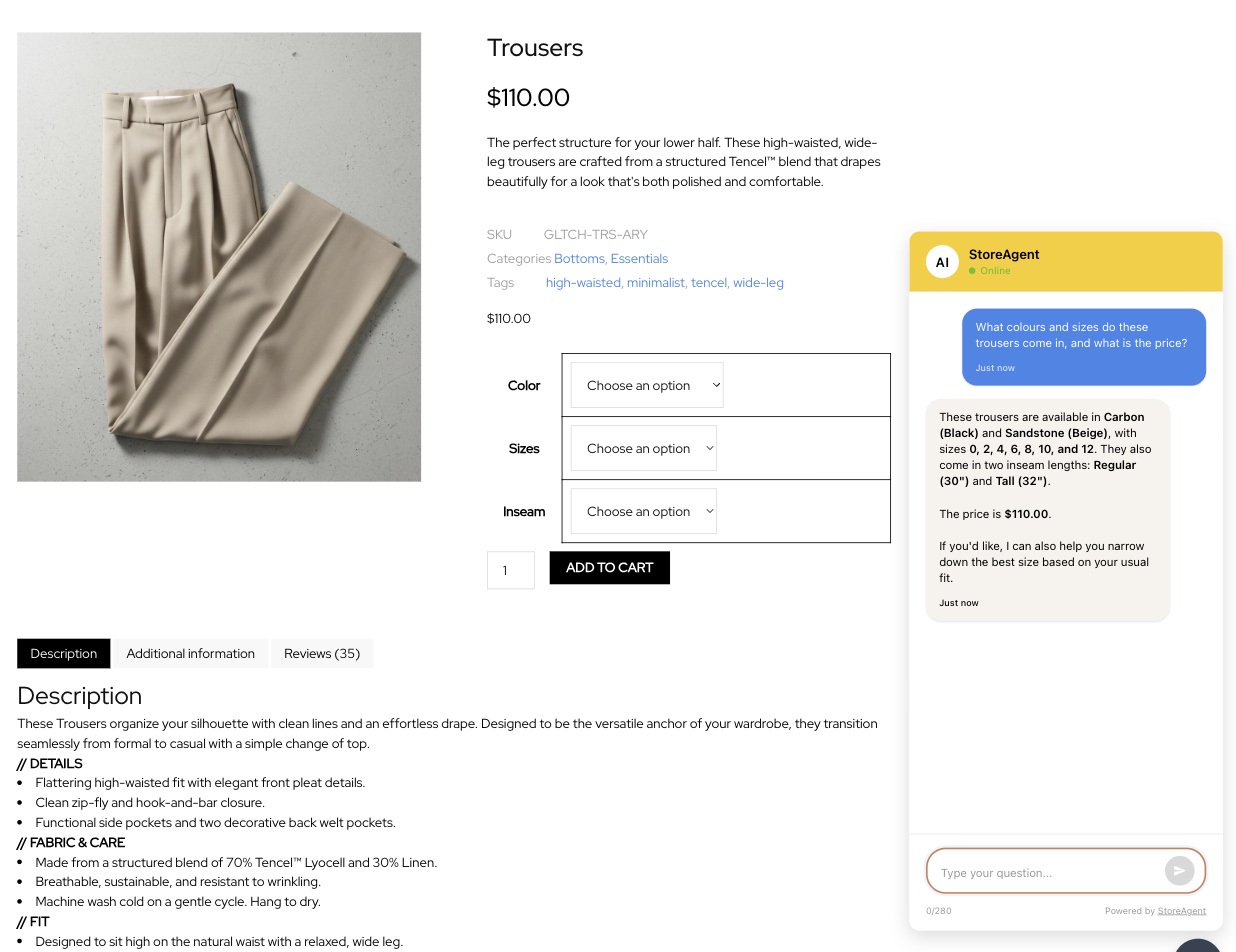
A StoreAgent quirk worth knowing before you install, because it looks like a bug and isn’t: the chat widget deliberately stays hidden on your storefront until the first product index finishes. You won’t see a chat bubble at all until the settings screen reports something like “Indexed 63 of 63 items”. It is doing that on purpose, so no shopper meets an assistant that can’t yet answer.
What We’ve Seen: Store owners buy a general WordPress AI plugin on the strength of its install count, wire it to their own OpenAI key, and only then discover that “supports WooCommerce” meant a keyword search over product titles. The question to ask before you buy isn’t “does this plugin support WooCommerce?” Almost all of them say yes. It’s “what exactly does the AI read at the moment a shopper asks, and does the answer come from live store records or from an index of page text?”
This matters most at the point of highest intent. Baymard Institute puts the average documented cart abandonment rate at 70.22% across 50 studies, and a wrong stock or price answer at that moment doesn’t just fail to help, it sends the shopper elsewhere.
How StoreAgent And AI Engine Pricing Compare
StoreAgent bills flat monthly, with the AI included and no keys to buy:
| Plan | Price | AI chat replies | Memory items | AI tasks |
|---|---|---|---|---|
| Lite | Free | 50 one-time | 1,000 | 25 one-time |
| Growth | $19/mo | 500 | 5,000 | 500 |
| Pro | $49/mo | 5,000 | 25,000 | 2,500 |
| Business | $249/mo | 50,000 | 100,000 | 10,000 |
Lite credits are one-time and don’t renew, so it’s a way to test the tool rather than run a busy store on it. Support Escalation starts on Growth, and full chat history is listed on Pro and Business. Every plan runs on unlimited websites and carries a 14-day money-back guarantee.
AI Engine bills yearly by site count, and the WooCommerce piece and the AI itself are separate lines:
| Line item | Price | Websites | What it covers |
|---|---|---|---|
| AI Engine (free) | $0 | Any | Chatbots, content generation, core MCP; no AI usage |
| Pro Starter | $79/yr | 1 | Function calling, embeddings, advanced MCP tools |
| Pro Standard | $99/yr | 5 | Same features, more sites |
| Pro Professional | $179/yr | 20 | Same features, more sites |
| Woo Basics add-on | $9/yr | 1 | Product search, order tracking, product carousel |
| AI provider usage | Metered by the provider | Any | Not included, billed to your own key |
That last row is the real pricing story. Meow Apps is honest about it and says so plainly on its own site: you bring your own provider account, your own keys and your own models, and “you pay your AI providers directly, at their price”. Nothing is hidden. It is just not a number anyone can put on a page for you, because it moves with your model choice, your conversation length and your traffic. AI Engine’s own FAQ answers a support question that starts “Error 429: You exceeded your current quota” by pointing you at your OpenAI billing settings, and its documentation asks you to set limits in queries, tokens or dollars across three separate tabs for logged-in users, guests and the whole system.
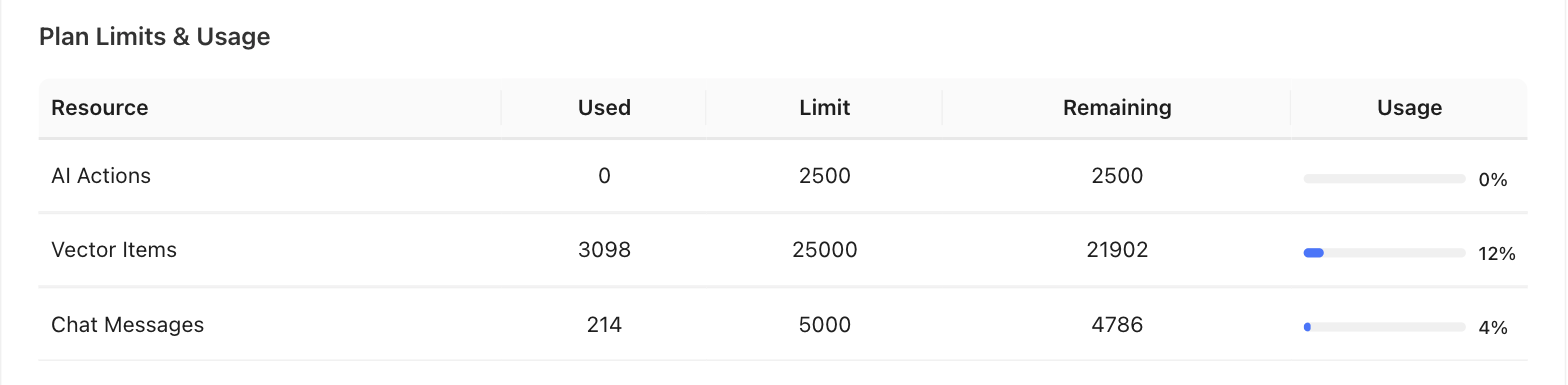
Here’s what the difference looks like in practice (example data, not a real store). A WooCommerce shop handling roughly 600 chat conversations a month runs on StoreAgent Pro at $49 a month, which is $588 for the year and covers 5,000 replies with room to spare. The same store on AI Engine pays $79 for a single-site Pro licence plus $9 for Woo Basics, so $88 for the year, and then the model bill on top. Our own guide to what an AI chatbot actually costs puts bring-your-own-key chat spend at roughly $20 to $50 a month at that volume, which lands the year somewhere between about $330 and $690. The licence is cheaper. The total is a range, not a price, and the range is set by a bill you don’t control.
There is one more line to watch. Meow Apps sells eight other AI Engine add-ons at $9 a year each, including Better Links for product thumbnails in replies and Content Parser for custom-field data, and its Neko Pass bundle states outright that “the AI Engine add-ons are not included”. A store that wants a polished shopping assistant tends to want two or three of them.
Beyond Chat: What Else Each Tool Does
Both plugins generate content, but they generate different things. AI Engine writes posts, rewrites blocks in the editor through its Copilot, translates, generates images and video, and builds AI forms. It is a writing environment for a WordPress site.
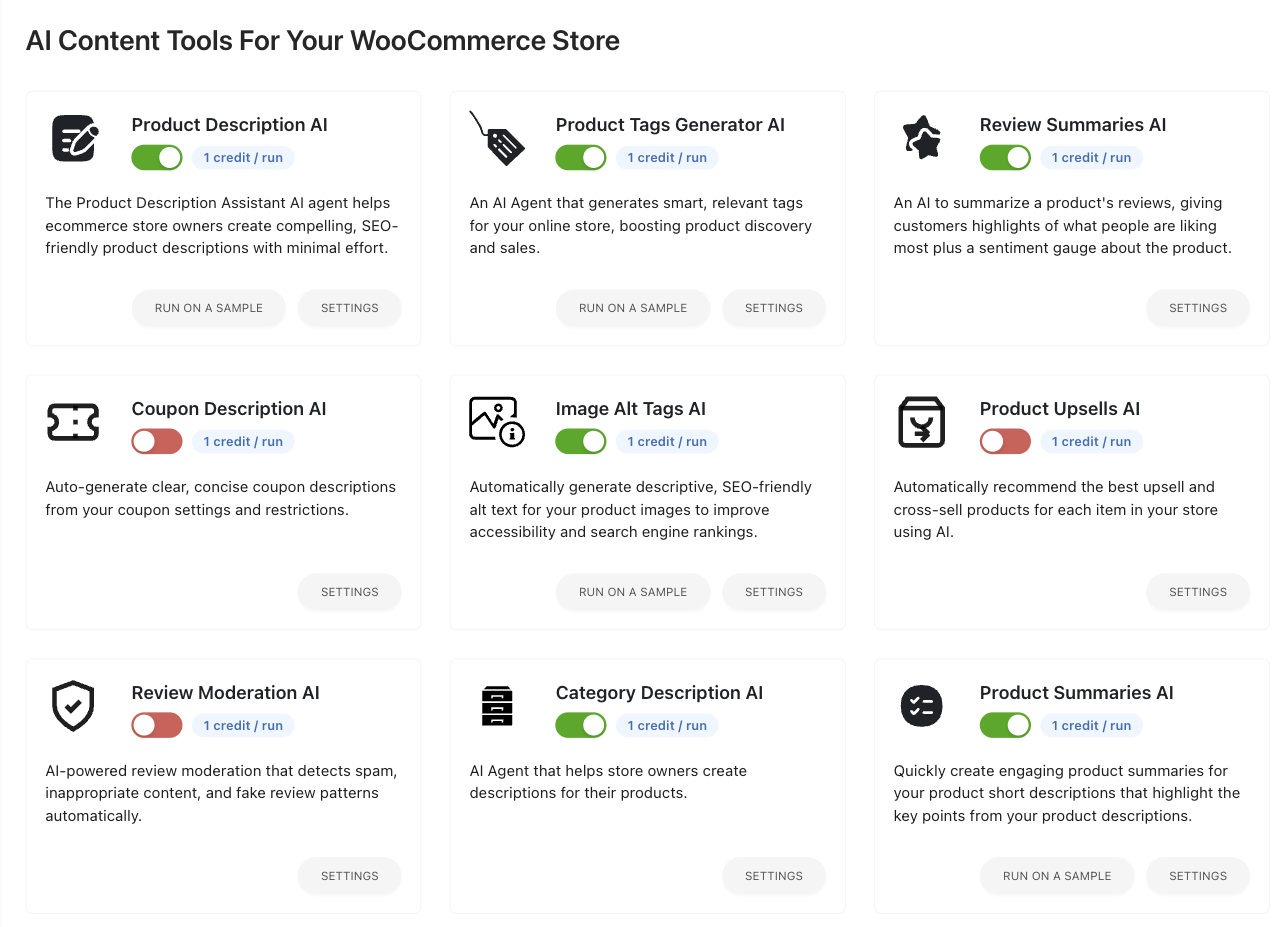
StoreAgent’s content agents only write the things a product catalog needs, and they read WooCommerce data to do it. There are nine of them: product descriptions, product summaries, product tags, category descriptions, image alt tags, product upsells, review moderation, review summaries and coupon descriptions. The coupon agent, for instance, reads the discount type, amount, free-shipping flag, expiry, spend limits and product restrictions off the coupon before it writes a word. That is a narrower job than AI Engine does, done with data AI Engine has no reason to look at.
Reporting is the clearest split. AI Engine’s analytics track tokens, costs and usage limits, which is exactly what you need when you are paying per token. StoreAgent reports on the store: four KPI cards for Revenue, Conversion rate, Chats and Impressions, and a funnel that runs from “Saw the widget” through “Opened the chat” and “Added to cart” to “Purchased”. Those AI-powered store insights sit on every plan, including the free one, with no analytics add-on to buy. One tool tells you what the AI cost. The other tells you what it earned.
On connecting an outside assistant, AI Engine is ahead today and it would be dishonest to pretend otherwise. Its MCP server is live and shipping in the free version, so Claude, ChatGPT or Claude Code can already work on your WordPress site through 36 core tools. StoreAgent registers 24 WooCommerce AI abilities and exposes them through the WordPress Abilities API, and its managed WooCommerce MCP gateway is live on every plan, including free. Both plugins can drive a site from Claude today; the difference is that StoreAgent’s tools are WooCommerce abilities and AI Engine’s are general WordPress ones.
Where AI Engine Is Genuinely Strong
AI Engine is one of the best-built plugins on WordPress.org and it would be silly to suggest otherwise. It carries 100,000 active installs and a 4.9 average across 862 reviews, it shipped a release two days before this was written, and its provider list is unmatched: OpenAI, Anthropic, Google, xAI, Mistral, Perplexity, OpenRouter, Replicate, Azure, plus an OpenAI-compatible connector for a local Ollama or LM Studio server. Its MCP implementation is thoughtful, and its author refused to add arbitrary PHP execution to the official plugin on safety grounds, which tells you something about how it is maintained. If your requirement is “AI across a whole WordPress site”, or you manage twenty sites where only three run WooCommerce, AI Engine is the right tool and StoreAgent is not.
Bring-your-own-key is also a real advantage in one specific case. If you already have provider credits, or you want to run a local model with no per-token cost at all, AI Engine lets you do that and StoreAgent does not.
Now the honest counterweight, because you should hear it from us rather than find out later. StoreAgent is not a multichannel helpdesk. There is no human-agent inbox, no SMS channel and no voice. It does not do email marketing, it does not write SEO meta fields, and it only works on WooCommerce, so a content site gets nothing from it. What it does instead is escalate: on paid plans, a conversation the AI can’t resolve is emailed to your team with the full context attached and the customer set as reply-to, so you answer from your normal inbox. That’s a faster human, not a ticketing system, and it is worth knowing which one you are buying. You can see how that trade plays out against other tools in our other StoreAgent comparisons.
Frequently Asked Questions
Does AI Engine work with WooCommerce?
Partly, and not by itself. The base plugin is a general WordPress AI framework with no WooCommerce awareness. Product search and order tracking in the chatbot come from a separate paid add-on, Woo Basics, starting at $9 a year for one site, and its documentation says product answers run on WordPress core search rather than live catalog data.
Do I need my own API key for AI Engine?
Yes. AI Engine includes no AI usage at any price. You create an account with OpenAI, Anthropic, Google or another provider, paste the key into the plugin, and pay that provider directly for every reply and every generated description. Meow Apps adds no markup, but it also cannot tell you what the monthly total will be.
Is StoreAgent a full helpdesk?
No, and that’s deliberate. There is no human-agent inbox, no SMS and no voice channel. StoreAgent answers the high-volume product, stock and order questions itself, then escalates anything it can’t resolve by email with the full conversation attached, on paid plans. If you need a shared agent inbox, run one alongside it.
How much does StoreAgent cost compared to AI Engine?
StoreAgent runs $19, $49 or $249 a month with the AI included, on unlimited websites. AI Engine Pro runs $79 a year for one site, plus $9 a year for Woo Basics, plus whatever your AI provider charges. The licence is cheaper; the total depends on a metered bill that arrives from someone else.
Can I try StoreAgent before paying?
Yes. The Lite plan is free with no credit card and no API key, and includes 50 AI chat replies and 200 AI tasks as one-time starter credits plus 1,000 memory items. Those credits don’t renew, so treat Lite as a test drive. Paid plans add a 14-day money-back guarantee.
Which AI Is Right For Your WooCommerce Store?
StoreAgent, if the site you care about is a store. AI Engine, if the sites you care about are WordPress sites that happen to include a store. StoreAgent vs AI Engine is a category question rather than a feature scorecard, and answering it wrong is how people end up with a chatbot that keyword-searches their catalog.
Here’s what to do with all this:
- Check what the tool needs bolted on before you compare anything else
- Ask what the AI reads at the moment a shopper asks, not what the integrations page claims
- Add the model bill to the licence price when you compare a bring-your-own-key tool to a flat one
- Decide whether you want reporting on tokens or on revenue, because they are different products
- Count how many of your sites actually sell things, because that single number picks the winner here
If you run a WooCommerce store and want AI that reads your real catalog and your real orders, StoreAgent is built for exactly that. Start free on StoreAgent Lite and see what it answers before you spend anything.
Sources
- Baymard Institute, Cart Abandonment Rate Statistics — Supports: “average documented cart abandonment rate at 70.22% across 50 studies”
Note: AI Engine plugin statistics, Pro and add-on pricing, WooCommerce add-on behaviour and MCP tool coverage were verified directly against Meow Apps’ own live product pages, its WordPress.org listing and its official documentation on 2026-08-28. StoreAgent plan pricing, quotas and feature availability were verified against the live StoreAgent pricing page and knowledge base the same day. Per the competitor linking policy, Meow Apps and AI Engine pages are named in prose but deliberately not linked.