
 Reviewed by
Customer service statistics show that support is a revenue lever, not a cost center. Shoppers leave after a single bad experience, expect faster answers every year, and increasingly prefer to solve simple problems themselves. The numbers below come from neutral industry research, grouped so you can act on them, not just quote them.
In this article, we’ll cover four clusters of customer service statistics. The cost of poor service, response time expectations, the shift to self-service, and how AI is changing the baseline. Under each one, we’ll ask what it means for your store.
Table Of Contents
How To Read These Numbers
Industry averages are a backdrop, not a verdict on your store. Treat them as direction, not destiny. The value is in the pattern these customer service statistics form together. Shoppers want fast, self-serve answers, and they quietly leave when they don’t get them.
Most page-one roundups for this topic stop at the list. After each cluster, we return to the harder question: where is this true for my store, and what would I actually change?
Big surveys typically cover enterprises with support teams, ticketing systems, and SLAs. A solo or small-team WooCommerce store doesn’t have any of that. That’s exactly why these averages cut both ways. The expectations apply to you, but the response gap they expose is also your opening.
The Cost Of Poor Customer Service
Poor service rarely shows up as a refund. It shows up as the sale you never see and the repeat customer who quietly stops coming back.
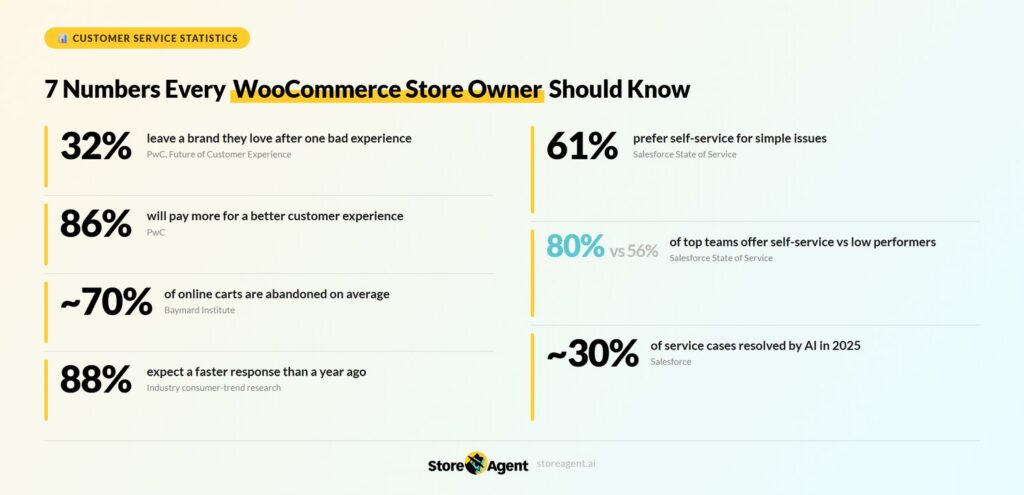
- 32% of customers would walk away from a brand they love after a single bad experience (PwC, Future of Customer Experience).
- Around 86% of buyers say they will pay more for a better customer experience (PwC). Shoppers factor service quality into what they’re willing to pay.
- ~70% of online carts are abandoned on average (Baymard Institute), and unanswered questions at the point of purchase are a recurring, fixable cause.
What this means for your store: the PwC figure shows even loyal customers don’t give many second chances. Good service isn’t charity, it protects margin. For a small store, responsiveness is one of the cheapest forms of revenue protection you have. A single unanswered “does this ship to my country?” at checkout can cost you the order outright. You’ll never see it in your reports as a complaint, only as a cart that never converted.
What Shoppers Expect From Support Response Times
The bar for “fast” keeps moving. Large retailers, not other small stores, set it.
- 88% of consumers expect a faster response than they did a year ago (industry consumer-trend research). That figure has risen most years researchers have tracked it.
- Speed of response consistently ranks as the top factor in a good support experience, per HubSpot State of Customer Service and Salesforce State of Service.
- For live chat, shoppers expect answers in seconds. For email, they expect a reply within roughly an hour. The tolerance for waiting shrinks the closer a shopper is to buying.
What this means for your store: you don’t have to beat enterprise brands on everything. But on the common questions (shipping, stock, order status), an instant answer is the expectation, not a delight. This is the single expectation a small store can realistically meet, because it’s a function of automation, not headcount. A shopper browsing at 2am still expects an instant answer, even when your store is closed in your timezone. That’s where most lost sales hide. Weighing automation against a live agent?
Our breakdown of a WooCommerce AI chatbot versus live chat covers where each one actually wins.
The Rise Of Self-Service
The most overlooked takeaway in this whole dataset: for simple things, customers would rather not talk to you at all.
- ~61% of customers prefer self-service for simple issues (Salesforce).
- 80% of high-performing service organizations offer self-service options, versus 56% of low performers (Salesforce). Self-service correlates with the teams customers rate highest, not the cheapest.
- Most customers try to resolve an issue themselves before contacting a person, reaching out only when self-service fails them.
What this means for your store: this flips support from a staffing problem into a self-service design problem, which is far cheaper to solve. Customers aren’t demanding more of your time. They want the answer instantly and on their own terms. They only want a human when the self-serve path breaks.
For a WooCommerce store, the everyday self-service wins are narrow and predictable. Order status, return policy, sizing, stock, and shipping windows. Get those answered without you, and the volume of “real” tickets that need your attention drops sharply.
What we’ve seen: across StoreAgent installs on small WooCommerce stores, the satisfaction gap is almost never agent attitude. It’s slow or after-hours response. The same “where is my order?” question, answered instantly at 11pm from live order data, lands completely differently. Twelve hours later, from a tired owner, it lands like a letdown. Store owners read stats like these as a reason to hire. The data says otherwise: automate first, and save your own time for the cases that genuinely need it.
How AI Is Changing The Support Baseline
AI is shifting what counts as a normal support experience. It absorbs the repetitive questions before they ever reach a person.
- AI resolved around 30% of service cases in 2025, with that share projected to keep climbing (Salesforce).
- Self-service and automation can deflect a large share of routine, repetitive contacts. Think “where is my order” and “how do I return this” — the questions that dominate small-store support volume.
What this means for your store: the practical effect isn’t that AI replaces you, it’s that the baseline customers compare you to has moved. When shoppers get instant answers everywhere else, a contact form promising “within 1-2 business days” feels broken. The opportunity is to meet that new baseline on routine questions without adding staff.
That movement is measurable, and the 2026 AI in customer service statistics put adoption at 66% of service organizations, up from 39% a year earlier, which is why instant answers now read as the default rather than a differentiator.
For the more complex issues that still require a human touch, relying on pre-written customer service response templates ensures your team maintains that same speed and consistency.
💡 Our benefits of AI in customer service and ROI of AI customer service pieces cover the wider upside in more depth.
What These Customer Service Statistics Mean For Your Store
The pattern across every cluster of customer service statistics is consistent. Customers want fast, self-serve answers, and they punish slow support by leaving. For a WooCommerce store, that points to a few concrete moves.
- Measure your own baseline first. Note how fast you currently answer common questions and where shoppers drop off. These averages become a target to track, not just trivia.
- Make instant answers the default for your most common questions, so speed doesn’t depend on you being at your desk.
- Lean into self-service for simple issues, since that’s what most customers prefer anyway.
- Reserve your own time for the complex, high-stakes cases where a human genuinely changes the outcome.
Conclusion
Here’s a quick recap of what these customer service statistics show:
- 32% of shoppers leave a brand they love after one bad experience, and 86% will pay more for a better one (PwC)
- ~70% of online carts are abandoned on average, and unanswered checkout questions are a recurring cause (Baymard Institute)
- 88% of consumers expect a faster response than a year ago, with speed ranked the top support factor
- ~61% of customers prefer self-service for simple issues and most try to solve problems themselves first (Salesforce)
- AI resolved around 30% of service cases in 2025, with that share projected to keep growing (Salesforce)
There is a quiet opportunity buried in these numbers. Most companies struggle to meet rising response-time expectations. A small store that answers instantly can out-serve competitors many times its size, on the thing customers care about most. Speed is one of the few areas where being small is no disadvantage at all, provided you automate the routine.
If you’re ready to put these findings into practice, StoreAgent’s WooCommerce AI chatbot is a good place to start. It ingests your catalog and store pages, keeps them in sync automatically, and answers around the clock with no coding.
Paid plans add live order lookup for logged-in customers and human escalation when it’s needed. Start on the free Lite plan, or upgrade to Growth at $19/mo or Pro at $49/mo; the full breakdown is on the pricing page.
Sources And Methodology
These figures come from neutral industry research, not vendor marketing. Sources: PwC (single bad experience, willingness to pay more), Baymard Institute (cart abandonment), and Salesforce State of Service (self-service preference, high- versus low-performer self-service adoption, share of cases resolved by AI).
Response-time expectation figures come from recurring consumer-trend research. Where a precise figure varies by study or year, we have described the direction rather than overstate a single number. Always weigh industry averages against your own store’s data before acting on them.
Frequently Asked Questions
Why is customer service important in ecommerce?
Because it directly affects sales and loyalty. Shoppers expect fast answers and abandon purchases when they don’t get them; the average abandonment rate sits around 70% (Baymard Institute). Responsive stores earn repeat business, and shoppers will pay more for a better experience. PwC found 32% would leave a brand they love after a single bad experience.
How fast do customers expect a response?
Faster every year. Around 88% of consumers expect a quicker response than a year ago. Survey after survey ranks speed as the top factor in a good support experience. For live chat, shoppers expect answers in seconds, and for email within roughly an hour.
Do customers prefer self-service?
For simple issues, yes. Around 61% prefer self-service (Salesforce), and most try to solve a problem themselves before contacting a person. They still want a human for complex or sensitive matters, so offering both paths is ideal.
How can a small WooCommerce store meet these expectations?
Use an AI assistant to answer common questions instantly from your store data, and reserve human support for the rest. It delivers the speed and self-service shoppers expect without a large team. StoreAgent answers 24/7 from your catalog and order data, and you can start free on the Lite plan.
Where do these customer service statistics come from?
From neutral industry research, mainly PwC, the Baymard Institute, and Salesforce, rather than vendor marketing. Treat them as direction for your own store, not a guaranteed result, and benchmark them against your own data.