
 Reviewed by
AI customer service has moved from experiment to standard, and the AI in customer service statistics for 2026 show how fast the shift is happening. As of 2026, most service organizations now run AI agents, and the market is on track for double-digit annual growth through 2030.
Every statistic here comes from neutral primary research, and each cluster is read for a small WooCommerce store deciding whether to act now, not for an enterprise contact center.
Table of Contents
How To Read These AI In Customer Service Statistics
Most published AI in customer service statistics describe the market as a whole, skewed toward larger organizations with budgets to match. For a small store, one question matters more than “what is everyone doing?”: what does this trend make possible for you now that it didn’t a year ago? Here’s the real headline.
The tools have become cheap and simple enough that a one-person store can run the same capability the big players are adopting. Read every figure below with that lens.
AI Customer Service Adoption Rates
Adoption has roughly doubled year over year, and executive pressure to implement is now near-universal, but most teams are still stuck between piloting and full production.
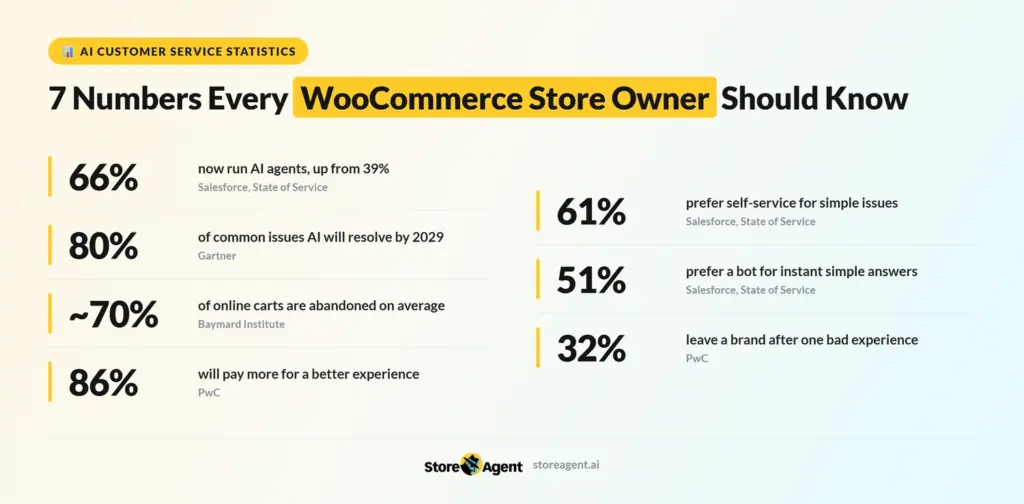
- 66% of service organizations now run AI agents, up from 39% a year earlier, a roughly 1.7x year-over-year jump (Salesforce, State of Service, 2026).
- 91% of customer service leaders report executive pressure to implement AI (Gartner, 2026).
- Gartner predicts agentic AI will autonomously resolve 80% of common customer service issues by 2029 (Gartner), and warns that adoption is outpacing controls (it expects over 40% of agentic AI projects to be scrapped by 2027), so the move from pilot to production is the 2026 story.
What this means for your store: AI support has crossed from early-adopter territory to default. That matters in two ways. Your customers increasingly expect the instant answers AI enables, because they already get them elsewhere. And the gap between piloting and production is exactly the gap a WooCommerce-native tool closes, because it connects to your live data out of the box instead of needing a build project.
Market Size And Growth
The AI customer service market is large and compounding quickly, which is good news for buyers because it pushes prices down and capability up.
- The global AI customer service market is projected at roughly $15.12 billion in 2026 (Polaris Market Research).
- The AI-for-customer-service market is forecast to grow from $12.06 billion in 2024 to $47.82 billion by 2030, a 25.8% compound annual growth rate (MarketsandMarkets, 2025).
What this means for your store: a fast-growing market favors buyers as much as vendors. More investment means tools get cheaper, simpler, and more capable quickly. The free and low-cost tiers a small store can use today would have been an enterprise project a few years ago. You are adopting into a maturing market, not betting on an unproven one.
ROI And Cost Savings
The financial case is what moves AI from a nice-to-have to a budget line. The headline projections are measured in tens of billions, and the mechanism is deflection: questions answered without a human.
- Conversational AI is projected to cut contact center agent labor costs by $80 billion in 2026 (Gartner, 2022 forecast).
- Agentic AI is forecast to autonomously resolve 80% of common customer service issues without human intervention by 2029 (Gartner, 2025).
- 86% of buyers say they will pay more for a great customer experience, and a fast, accurate first response is a core driver of that experience (PwC).
What this means for your store: the enterprise number is $80 billion; your number is whatever an unanswered after-hours question costs you in a lost sale. The economics scale down cleanly. Each question an assistant resolves on its own is a support touch you did not have to staff and, often, a sale you would otherwise have lost to silence.
We walk through how to model this for a small catalog in our guide to the ROI of AI customer service, and at how it lowers the bill in reducing customer support costs with AI.
Consumer Sentiment And Preference
Shoppers don’t reject AI. They reject friction. They want a bot for speed on simple questions and a human for anything complex, which is why how you deploy AI matters more than whether you do.
- 79% of Americans say they prefer a human over an AI agent overall (Salesforce, State of Service, 2026).
- 51% of consumers prefer a bot over a human for immediate answers to simple questions (Salesforce, 2026).
- 61% of customers prefer self-service for simple issues (Salesforce, 2026).
- 32% of consumers will leave a brand they love after a single bad experience (PwC).
What this means for your store: the apparent contradiction (79% prefer humans, yet a majority want bots for speed) is the whole strategy. Use AI for the instant, factual questions shoppers want answered immediately, and hand off cleanly to you for the rest. The losing setup is a bot that cannot answer and cannot escalate.
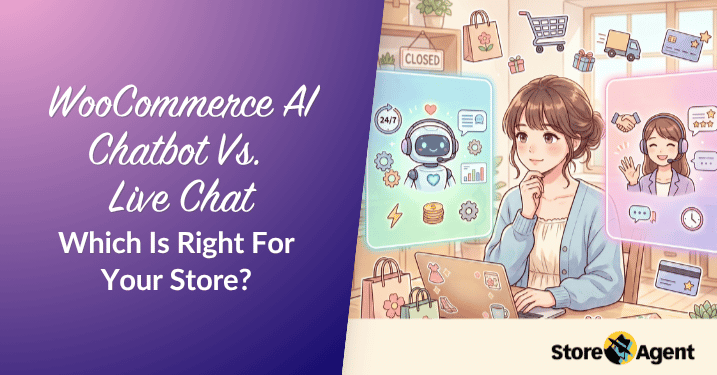
For where that line sits, see our comparison of a WooCommerce AI chatbot versus live chat.
Performance And Resolution
The reason adoption keeps climbing is that the resolution numbers hold up. AI now handles a meaningful share of routine volume end to end.
- Salesforce expects 50% of service cases to be resolved by AI by 2027, up from 30% in 2025 (Salesforce, 2026).
- Agentic AI is forecast to resolve 80% of common issues autonomously by 2029 (Gartner, 2025), concentrated in the repetitive, factual questions that dominate ecommerce inboxes.
What this means for your store: the half of cases AI is projected to resolve are exactly the ones a store gets most: “where is my order,” “does this ship to my country,” “is this in stock.” Those need live order and catalog data, not a clever script. The metrics worth watching for your own store, once live, are deflection rate and first-response time, which we break down in our guide to AI chatbot metrics.
Why Ecommerce Is Adopting AI Customer Service Faster
Stores have a structural head start: their data (catalog, prices, orders) is already organized and ready for an assistant to read.
Combine that with around 61% of customers preferring self-service for simple issues (Salesforce) and an average documented cart abandonment rate of around 70% (Baymard Institute, 70.22% across 50 studies) that fast answers help recover, and the case for AI support in ecommerce is unusually strong. Stores hit the sweet spot: high volumes of repetitive, factual questions, structured data to answer them from, and direct revenue at stake on every unanswered question. That is why stores see a return faster than industries where the questions are open-ended or the data is messy.
There is a timing angle too. Because adoption is racing ahead of full production across the industry, the stores that connect AI to their live data now are quietly ahead of much larger competitors still stuck in pilot mode. For once a small store’s simplicity is the advantage: there is no legacy support stack to untangle, so going from installed to answering real questions can take an afternoon rather than a quarter.
What we’ve seen: the gap between running a pilot and being in full production is where most stores stall. They switch something on but never connect it to live store data, so it stays a novelty that answers “what are your hours” and nothing else. The stores getting real value are the ones using an assistant that reads their actual catalog and orders from day one, so it can confirm stock and look up an order instead of deflecting to a contact form.
What This Means For A Small WooCommerce Store
AI customer service is no longer early-adopter territory; it is becoming the baseline, which quietly resets what counts as normal service. The practical reading of these AI in customer service statistics for a small WooCommerce store is that the barrier to entry has effectively disappeared. You can run the same core capability the big players are racing toward, at little or no cost, without a development team.
The tool that fits this is one built for your platform. StoreAgent’s WooCommerce AI chatbot is a no-code assistant that auto-ingests your catalog and content and answers from your live store data around the clock.
Once you create a free StoreAgent.ai account to connect, it can:
- Confirm stock and surface product details straight from your live catalog
- Look up orders for logged-in customers
- Escalate to you when a question needs a human (paid plans)
It starts on a free Lite plan, with Growth at $19 and Pro at $49 when you want more.
💡 For a wider view of the options, see our roundup of the best WordPress chatbot plugins.
Sources And Methodology
The AI in customer service statistics above come from neutral primary research, not vendor marketing. Each figure is mapped to its publisher and year:
- Salesforce State of Service: adoption, case resolution, consumer preference, and self-service
- Gartner: executive pressure, pilot-versus-production, the $80 billion labor-cost projection, and the 80%-by-2029 resolution forecast
- Polaris Market Research and MarketsandMarkets: market size and CAGR
- PwC: willingness to pay and the cost of a bad experience
- Baymard Institute: cart abandonment
Market forecasts are projections, not guarantees, and adoption figures skew toward larger organizations. Weigh them against the realities of your own store.
Frequently Asked Questions
How widely adopted is AI customer service in 2026?
Widely. Salesforce reports 66% of service organizations now run AI agents, up from 39% a year earlier, and Gartner finds 91% of CX leaders are under executive pressure to adopt AI. Most teams are now past piloting and moving toward full production.
Do customers actually want AI customer service?
It depends on the question. Salesforce finds 51% of consumers prefer a bot for immediate answers to simple questions, even though 79% prefer a human overall. The takeaway is to use AI for instant factual answers and hand complex issues to a person.
Is AI customer service only for large companies?
No. Small stores often benefit most, because AI covers around-the-clock work a solo owner cannot, and WooCommerce-native tools make adoption simple and affordable. Free and low-cost tiers have removed the cost barrier that used to limit AI support to enterprises.
How much money does AI customer service save?
At scale, Gartner projects conversational AI will cut contact center labor costs by $80 billion in 2026. For a small store the saving is per question: each issue resolved without you is a support touch you did not staff and often a sale you did not lose to a slow reply.
How do I add AI customer service to WooCommerce?
Install an AI chatbot plugin like StoreAgent, create a free StoreAgent.ai account to connect it, and it answers from your live store data with no coding or manual training. It reads your catalog and content automatically and can look up orders for logged-in customers. Paid plans add human escalation when a question needs a person.
Where do these AI in customer service statistics come from?
From neutral primary research: Salesforce, Gartner, Polaris Market Research, MarketsandMarkets, PwC, and Baymard Institute, not from vendor marketing. Market figures are forecasts, so treat them as direction rather than certainty.