

 Reviewed by
A review summary is a concise overview of customer reviews that highlights the most common themes, pros, and cons for a product or business. It lets shoppers understand the overall sentiment in seconds, without reading dozens of individual reviews. In an ecommerce store, a good review summary sits at the top of the product page and answers the question most shoppers actually have: “is this product going to work for me?”
According to BrightLocal’s 2026 Local Consumer Review Survey, 97% of consumers read online reviews before making a purchase decision, and 41% now “always” read reviews when browsing. That’s a significant jump from 29% the year before. Reviews are no longer a nice-to-have; they are the decision layer. The problem is that every popular product accumulates hundreds of reviews, and nobody has time to read them all. That’s exactly what a review summary solves.
In this article, we’ll cover what a review summary is, why it matters for shoppers and merchants, the three main types you’ll see in the wild, what separates a good summary from a useless one, and how it actually looks when generated on a live WooCommerce product page.
So, let’s get started!
What Is A Review Summary?
A review summary is a short paragraph (usually 2 to 5 sentences) that condenses the full body of reviews for a product or service into a single, balanced overview. It pulls out the most frequent positive comments, the most common complaints, and the overall sentiment. Think of it as the read a friend might give you if you asked them, “so what do people actually think of this?”

Some review summaries are written by the merchant. Some are template-generated from rating averages. The most useful ones are produced by AI that reads every individual review and synthesizes what the reviews actually say, not just what stars they gave.
Why Review Summaries Matter For Shoppers And Merchants
The short answer: shoppers want a verdict, not a reading assignment. Review summaries give them that verdict in a few seconds of scanning. But the benefits flow in both directions.
For shoppers
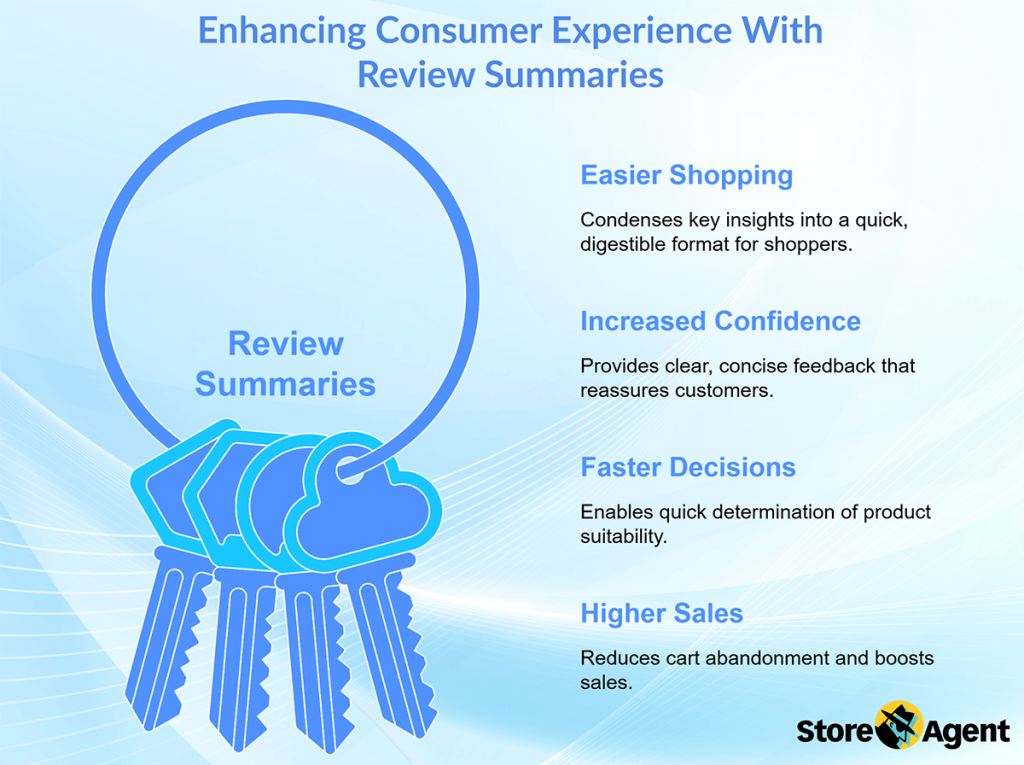
- Faster decisions. A summary lets a shopper understand the product’s real-world performance in seconds instead of spending 10 minutes reading reviews.
- Fewer surprises after purchase. A good summary surfaces the most common complaints upfront, so shoppers buy with realistic expectations.
- Less review fatigue. As Baymard Institute UX research has noted, reviewing extensive review lists is one of the more cognitively expensive tasks on a product page. Summaries remove that load.
- Language-agnostic signal. If reviews exist in multiple languages (Japanese, French, Russian, etc.), a summary in the shopper’s language lets them benefit from feedback they otherwise couldn’t read.
For merchants
- Higher conversion on high-review products. When a product has 200+ reviews, the sheer volume can paralyze shoppers. A summary unlocks that conversion potential.
- Reduced returns and complaints. Shoppers who buy based on an accurate summary are less likely to be surprised by a known limitation, which means fewer refund requests.
- Trend detection. A summary that surfaces the same complaint repeatedly is a signal that the product has a real issue worth addressing. It’s quality control feedback without reading every review.
- Trust-building. A balanced summary that acknowledges weaknesses alongside strengths reads as more honest than marketing copy, and shoppers notice.
Types Of Review Summaries
Not every review summary is created equal. There are three common approaches, each with different costs and trade-offs:
Manual summaries written by the merchant
The merchant reads the reviews and writes a short paragraph summarizing them. This produces the highest-quality output when done well, but it takes serious time. The summary also goes stale the moment a new batch of reviews arrives. For a store with 50 products and ongoing review volume, manual summaries are effectively unmaintainable.
Template-based summaries from star ratings
Some platforms generate a boilerplate summary from star rating averages: “Customers rate this product 4.3 out of 5 stars based on 127 reviews.” This is better than nothing but barely useful. It restates the rating without telling shoppers what the reviews actually say. Two products with identical 4.3-star averages might have wildly different review content (one praised for durability, one praised for price), but a star-average summary would describe them identically.
AI-generated summaries from the review text
AI tools read every individual review and synthesize the themes. The output is a few sentences that capture the actual substance of customer feedback: specific praise, specific complaints, specific use cases, not just a restated average. This is the only approach that scales for a store with ongoing review volume across many products. WooCommerce store owners can use the AI Review Summary Agent for WooCommerce to generate and refresh these summaries automatically.
What We’ve Seen: Store owners often assume any “review summary” feature is equivalent. In practice, template-based summaries generated from star averages add almost no decision-making value for shoppers. The thing that moves conversion is a summary that names specific things shoppers said, which only comes from reading the actual review text.
What Makes A Good Review Summary
Four qualities separate a useful review summary from a useless one:
- Accuracy. The summary must reflect what reviewers actually said, not a generic description of the product. If the reviews mention that a book has “unexpectedly emotional moments,” the summary should surface that, not just restate the product category.
- Balance. A trustworthy summary includes the common complaints alongside the praise. Summaries that read like pure marketing copy get ignored. Shoppers are looking for honest signal.
- Specificity. “Customers love this product” is useless. “Customers repeatedly praise the binding quality and find the story engaging for all ages” is useful. Specific observations build trust; vague ones erode it.
- Freshness. A summary that’s a year stale misses recent quality changes, shipping issues, or packaging updates. The best summaries refresh automatically as new reviews arrive.
The more of these qualities a summary meets, the more shoppers trust it, and the more it actually moves the needle on conversion.
What Do AI Review Summaries Look Like? (Examples)
AI review summaries condense dozens of product reviews into a single paragraph that highlights what shoppers consistently say about a product. Here are three example outputs across different product categories, showing how summaries vary by product type and what kinds of themes tend to surface in each.
Example 1: Apparel product
Across 42 reviews, customers consistently mention soft fabric and accurate sizing. The most common positive theme is fit (mentioned in 31 reviews). Common concerns: shipping time was longer than expected for international customers (8 reviews).
Example 2: Electronics product
Across 87 reviews, the strongest themes are battery life (mentioned in 56 reviews) and ease of setup (44 reviews). Recurring concerns: the included cable is short (12 reviews) and the user manual is hard to read (9 reviews).
Example 3: Beauty / skincare product
Across 134 reviews, customers consistently praise gentle ingredients (78 mentions) and rapid visible results (51 mentions). Most common concern: bottle pump can stick after a few weeks (17 reviews).
Notice the pattern: each summary names a specific theme, attaches a rough count, and surfaces the most common concern alongside the praise. That’s the level of detail a shopper can actually use to make a buying decision.
Review Summaries In Practice: A Real Product Walkthrough
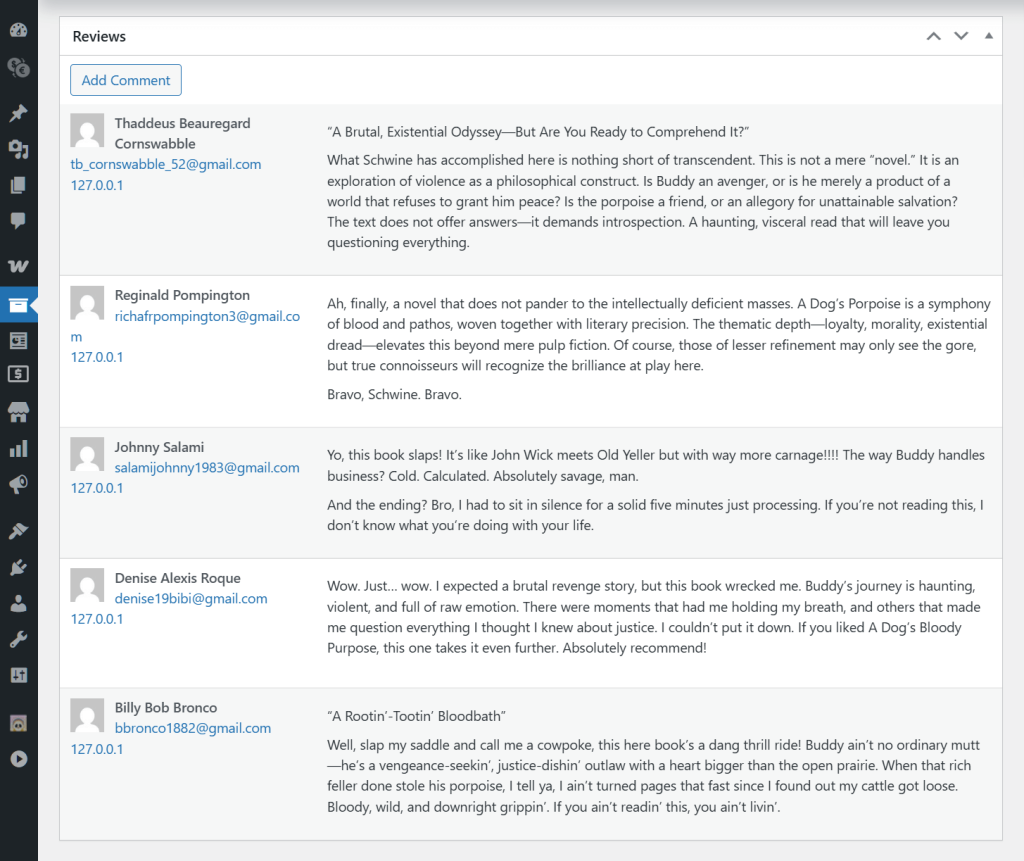
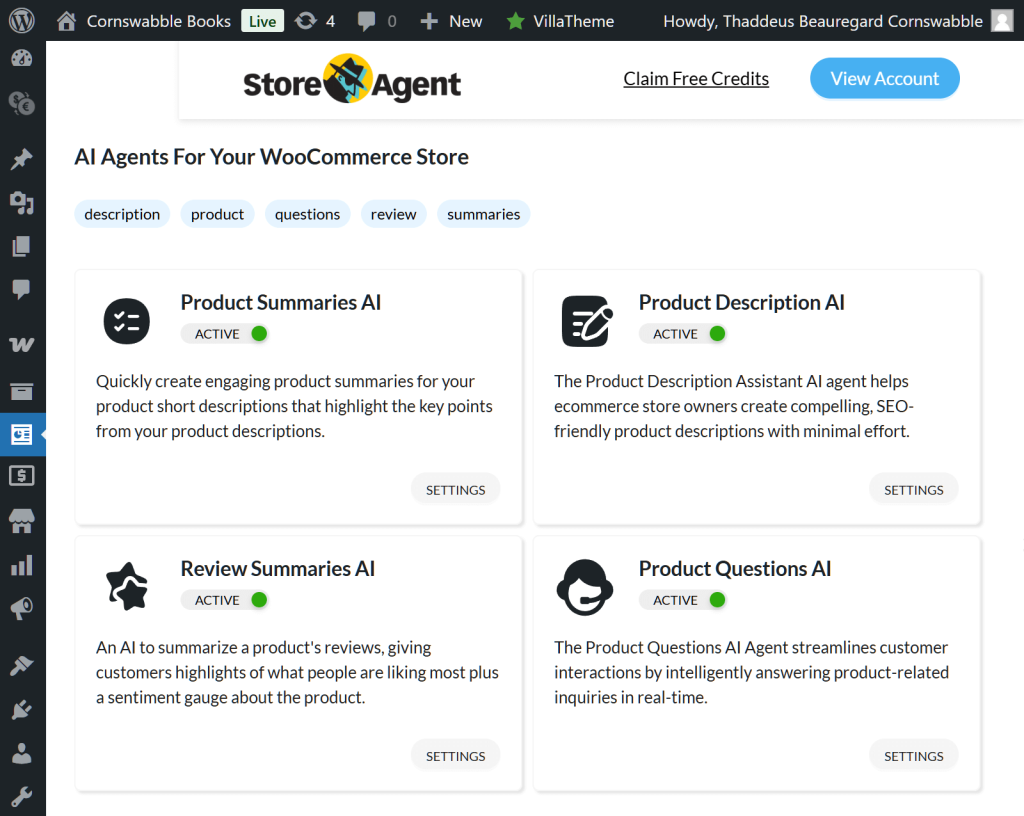
To show what a good review summary looks like on an actual product page, here’s a walkthrough using a children’s book called A Dog’s Porpoise, a small-catalog test store we set up to demonstrate how review summaries appear in practice. The example store uses the AI review summaries from StoreAgent, a WooCommerce AI agent, which also feeds low-rating alerts into the WooCommerce store insights dashboard, but the principles apply to any review summary implementation.
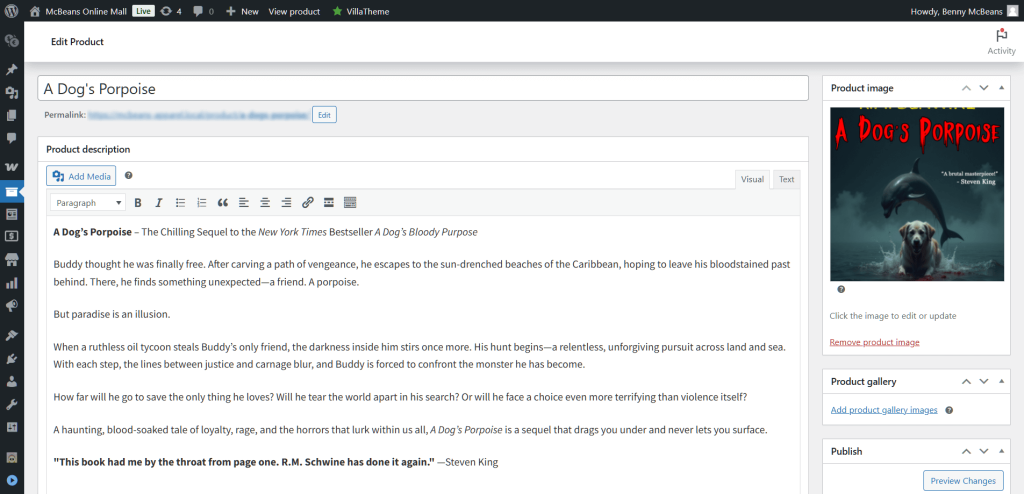
The product has five customer reviews in different voices: some short, some detailed, most positive, one mixed. This is the kind of review volume where a summary starts paying off. There’s enough to have meaningful signal, but few enough that each review carries weight.
Configuring the summary settings
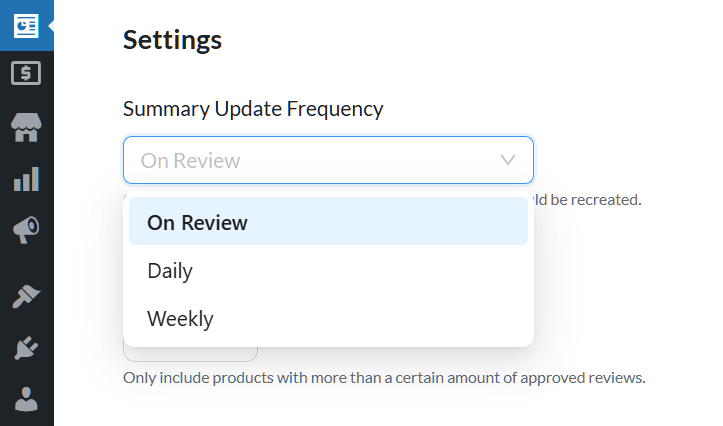
Before generating summaries, a few settings need configuring. The first is how often summaries regenerate as new reviews arrive. The three options are On Review (every time a new review is approved), Daily, and Weekly. The default is On Review, which keeps summaries continuously fresh. For stores with very high review velocity, switching to Daily or Weekly can help manage AI credit usage without letting the summary drift too far out of date. A manual “Regenerate with AI” button is always available on the product edit screen if you want to refresh a specific product on demand.
A second useful setting is the minimum review threshold. Summaries written from 1 or 2 reviews aren’t statistically meaningful and can mislead shoppers. The agent ships with a default of 3 reviews, which is a sensible floor, but most stores get more reliable summaries by bumping that to 5 or more. The threshold also doubles as a gate: products that haven’t hit it yet simply won’t display a summary on the live page.
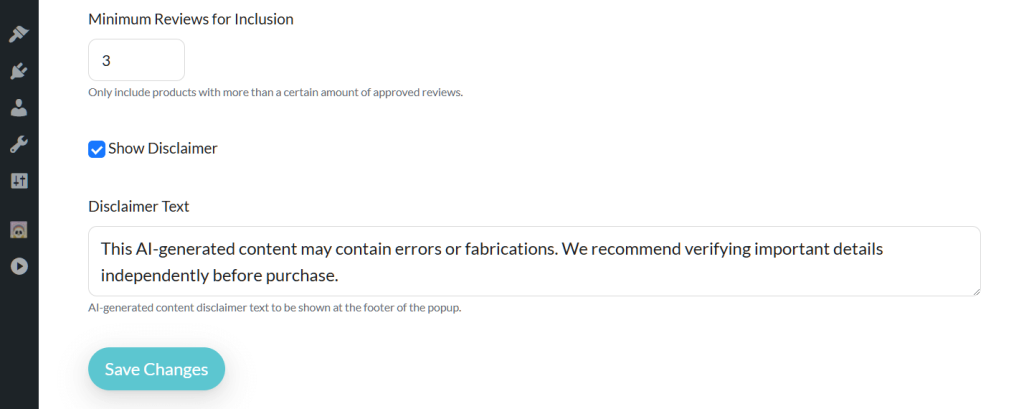
A third setting worth configuring is the Disclaimer. When enabled, a short note appears alongside the summary on the live product page letting shoppers know the text was AI-generated from real customer reviews. You can customize the disclaimer wording or leave the default.
This is a small piece of transparency that builds trust, particularly for stores where shoppers are increasingly skeptical of AI-generated content. The agent also exposes a Language setting that controls which language the summary is generated in, which we’ll cover in the multilingual section below.
What the generated summary looks like
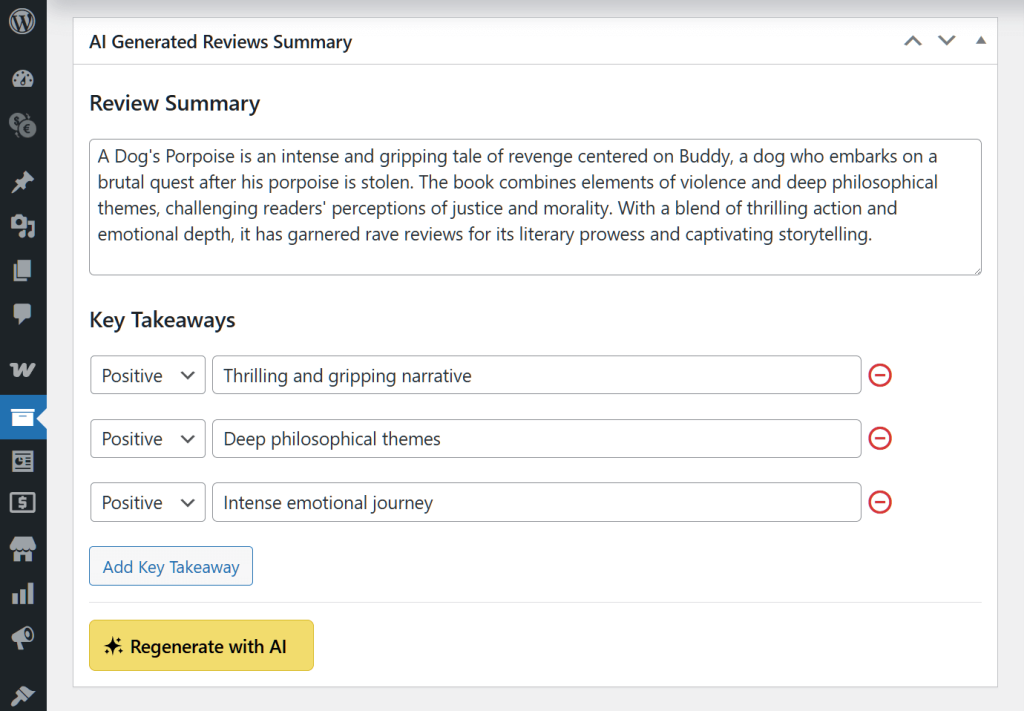
Once configured, the summary appears in the “AI Generated Reviews Summary” metabox on the product edit screen, alongside the review data. This is the merchant-facing view: an editable preview of what shoppers will see on the live page, with the summary text, the key takeaways list, sentiment selectors, and a “Regenerate with AI” button.
On the live product page, the summary appears at the top of the reviews section, the first thing shoppers see when they scroll to that part of the page. The key takeaways display as short tagged labels colored by sentiment (positive, neutral, or negative), making it easy to scan the recurring themes at a glance before reading the full summary paragraph.
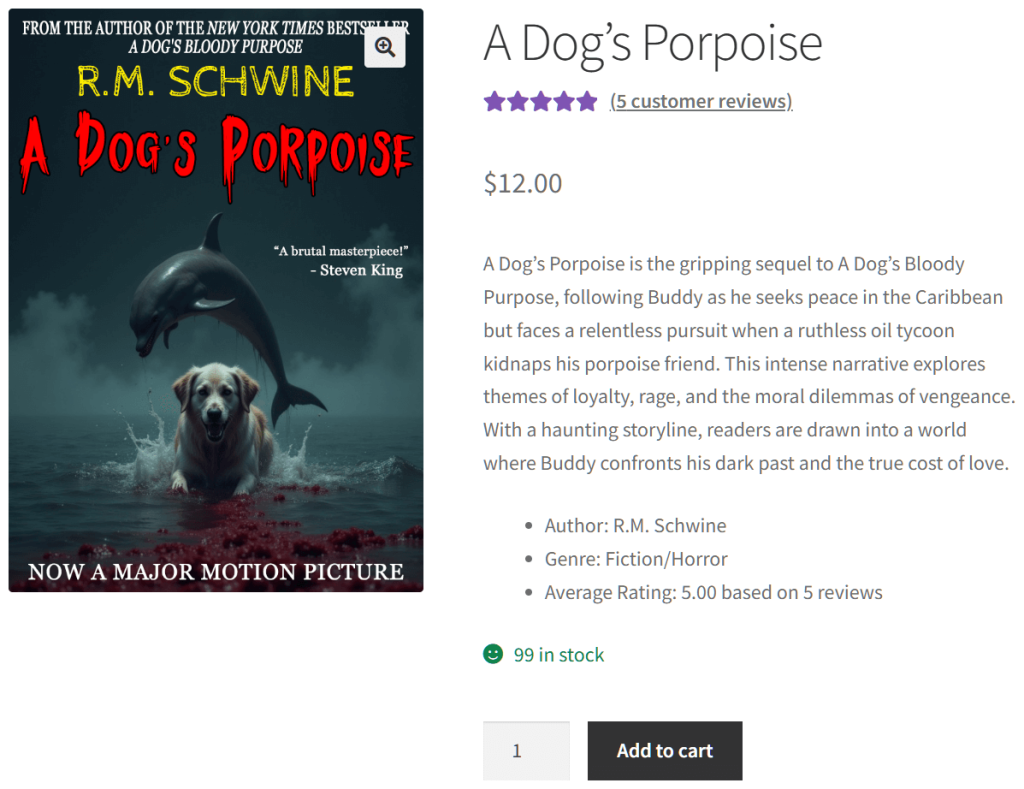
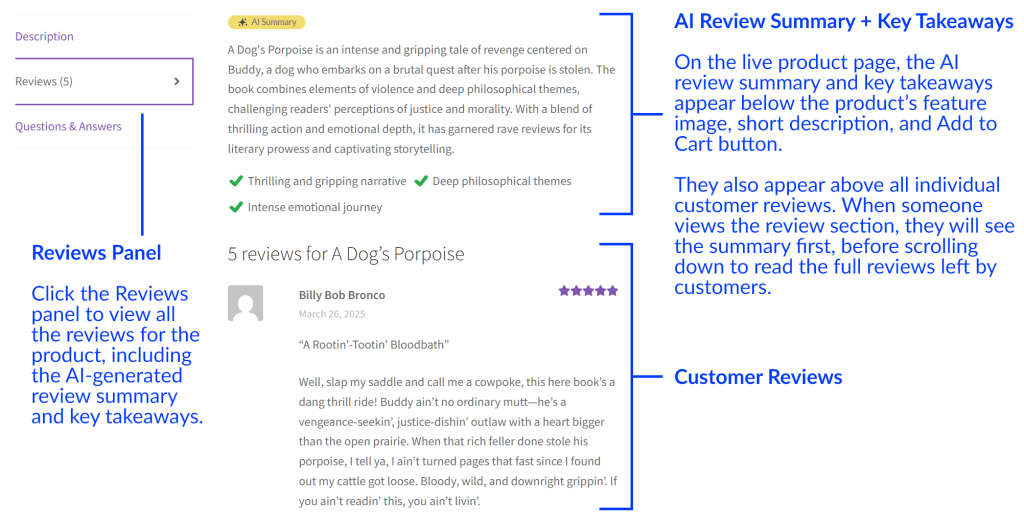
A shopper landing on this page gets the verdict in about 10 seconds: the book is beloved for its emotional storytelling and appeal across age groups, with a small mixed signal on pacing. That’s faster than reading five individual reviews, and at scale across a full catalog, the time saving compounds for every shopper on every visit.
Summaries across multiple languages
If a store serves international customers, reviews often arrive in multiple languages. The A Dog’s Porpoise test store also has reviews in Russian, Japanese, and French, alongside the English-language reviews.
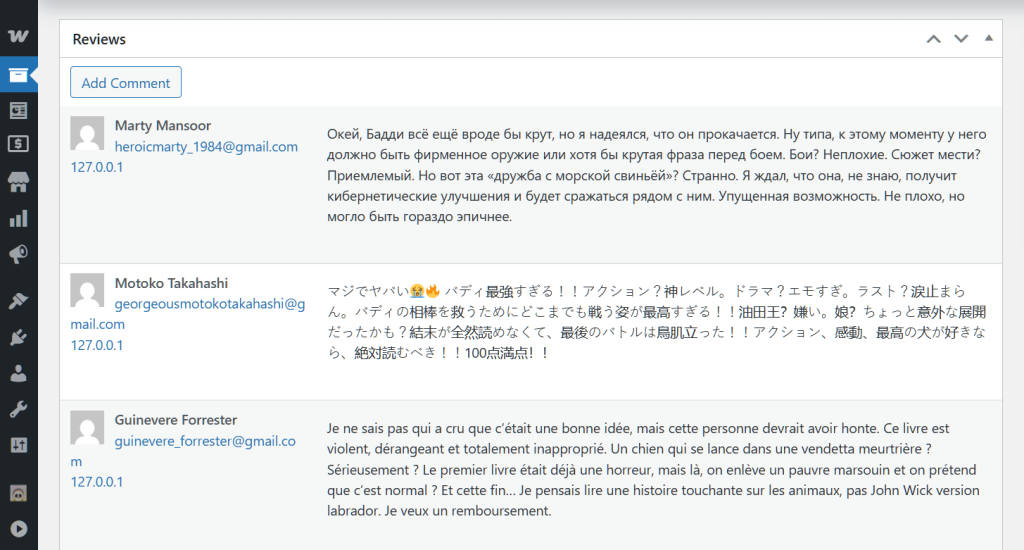
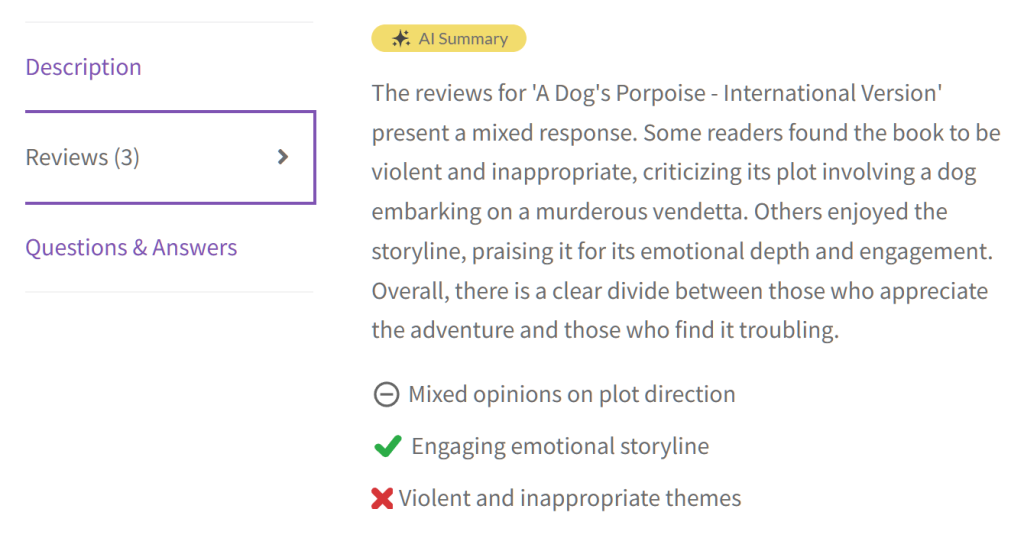
A shopper who only reads English would otherwise skip over those non-English reviews entirely, losing potentially useful feedback. The agent reads every review regardless of source language and produces a unified summary in the language you configure on the agent’s Language setting. Note that the output language follows that setting, not the shopper’s browser locale. So if you want different language outputs for different audiences, you’d configure that through the agent. StoreAgent’s multilingual AI handles the underlying translation and synthesis automatically.
Common Pitfalls To Avoid
Not every review summary implementation produces good results. Here are the most common mistakes we see, and how to avoid them:
- Generating summaries from too few reviews. A summary built from 1 to 3 reviews isn’t really a summary; it’s paraphrasing. Set a minimum threshold (5+ reviews is a sensible starting point) so summaries only appear when there’s real signal behind them.
- Hiding negative feedback. Some store owners are tempted to filter out the negative themes and produce a glowing summary. Shoppers see through this. A summary that only ever praises the product erodes trust in everything else on the page.
- Letting summaries go stale. A summary generated six months ago doesn’t reflect last month’s reviews, which might include shipping issues, packaging changes, or new complaints. Regenerate on a schedule that matches the product’s review velocity. On Review is the safest default; Daily or Weekly is better for high-volume stores managing credit usage.
- Over-formatting the output. A summary that’s 300 words long with bullet points and bolding defeats the purpose. The point is to save shoppers time, not to reformat the reviews. Aim for 2 to 5 sentences plus a handful of short key-takeaway labels.
- Not linking back to full reviews. A summary should complement the full review list, not replace it. Shoppers who want more detail should be able to scroll down and read the individual reviews with one click.
Where Review Summaries Fit In A Broader AI Strategy
Review summaries are one piece of a larger AI-for-ecommerce approach. Most stores adopting them also look at AI product descriptions, AI chatbots, and AI-driven content workflows. The shared theme is the reuse of existing data (reviews, product specs, past conversations) to help shoppers decide faster. If that broader picture is useful context, our guides on WooCommerce AI content generation and WooCommerce AI chat cover adjacent parts of the same stack.
Frequently Asked Questions
What is a review summary?
A review summary is a short paragraph (usually 2 to 5 sentences) that condenses many individual customer reviews for a product into the most common themes, strengths, and complaints. It gives shoppers a fast way to understand overall sentiment without reading every review.
How many reviews do I need before a summary is useful?
A summary becomes genuinely useful at around 5 or more reviews. With fewer than that, there isn’t enough signal to identify recurring themes, and the summary is really just paraphrasing. Most stores set a minimum threshold so summaries only appear on products that meet it. The AI Review Summary Agent ships with a default of 3, which is fine to start with, but bumping it to 5 tends to produce more reliable summaries.
Do review summaries replace the full reviews?
No. A good summary complements the full review list, giving shoppers a fast first read. Shoppers who want specific detail should still be able to scroll to the individual reviews. The summary is the executive brief; the reviews are the full report.
How often should a review summary be regenerated?
It depends on review velocity. The AI Review Summary Agent offers three update frequencies: On Review (regenerates every time a new review is approved), Daily, and Weekly. On Review is the default and keeps summaries continuously fresh. High-volume stores accumulating reviews quickly may prefer Daily or Weekly to manage AI credit usage. A manual regenerate button is also available per product, on any frequency setting.
Can a review summary show fake or biased output?
A summary reflects the reviews it’s given. If those reviews are genuine customer feedback, the summary is an honest synthesis of them. If reviews are inflated or filtered, the summary inherits that distortion. Shoppers trust summaries generated from the full, unfiltered review pool, which is why manipulating the underlying reviews is a short-term win that costs more trust in the long run.
Final Thoughts
Shoppers don’t want to read every review. They want a verdict. A good review summary gives them that verdict: specifically, honestly, and in the language they read in. For merchants, the payoff is faster decisions, fewer mismatched-expectation returns, and conversion unlocked on products whose review volume was previously overwhelming rather than helpful.
The tools have changed what’s possible. Summaries used to be merchant-written and unmaintainable, then template-generated and shallow, and now AI-synthesized and specific. If you’re ready to put a review summary on every product in your WooCommerce store without lifting a finger, StoreAgent’s WooCommerce review summaries handle the generation and refresh automatically, so every product page surfaces the real signal hiding in its reviews. Explore our plans and pricing today.