

 Reviewed by
Every store owner wants a 24/7 assistant that never takes a break. But the decision between a rule-based chatbot vs. AI chatbot can feel overwhelming when you’re bombarded with technical jargon.
Which technology actually works for small businesses trying to automate customer service?
The rule-based chatbot vs. AI chatbot debate is simpler than it seems. Rule-based systems follow rigid scripts like a phone menu. AI chatbots understand customer intent and respond naturally.
This guide breaks down both options so you can choose the right automation tool to save time and boost sales.
Here’s a quick rule-based chatbot vs. AI chatbot comparison at a glance:
| Feature | Rule-Based Chatbot | AI Chatbot |
|---|---|---|
| Flexibility | Only answers programmed questions | Understands variations and context |
| Maintenance | Manual updates for every change | Auto-syncs with store data |
| User Experience | Feels like a phone menu | Feels like a conversation |
| Setup Time | Weekend project for basics | Hours with modern tools |
| Learning Curve | Low initially, high long-term | Low with right platform |
| Cost | Lower upfront, higher maintenance | Higher upfront, lower long-term |
What Is A Rule-Based Chatbot And How Does It Work?
A rule-based chatbot is a digital assistant that follows pre-written “if-then” scripts to answer customer questions. It works like a flowchart. When a customer clicks a button or types a specific keyword, the bot follows a set path to deliver a scripted response.
This rigid structure is the core of the rule-based chatbot vs AI chatbot debate.
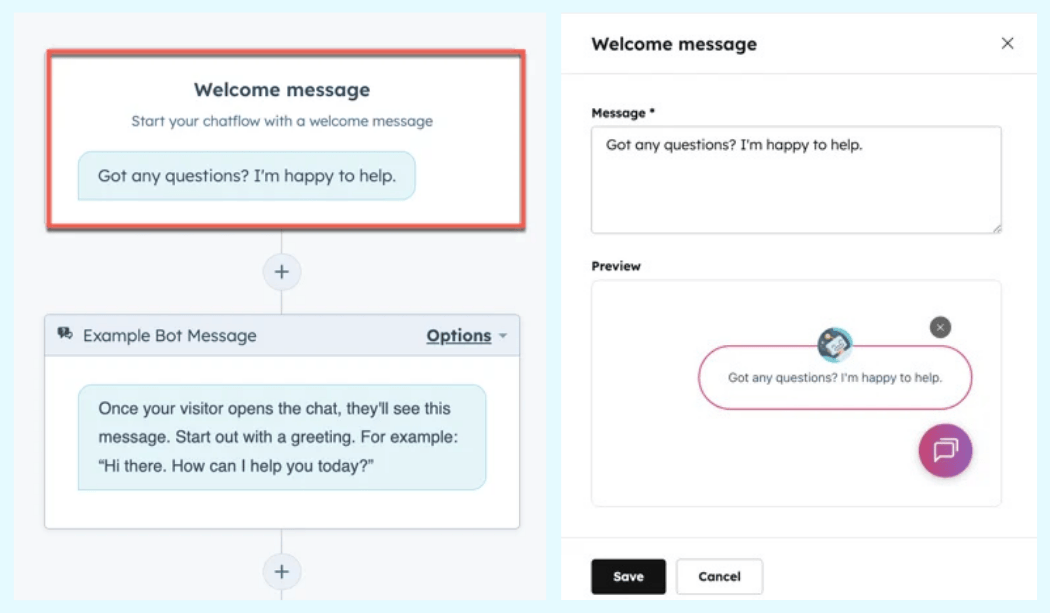
Think of it as an automated phone menu for your website. The customer asks “Where is my order?” and the bot recognizes the keyword “order.” It then offers button options like “Track Order” or “Cancel Order.”
How rule-based bots operate:
- Follow pre-programmed decision trees
- Recognize specific keywords or button clicks
- Deliver scripted responses based on exact matches
- Require manual updates for every new scenario
After testing rule-based chatbots on demo stores, the biggest frustration was updating scripts every time product information changed. Even simple updates like new shipping times required manually editing multiple conversation paths.
Rule-based Chatbots examples
Looking at rule-based chatbots examples helps you understand when they’re useful and when they fall short. These bots excel at handling simple, repetitive tasks with predictable customer inputs.
Common rule-based chatbots examples:
1. FAQ Bot
- Customer clicks the “Shipping info” button
- Bot displays: “We ship within 2-3 business days”
2. Business Hours Bot
- Customer types: “hours”
- Bot replies: “We’re open Monday-Friday, 9am-5pm EST”
3. Return Policy Bot
- Customer selects the “Returns” button
- Bot shows the return policy
- Bot then asks: “Would you like to start a return?”
These simple rule-based chatbots examples work well for basic tasks, but the rule-based chatbot vs. AI chatbot differences become clear when questions get more complex.
Pros and Cons of Rule-based Chatbots
When evaluating the rule-based chatbot vs. AI chatbot options, consider these trade-offs for rule-based systems:
Pros:
- Low initial cost – Often free or very cheap to set up
- Easy to understand – You control exactly what the bot says
- Predictable responses – No surprises in how it answers
- Works offline – Doesn’t need internet connection for basic scripts
- Simple to test – Easy to check and fix specific conversation paths
Cons:
- Extremely rigid – Fails when customers phrase questions differently than programmed
- High long-term maintenance – Every new product or policy needs manual script updates
- Poor user experience – Feels robotic when conversations don’t follow the expected path
- Doesn’t scale – Becomes unmanageable as your business grows
- Can’t learn – You must program every possible scenario yourself
- Limited to keywords – Misses customer intent behind questions
What Is An AI Chatbot And How Does It Understand Customers?
An AI chatbot uses Natural Language Processing (NLP) to understand the intent behind customer questions. Instead of following a rigid script, it reads the context of what someone asks and generates a natural, helpful response in real time.
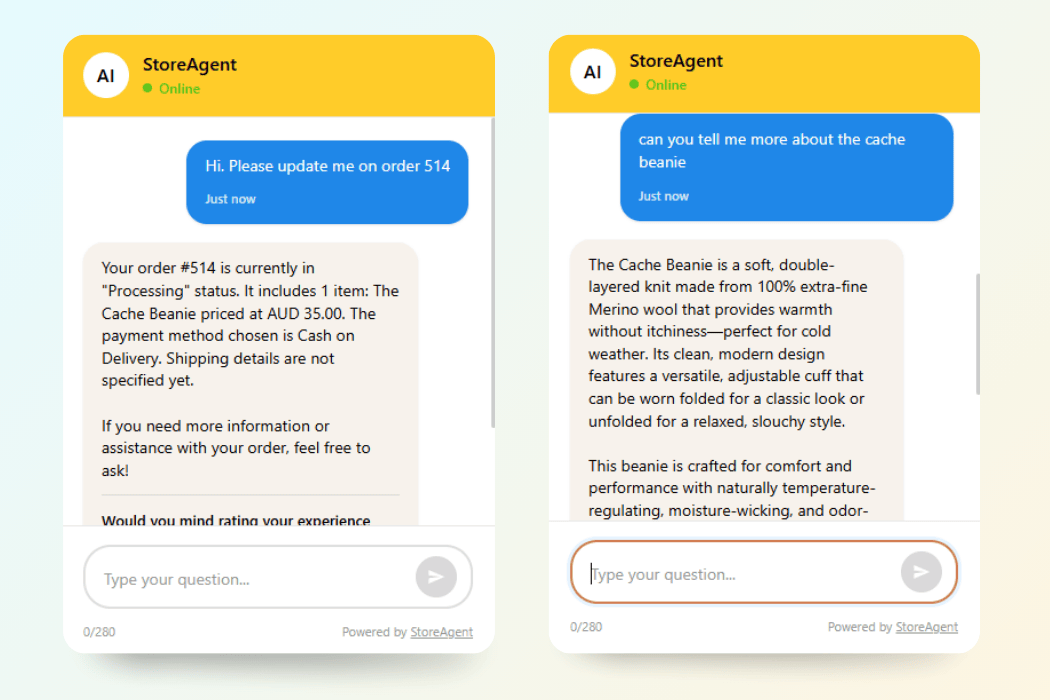
This means AI doesn’t need you to predict every possible way a customer might phrase a question. It interprets meaning rather than matching exact words.
What modern AI chatbots can do in 2026:
- Understand customer intent, not just exact keywords
- Pull real-time data from your product catalog
- Summarize customer reviews to help shoppers decide
- Recommend products based on browsing behavior
- Adapt to natural conversation flow
- Handle multiple languages automatically
When I tested AI chatbots like StoreAgent on demo stores, the most impressive difference was how they handled unexpected phrasing and context. Customers could ask about similar but cheaper alternatives, compatibility between products, or vague preferences, and the AI understood the underlying intent without those specific scenarios being programmed.
Tools like WooCommerce AI Chat learn from your existing product descriptions, categories, and reviews. The AI accesses your store’s information without requiring manual programming for each answer.
This automatic learning is what separates the rule-based chatbot vs. AI chatbot approaches at their core.
AI Chatbots examples
Reviewing AI chatbots examples shows how modern conversational AI handles complex, unpredictable customer questions. These bots understand context and can pull from your actual store data to give accurate answers.
Real-world AI chatbots examples:
1. Product Recommendation Bot
- Customer asks: “I need a waterproof jacket for hiking”
- What the AI does: Searches your catalog for jackets, checks product specs for waterproof ratings, reads customer reviews
- AI responds: “Here are 3 waterproof jackets perfect for hiking: [Product A] has a 10K rating, [Product B] is lightweight, and [Product C] is our best-seller”
2. Size Advisor Bot
- Customer asks: “Will a medium fit me if I’m 5’10” and 180 lbs?”
- What the AI does: Checks the product’s size chart and reads reviews from customers who mentioned their height and weight
- AI responds: “Based on the size chart and customer reviews, a medium should fit you well. Customers with similar measurements said it fits true to size”
3. Order Status Bot
- AI responds: “Your order #1234 shipped yesterday via UPS and will arrive this Thursday by 5pm”
- Customer asks: “Where’s my order?”
- What the AI does: Accesses real-time order data from your WooCommerce store
Pros and Cons of AI Chatbots
On the other side of the rule-based chatbot vs. AI chatbot comparison, AI systems offer these advantages and limitations:
Pros:
- Understands intent – Handles questions phrased in many different ways
- Learns from your data – Pulls information from products, reviews, and policies automatically
- Natural conversation – Responds in a conversational manner that feels less robotic
- Scales with growth – Adapts as you add products without reprogramming
- Multilingual support – Can handle multiple languages without extra setup
- Real-time data access – Checks inventory, orders, and pricing instantly
Cons:
- Higher upfront cost – Typically requires a monthly subscription
- Needs quality data – Only as good as your product descriptions and store information
- Can hallucinate – May give wrong answers if not properly grounded in your data
- Less predictable – Responses vary based on how customers phrase questions
- Requires monitoring – Should check conversations periodically for accuracy
Which Type Of Chatbot Is Best For Your WooCommerce Store?
By now, you’ve seen how rule-based and AI chatbots work differently. The choice comes down to your store’s size and growth plans.
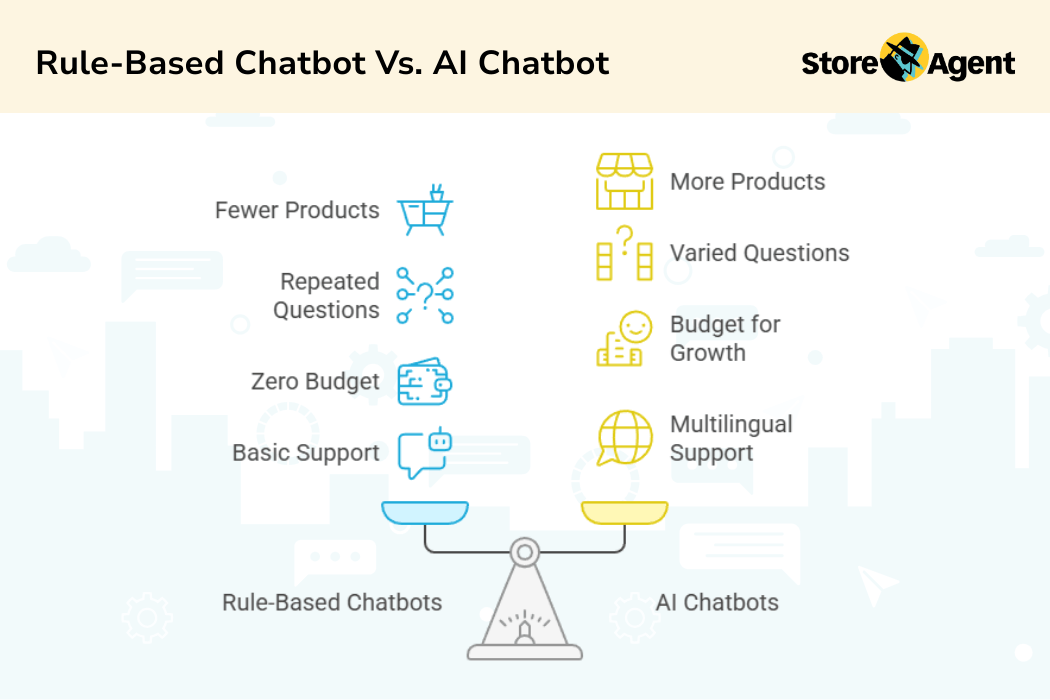
Choose rule-based if you:
- Sell fewer than 10 products
- Get the same 3-5 questions repeatedly
- Have zero budget for automation
Choose AI if you:
- Have more than 20 products
- Get varied customer questions
- Need multilingual support
- Plan to grow your business
For WooCommerce stores specifically, AI integration is a game-changer. This is exactly how chatbot for customer support tools are designed to work.
The rule-based chatbot vs. AI chatbot performance gap is most visible during high-traffic periods when customers need quick, accurate answers.
According to Tidio, 82% of customers would prefer to talk to a chatbot rather than wait for a human representative. This preference becomes even stronger during peak shopping periods when response speed directly impacts purchasing decisions.
Why Is StoreAgent Chat Best For WooCommerce Stores?
StoreAgent is a specialized AI chatbot built specifically for WooCommerce that eliminates the setup complexity most store owners fear. It trains on your product pages, blog posts, and store content to learn about your business.
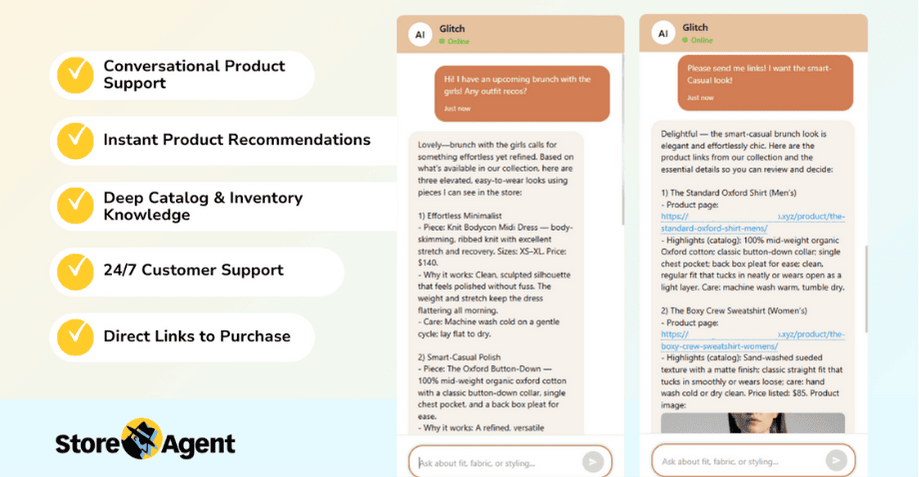
The chatbot connects directly to your WooCommerce catalog. This means it automatically pulls information from your existing product descriptions and reviews. In other words, it already knows your inventory the moment you connect it.
Key features:
- Real-time order tracking – Customers can ask about their orders and get instant updates
- Multilingual support – Handles questions in multiple languages without extra setup
- Escalation system – Routes complex issues to your team when needed
Beyond these core features, you can also embed the chat widget on specific pages using shortcodes. Plus, if you need to reset what the bot remembers, you can manage AI memory and filter chat history by site.
Setup takes about 15 minutes using the onboarding wizard. The rule-based chatbot vs. AI chatbot choice really depends on whether you need fixed scripts or something that adapts to how your customers actually talk.
💡 Want to see how it works in practice? You can test StoreAgent Chat on our live demo store and ask it questions about products, shipping, or returns to see how it responds.
Since Tidio is a leading choice for many stores, we’ve created a detailed comparison of StoreAgent vs Tidio to help you understand which platform’s AI capabilities are best suited for your specific WooCommerce needs.
Conclusion
The rule-based chatbot vs. AI chatbot decision comes down to your store’s size and growth plans. Throughout this guide, we’ve covered the fundamental differences between these two technologies and how each one fits different business needs.
Here’s what we covered:
- What is a rule-based chatbot and how does it work?
- What is an AI chatbot and how does it understand customers?
- Which type of chatbot is best for your WooCommerce store?
- Why is StoreAgent chat best for WooCommerce stores?
Most WooCommerce stores benefit more from AI because it adapts to how customers actually talk and scales with your business. If you’re ready to see how AI handles your store’s questions, try StoreAgent free for 14 days.
Frequently Asked Questions
How accurate are AI chatbots for e-commerce?
AI chatbot accuracy depends entirely on your product data quality. If your descriptions, policies, and FAQs are complete, the chatbot will be accurate. However, if your data is incomplete or outdated, accuracy drops. Rule-based chatbots are only accurate for exact programmed questions.
Can I use both rule-based and AI together?
Yes, this is called a hybrid approach. Some stores use AI for complex product questions and rule-based scripts for simple tasks like collecting email addresses. However, most stores find that once they switch to AI, they don’t need rule-based components anymore.
How long does it take to train an AI chatbot?
Modern AI chatbots for WooCommerce train automatically by reading your existing product pages and store content. Setup takes about 15 minutes. In contrast, rule-based chatbots require weeks of manual programming for each conversation path you want to build.
Will AI chatbots replace human support teams?
No, but they handle the repetitive questions so your team can focus on complex issues. Think of AI as the first line of defense that filters out most of basic inquiries. Understanding benefits of AI in customer service helps you see how both work together.
When should I upgrade from rule-based to AI chatbot?
Upgrade when you spend more time updating chatbot scripts than the AI subscription would cost. Other signs include frequent “I don’t understand” errors, growing product catalogs, or needing multilingual support for international customers.