
 Reviewed by
Customer service is tough, but studying successful examples of AI chatbot implementations proves it doesn’t have to be.
Big brands are using smart bots to handle millions of conversations, saving money while keeping shoppers happy. You might think you need a massive budget to get these results, but that is changing fast.
We are so excited to share how you can finally get these same results on your own store, and prove them with AI-powered insights for your WooCommerce store. In this guide, we break down the best chatbot examples from major companies and show you exactly how you can copy their strategies.
What Is An AI Chatbot?
An AI chatbot is a smart software program that simulates human conversation using artificial intelligence. It relies on Natural Language Processing (NLP) and Machine Learning (ML) to understand the intent behind a user’s words, rather than just matching keywords.
Unlike traditional rule-based bots that force users to tap buttons like a rigid phone menu, an AI chatbot flows naturally. It understands context, answers complex questions, and learns from every interaction.
This adaptability is what defines the top examples of AI chatbot technology today.
The Financial Power Of Chatbots
Why are so many businesses rushing to use this technology? The numbers tell a very clear story.
The chatbot market is growing at incredible speed. According to Statista, in 2018, market revenue was a modest $40.9 million. By 2023, that number jumped to approximately $137.6 million.
Experts predict this growth won’t stop. They project revenues will soar to $454.8 million by 2027. This rapid growth is driven by the positive examples of AI chatbot ROI seen across the market.
Why The Surge?
Integrating a chatbot is comparable to adding a highly skilled team member who works around the clock. However, these digital assistants do more than just resolve inquiries; they are powerful tools for capturing insight.
Every interaction provides valuable data on customer preferences and behavior. Companies can analyze these conversations to refine their products and tailor their marketing strategies.
It represents a fundamental shift in how businesses approach customer satisfaction and engagement.
Quick Look: The “Big 7” Chatbot Success Stories
| Brand | Industry | Key Feature | Key Result |
|---|---|---|---|
| Klarna | Finance | 24/7 Multilingual Support | $40M profit improvement |
| Starbucks | Food & Bev | Personalized Ordering | Higher customer loyalty |
| Sephora | Beauty | Virtual Consultant | Increased conversion rates |
| Domino’s | Food | Order Tracking | Fewer “Where is my order?” calls |
| H&M | Fashion | Personal Stylist | Reduced returns |
| Spotify | Music | Personalization | Deep user engagement |
| Uber | Travel | Real-Time Data | Faster operations |
7 Real-World Examples Of AI Chatbot Success
You might look at these examples of AI chatbot success and feel a bit discouraged. It is easy to assume that you need a massive engineering team like Uber or Klarna to build these tools.
Today, powerful tools exist that allow WooCommerce stores to replicate these exact strategies without writing a single line of code.
Here is what makes these brands special, and exactly how you can use tools like StoreAgent, a WooCommerce AI agent, to copy their success.
1. Klarna: The efficiency engine

Image source: Klarna Press Kit
Klarna recently made headlines by launching an AI assistant that manages the workload of 700 full-time agents. Impressively, this bot handles two-thirds of its customer service chats and resolves issues in under two minutes.
Why it works:
Speed matters most in finance. By answering instantly in the customer’s native language, Klarna builds massive trust while saving millions in operational costs.
How to copy Klarna:
Klarna wins because they speak their customers’ language. You can achieve this same global reach.
Using a multilingual AI tool like StoreAgent allows your store to chat fluently in dozens of languages. If a shopper from France visits your site, your bot instantly chats in French. You don’t need to hire translators; you just need a bot with global language settings.
2. Starbucks: The loyalty builder
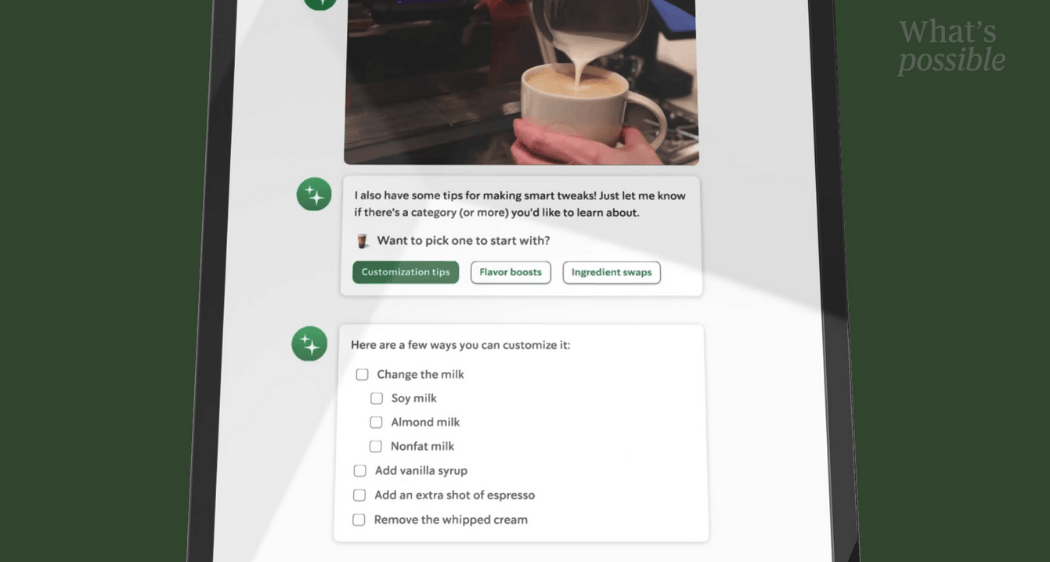
Image source: Starbucks Stories
Starbucks uses AI to make ordering coffee as simple as texting a friend. Their chatbot remembers your favorite “triple-venti-soy-no-foam” latte, so you never have to repeat your order.
Why it works:
It removes friction. When it is easier to buy from you than from the competition, customers naturally stick with your brand.
How to copy Starbucks:
Starbucks relies on memory to build loyalty, and your store should too.
Modern WooCommerce chatbots now feature AI Memory. This means if a customer mentioned they love dark roast coffee last month, the bot remembers that detail. It uses that history to make smarter suggestions, making every shopper feel like a regular.
3. Sephora: The virtual beauty consultant
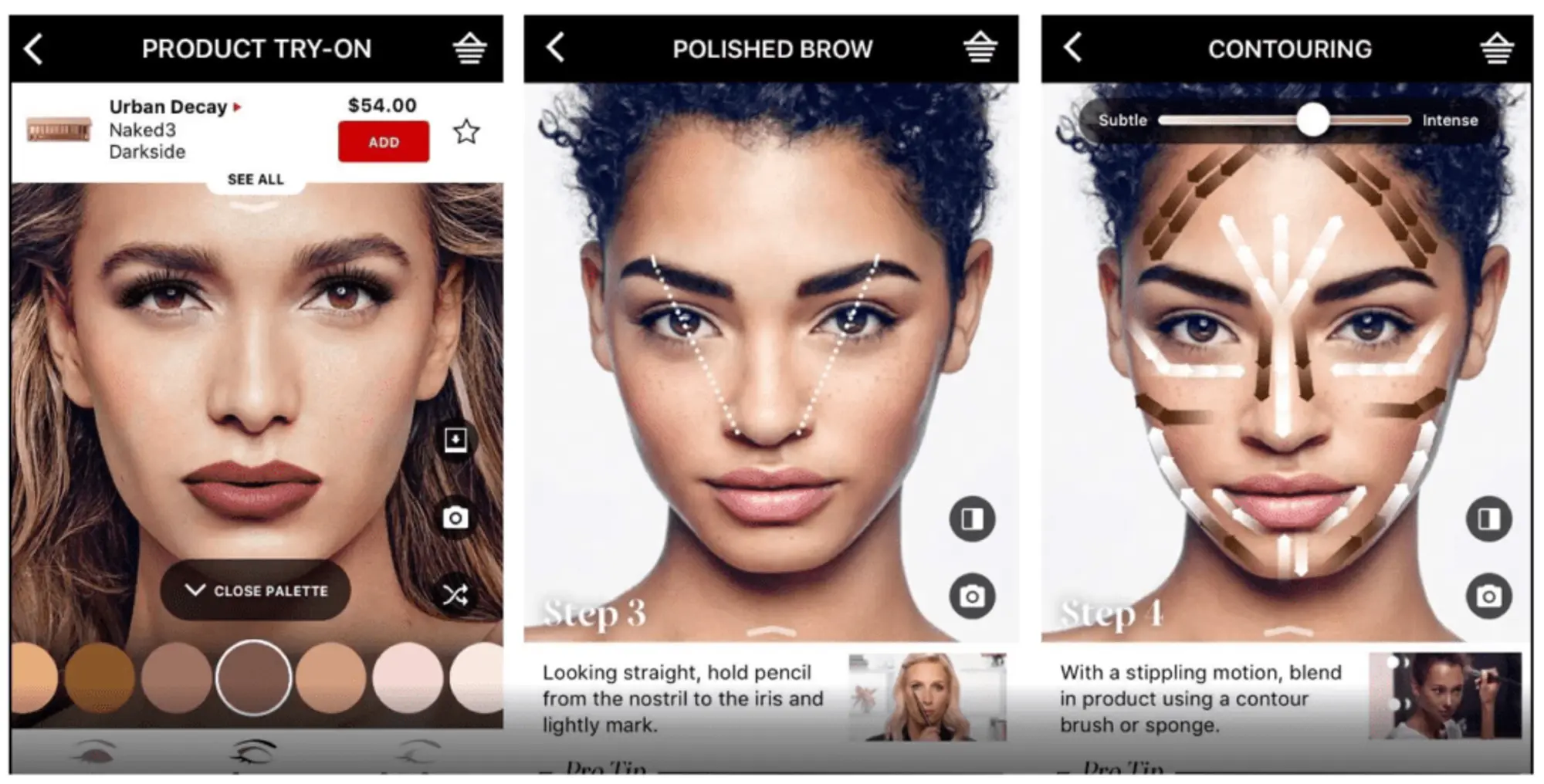
Image source: CB Insights
Sephora didn’t just automate support; they automated advice. Their bot acts like a knowledgeable store associate that asks about your style before recommending the perfect product.
Why it works:
Shoppers often leave a site because they are overwhelmed by choices. By guiding them to the right purchase, Sephora significantly boosts their conversion rates. This is why this is often cited as one of the most effective retail examples of AI chatbot ROI.
How to copy Sephora:
Sephora’s bot drives sales because it knows the products inside out. To replicate this, your bot needs to be “product-aware.”
Tools like StoreAgent can read your live product prices and inventory levels. Instead of just chatting, it acts like a real salesperson that recommends in-stock items to help close the sale for you.
4. Domino’s: The transparency king
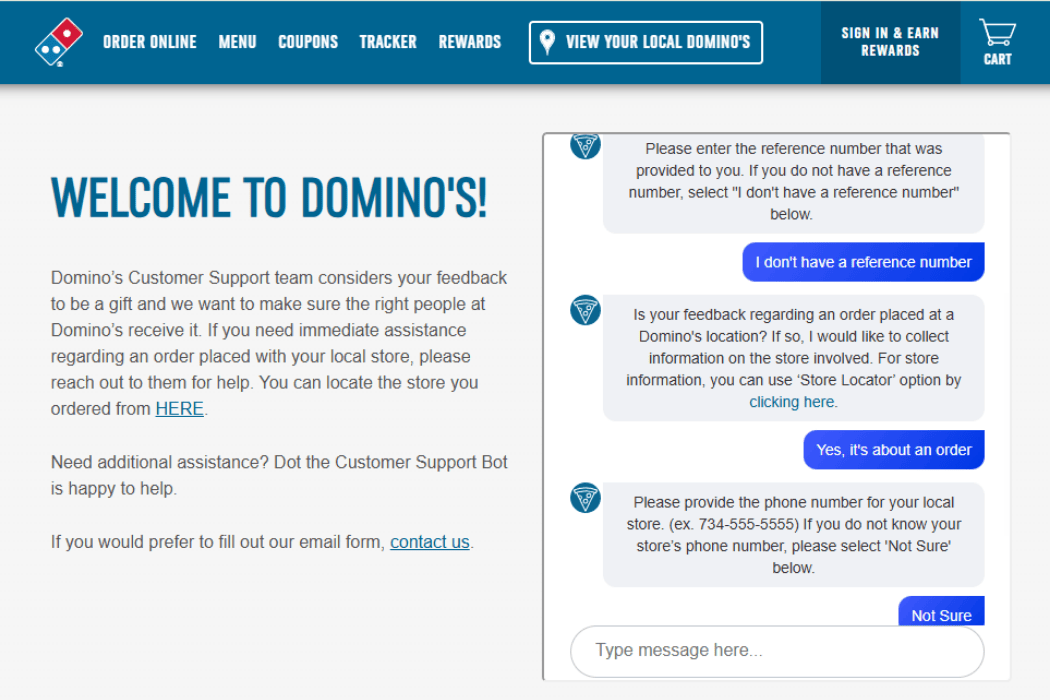
The most common question a pizza place gets is, “Where is my food?” Domino’s solved this by building a bot specifically connected to their delivery system for real-time updates.
Why it works:
It automates the most repetitive question they receive. Consequently, this frees up their human staff to focus on making pizzas instead of answering phones.
How to copy Domino’s:
You can save hours of support time by automating order tracking.
Advanced chatbots can now fetch live order data directly from your database. When a customer asks, “Has my package shipped?”, the bot checks the status and provides the real tracking info instantly. This one change can cut your support tickets in half.
5. H&M: The digital stylist
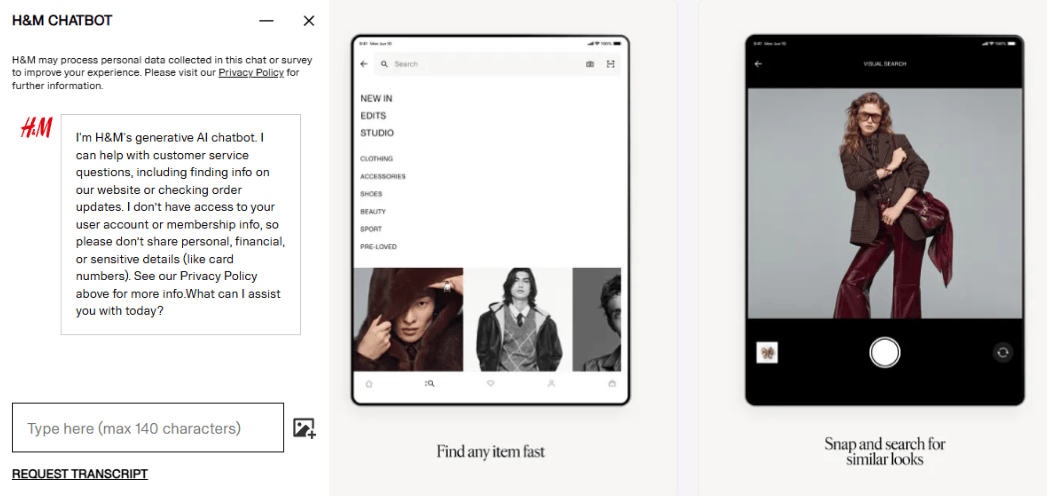
While many examples of AI chatbot usage focus on support, H&M uses the technology to act as a digital stylist.
Instead of just keywords, H&M uses AI Visual Search. Shoppers can upload a photo of a look they like, and the AI instantly finds matching items from H&M’s catalog.
They also have a support chatbot that helps by guiding users to specific departments or collections based on their needs.
Why it works:
It reduces the friction of finding the right look. By letting customers search with images or broad descriptions, H&M mimics the helpful eye of a personal shopper.
How to copy H&M with StoreAgent:
H&M succeeds by making product discovery easy. You can copy this with AI Product Tagging.
StoreAgent’s Product Tag Generator automatically scans your product images and details to create rich, descriptive tags (like “boho,” “summer,” “floral”). This ensures that when a customer searches for a specific “vibe” on your site, your search bar actually finds the right products—just like a stylist would.
6. Spotify: The discovery engine
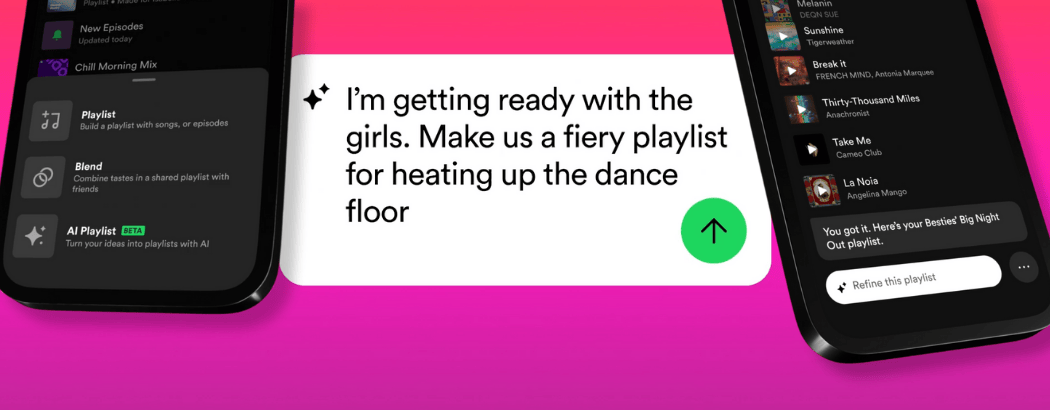
Image Source: Spotify Newsroom
Spotify’s AI is famous for knowing what you want to hear before you do. Their bot extends this by letting you ask for music based entirely on your current mood.
Why it works:
It creates a personal connection. When an app understands your taste this well, you are far less likely to switch to a competitor.
How to copy Spotify:
Discovery is key to increasing your average order value. You can use AI to suggest related products.
Just like Spotify suggests a song, your bot can suggest a matching accessory or an upgraded item. It turns a simple support chat into a powerful product discovery engine.
7. Uber Eats: The merchant assistant
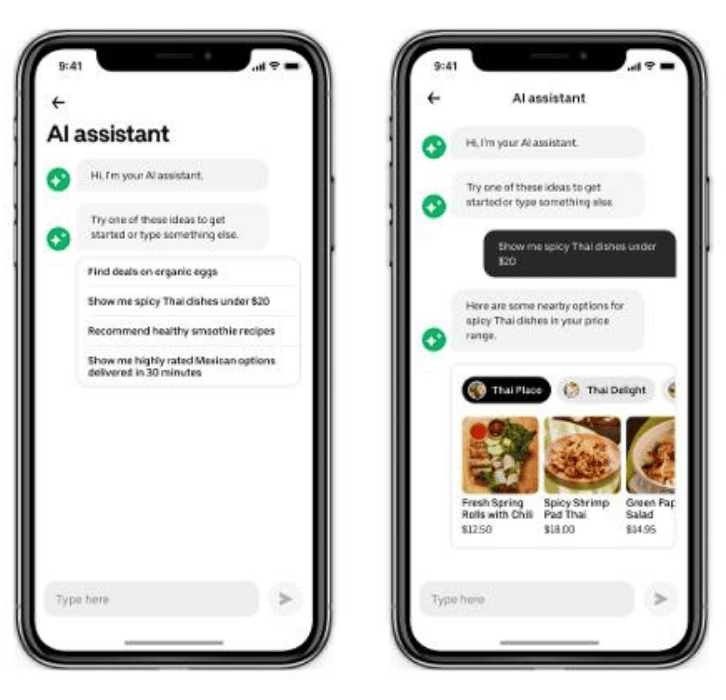
Uber Eats is using AI to help restaurants run smoother businesses, not just deliver food. They recently launched a suite of AI tools that write menu descriptions, summarize customer reviews, and allow live chat for order updates.
Why it works:
It solves the “blank page” problem. Instead of forcing busy restaurant owners to write descriptions or read thousands of reviews, the AI does the heavy lifting for them. This focus on merchant support makes it one of the most practical examples of AI chatbot utility in the food industry.
How to copy Uber Eats with StoreAgent:
StoreAgent brings this exact toolkit to your WooCommerce store. Just like Uber Eats, StoreAgent’s Product Description AI instantly writes SEO-friendly copy for your catalog, while the Review Summaries Agent distills customer feedback into helpful insights.
Furthermore, it replicates the “Live Order Chat” experience by automatically syncing with your inventory to answer stock questions in real-time.
Using AI Chatbot For WooCommerce: How StoreAgent Works
You have seen how the major brands use automation to improve their business. Now, you need a tool that helps you build your own examples of AI chatbot success directly on your specific platform.
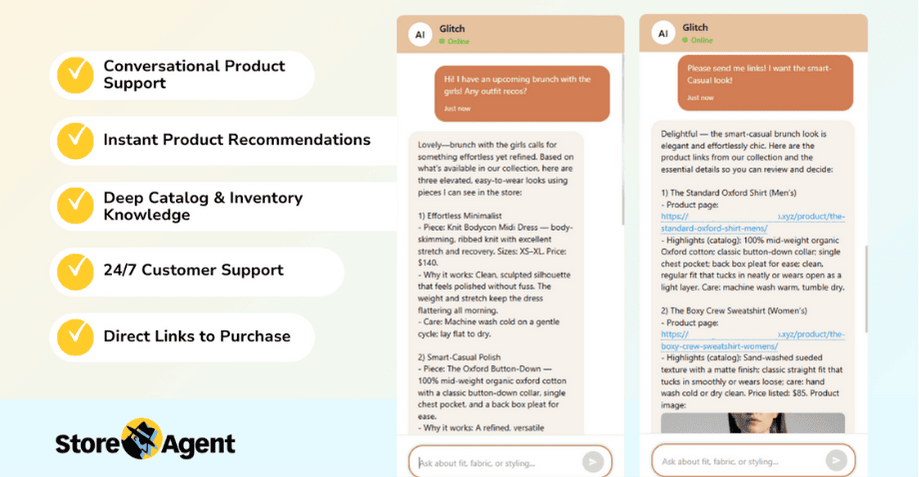
If you run a store on WordPress, StoreAgent is the specific tool designed to handle these tasks. It connects directly to your store’s data to solve the problems we discussed above.
Here are the specific features you can use to upgrade your customer service.
1. Multilingual support for global sales
Klarna proved that speaking the customer’s language builds trust. StoreAgent allows you to do this without hiring a support team.
The AI automatically detects the language the shopper is using. It then replies fluently in that same language. This allows you to sell to customers in France, Japan, or Brazil as easily as you sell to locals.
2. Live WooCommerce order tracking
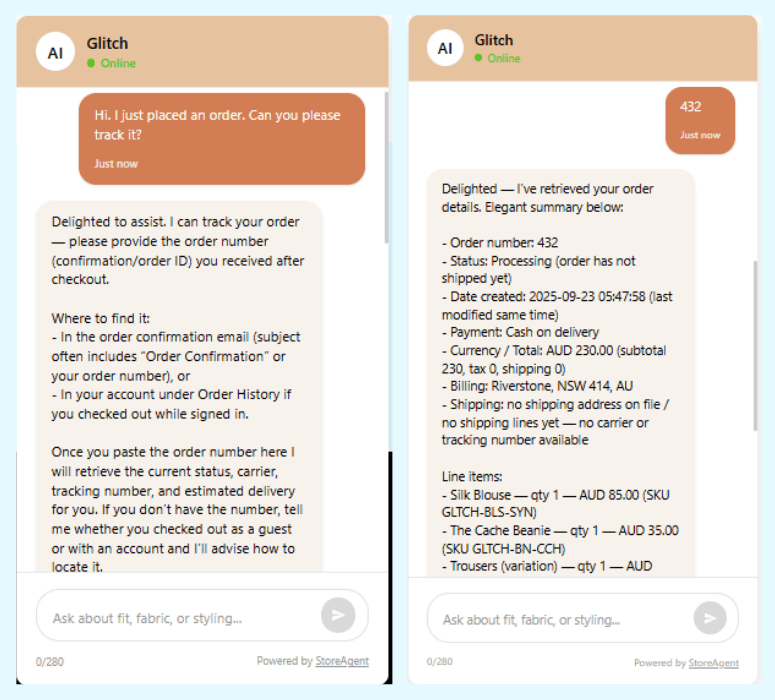
Generic chatbots often fail because they cannot see your internal data. They cannot tell a customer where a package is.
StoreAgent connects directly to your WooCommerce order database. When a user asks, “Where is my order?”, the bot looks up their specific order number. It then provides the current status and tracking link instantly. This reduces the number of support tickets your team has to handle manually.
3. Real-time inventory sync
Recommending products is only useful if the items are actually for sale. StoreAgent reads your live inventory levels and pricing.
It will never recommend an out-of-stock item to a customer. Instead, it acts like a knowledgeable shop assistant. It suggests available products that match what the customer is looking for, helping you close more sales without human intervention.
4. AI memory and context
Starbucks uses memory to make re-ordering easy. StoreAgent uses AI Memory to improve conversations on your site.
The bot remembers details from previous chats. If a customer mentioned they have a specific preference or issue in the past, the bot recalls that information. This prevents customers from having to repeat themselves and creates a smoother shopping experience.
5. Complete brand customization
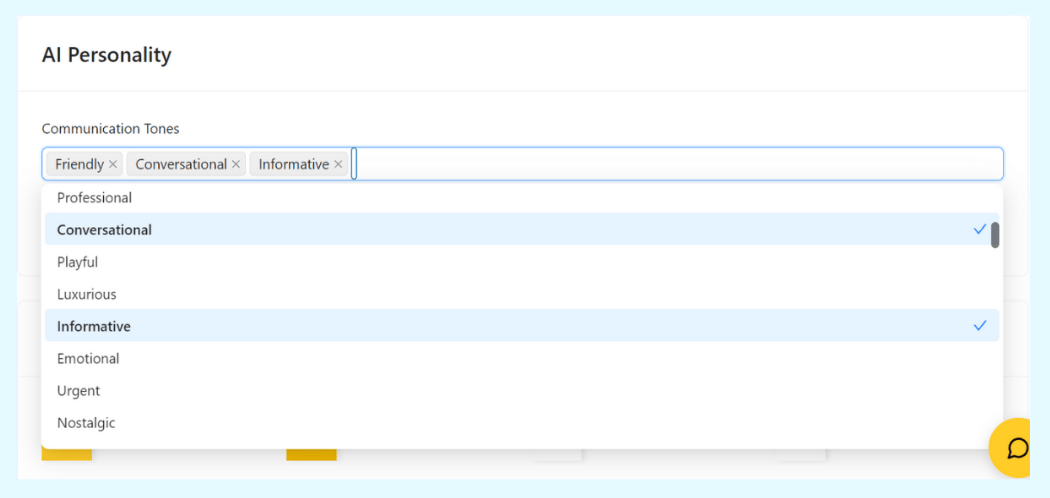
You don’t want a generic robot representing your brand; you want an assistant that sounds like you. StoreAgent gives you total control over your bot’s identity.
You can customize its personality, voice, and style to match your brand’s tone—whether that is professional, friendly, or witty. You can also name your chatbot, set custom greetings, and tweak the colors to fit your site perfectly.
Conclusion
The gap between giant retailers and independent stores is finally closing. As we have seen, the most successful brands aren’t just using chatbots to answer simple questions; they are using them to solve real business problems like order tracking, personalization, and global support.
Here are the 7 examples of AI chatbot success we covered today:
With StoreAgent, you can now offer this same level of care on your WooCommerce site. By using tools that handle multilingual support and live data fetching, you can deliver the premium experience seen in these examples of AI chatbot success.
Try StoreAgent today and turn your support chat into your best sales agent.
Frequently Asked Questions
1. Do I need coding skills to use an AI chatbot?
No, coding skills are not required today to use AI chatbots. Modern tools like StoreAgent are designed as “no-code” plugins that install in minutes. They automatically scan your store to build a knowledge base without any technical setup.
2. How do I stop the AI from giving wrong answers?
You must connect your AI chatbot to your live store data. Hallucinations happen when AI guesses, but a WooCommerce-integrated bot reads your actual inventory. This ensures it only provides factual, real-time information to your customers.
3. Do customers dislike interacting with chatbots?
Shoppers prefer bots that solve problems fast. Customers usually only dislike chatbots that force them into rigid menus or dead ends. If the AI provides instant, accurate answers about orders, they often prefer it over waiting for a human.